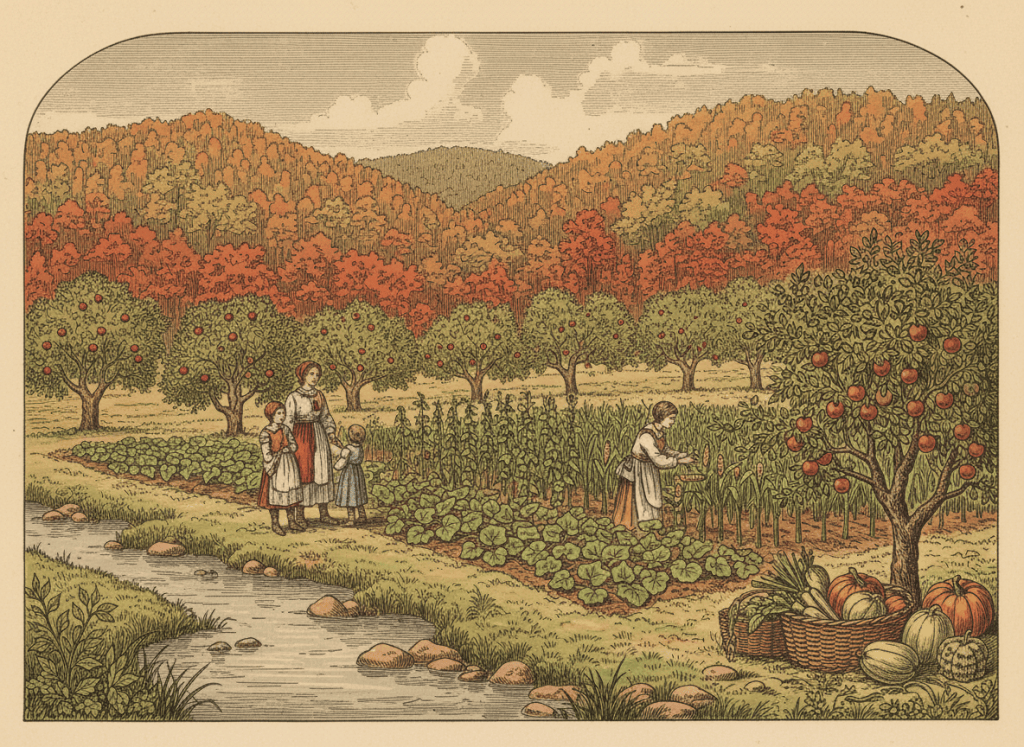
Did you know that the hills around Living Springs Log House were once one of America’s great destinations for people seeking a simpler, more rooted life? In the late 1960s and through the 1970s, thousands of young people left cities across the country and headed for the countryside in what came to be called the back-to-the-land movement. The Ozarks of northwest Arkansas, with their clear springs, wooded hollows, affordable land, and mild winters, drew more than their share of these hopeful newcomers.
Today, as more and more people once again feel the pull toward land, community, and self-reliance, it’s worth looking back at what those early homesteaders learned, and why this corner of the world still calls to people looking for a different way to live.
Why They Came
In 1986, Mother Earth News published a wonderful look back at this wave of Ozark homesteaders, written by Paula Thompson, an Ozark native and blueberry farmer herself. The article, “The Ozarks: Homesteading in Northwest Arkansas,” follows a group of people who arrived in the early to mid-1970s, most of them in their twenties.
Their reasons were as varied as they were. One was an engineer who found northern winters too hard and noticed on a map how few people lived per square mile in Arkansas. Another was a young woman from Chicago who visited rural Arkansas, fell in love with it, and simply stayed. A couple working in Tucson saved for two more years to pay off forty secluded acres they had found on a visit. A Memphis businessman and his wife decided, after the shock of the assassination of Dr. Martin Luther King Jr. in their city, that it was time to take their family out of urban life. Others came specifically to learn how to farm and grow food.
What united them was a longing to reconnect with the earth, with their own hands, and with one another.
What They Learned the Hard Way
The article is refreshingly honest about the challenges. Many newcomers arrived with plenty of books and ideals but few practical skills. Some bought large tracts of cheap land only to discover there was no water, no road, and no utilities for years to come. One homesteader eventually offered friends a simple rule of thumb: look for land that already has an old house on it, because that means someone was once able to make a life there.
Others found that extreme frugality, while admirable at first, could wear families down over time. Growing children, long drives on rough dirt roads, and the need for steady income all pushed people to adapt.
And adapt they did. The ones who stayed often became entrepreneurs, building honey businesses, woodworking shops, nurseries, and consulting services that let them keep their rural lives while earning a living. Many kept a foot in the countryside even when they moved closer to town.
The Heart of It All: Community
The most lasting thread in Thompson’s article is community. In those early years, it wasn’t unusual for fifty people to gather for a potluck or a shared workday. Newcomers formed food-buying clubs, including one connected to the Fayetteville co-op, and built what the article describes as intentionally chosen extended families. A decade later, even those who had moved on still spoke with deep affection about the land and the people.
One woman summed up her years in the hills in five simple words: “Life is better in the country.” She said that many who had left were only trying to earn enough to come back.
Why Their Lessons Still Matter
Nearly forty years after that article was written, its lessons read like a checklist for anyone dreaming of homesteading today:
- Start with good water. Reliable water is the foundation of everything else.
- Choose land where people have already made a life. An established home, outbuildings, and gardens save years of struggle.
- Have a way to earn. A home-based business, remote work, or a cottage enterprise keeps the dream sustainable.
- Don’t go it alone. Shared meals, shared work, and shared purpose are what carried the original homesteaders through.
- Stay close enough to town. Being able to reach schools, stores, and services makes rural life work for the long haul.
Living Springs Log House: Ready for the Next Chapter
Living Springs Log House sits on 14.75 acres just outside Huntsville in Madison County, right in the heart of the country those early homesteaders came looking for. In many ways, it already answers the hard-won lessons of the back-to-the-land generation.
Water: The property is blessed with a natural cave spring, the kind of resource earlier settlers prayed to find.
A home already rooted in the land: The house is a hybrid log home, with solid cypress log walls in the living room and master bedroom and framed construction in the rest. It comes with a metal building, established flower and vegetable gardens, and spaces that have already proven their usefulness, including a storm shelter that has served as a winter grow room for greens and herbs.
Room for enterprise and extended family: A separate basement suite, a two-car garage with conversion potential, and an open, gathering-friendly layout offer room for a home business, multigenerational living, guests, or volunteers.
A place for community: The house has hosted family holidays, celebrations, and gatherings of fifty people. The fire ring, the deck overlooking the land, and the open lawn are made for exactly the kind of potlucks and workdays the early homesteaders treasured.
Healthy, living land: Swallows have returned to nest under the deck year after year, their numbers growing, one small sign of a property that is thriving.
Whether you dream of a family homestead, an intentional community, a sanctuary for rescued animals, a healing retreat, or a quiet place to grow your own food, Living Springs Log House offers a head start the 1970s pioneers would have envied.
The back-to-the-land dream never really left the Ozarks. It’s still here, waiting for the next family or community to take it up.
A Few Insights
- The early homesteaders’ best advice still holds: start with good water and land where someone has already made a life.
- Community was what carried people through the hard years, more than skills or savings.
- A place with water, shelter, and gardens already in place lets the next people spend their energy on the dream instead of the basics.
See more of the property’s highlights at www.livingspringsloghouse.com.
This article was written by Patricia Mikkelson, a resident of Living Springs Log House and friend of its owner, in collaboration with Claude.ai of Anthropic. Patricia brought the vision and the love of this land; Claude helped with research and shaping the words.
Source: Paula Thompson, “The Ozarks: Homesteading in Northwest Arkansas,” Mother Earth News, September/October 1986.


[…] more: Homesteading in the Ozarks, Living Off the Grid, Gently, An Off-Grid Living Checklist for the Arkansas Ozarks, and The Garden […]
LikeLike
[…] more: Homesteading in the Ozarks, Living Off the Grid, Gently, The Garden That Grew From a Trench, and The Cave Spring: Where the […]
LikeLike