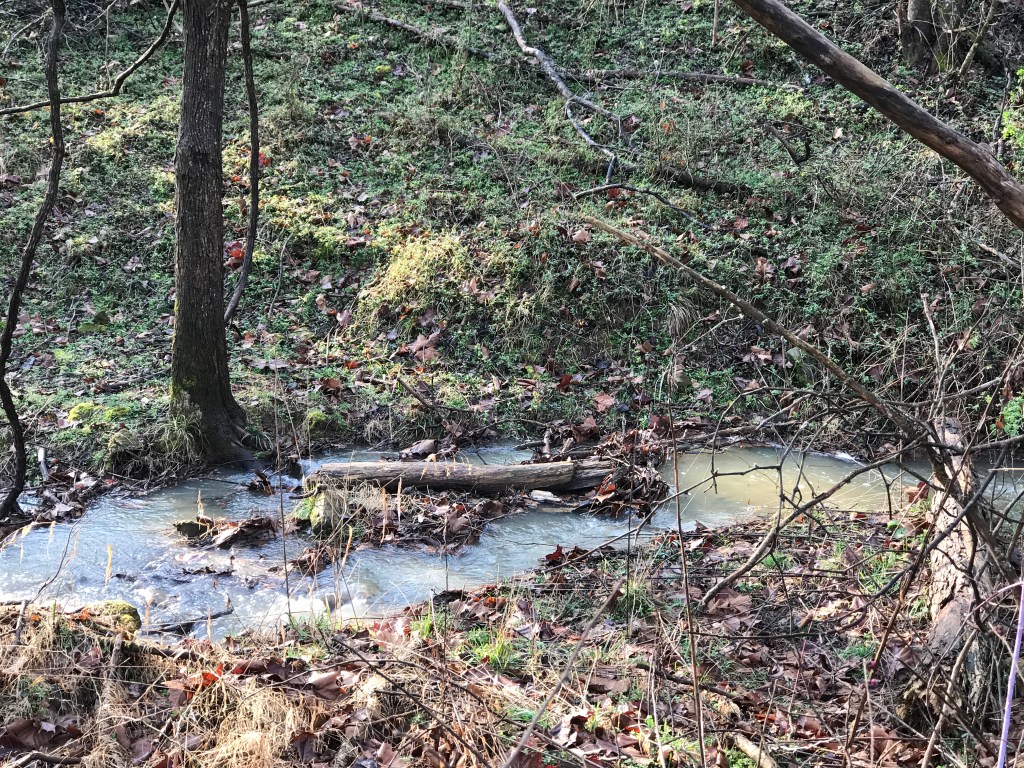
Almost every morning now, my walk takes me up to the spring. India, our Great Pyrenees, goes ahead of me, and she always stops for a long drink from the little pool below the spring before we turn back. I love that dog so much, and I love that this is part of our day.
The spring comes out of a cave in the hillside. Before you even see the water, you can feel cool air breathing out of the rock. I’ve never wanted to crawl in myself, but you can, and any adventurous soul who wants to explore it is welcome. Robert, my former husband and a resident here at the log house, says he once saw a rattlesnake in there, which still puzzles me, because it’s so cold inside. I admire his fortitude, for he had to do the work inside the cave. Now I remember: I crawled partway in a few times to help him.
When it rains hard, the wet-weather creek below the spring comes alive. Water rushes down it like crazy, and the forest along the creek is lovely to walk through. Near the spring there’s a small clearing under the steep hill. I’ve always dreamed it could be a little home site, or even better, a quiet place to sit right beside the water, on a covered bench so it would be nice even in the rain.
A simple system that works
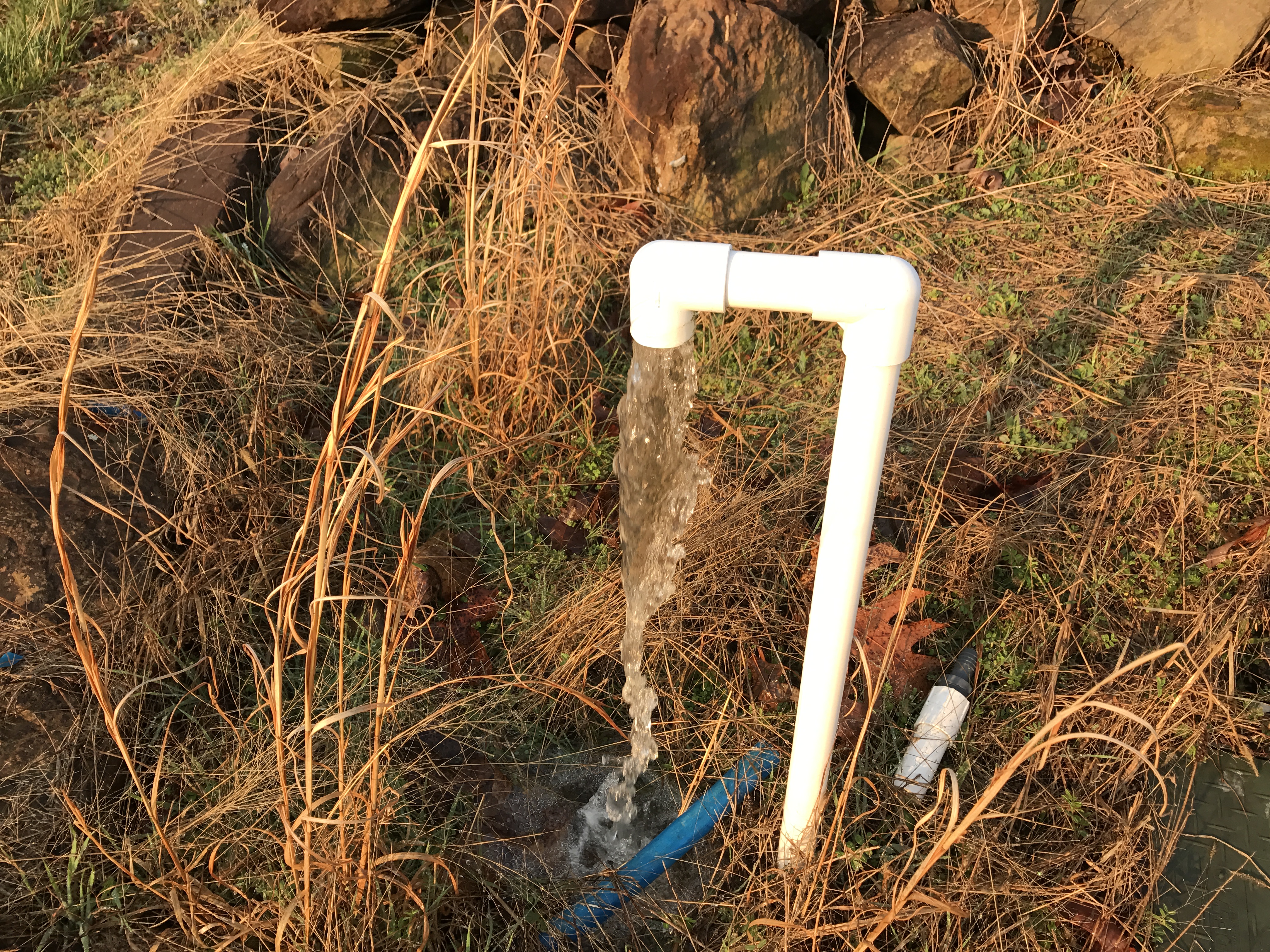
What amazes me most is how humble the setup is. A former owner told me he repaired the spring and did a lot of work to make it more dependable. The spring box is just a plastic tub and PVC pipe. Over the past three years, Robert has had to repair it only twice that I know of, once with help from my daughter-in-law. Now that I recall, I helped him the first time. Someone could hire a spring specialist or pour a concrete basin someday, but so far this simple system has done its job.
For about nine years, the spring has fed two cisterns and supplied both the house and the metal building. The cisterns have gone dry only when something went wrong with the parts in the spring box or when a hose was left running. And when they go dry, it takes a few days for them to fill back up.
It has handled a full house, too. For six months, when my son, his wife, and their four children lived here, there were eight of us, and the spring kept up with all of us.
One repair is waiting: the line from the cistern to the metal building cracked in a hard freeze and needs to be fixed. It’s a fixable thing, but anyone who comes next should know about it.
Living with spring water
I love this water. We’ve never had it tested. There’s a filter system in the house, Robert uses his own filter, and my son and daughter-in-law did too when they lived here, just as a precaution. I’m the only one who doesn’t filter it. I drink it straight, and I’ve stayed healthy. It tastes wonderful to me.
After a hard rain the water turns cloudy for a while. I’ve made my peace with that, but I’d tell anyone living on spring water: test it, and keep a filter. If someone ever builds on the land up above the spring, it would be worth making sure their septic system is placed where it can’t affect the water. You can call the health department to find out if a permit for a septic system has been granted.
I’ve learned that many banks hesitate to finance a spring-fed property. That makes me a little sad. Wells can go dry, city water can be contaminated, and out here county water isn’t really an option, because we’re so far from the source. To me, a spring is a gift.
When the rains come
After a heavy rain, water pours out of the cave mouth in a rush, far more than the house could ever use. It runs down the wet-weather creek all the way to the lake, and in all these years it has never flooded the driveway. I love going to see it and hearing all that water running.
There’s also overflow near the main cistern. That water could easily be piped to the gardens instead of running away.
Water everywhere
There’s more water here than just the spring. Because the spring sits high on the land, its water could flow by gravity down to the gardens, the fruit trees, and other growing areas, with no pump needed. Runoff from the roofs of the log house and metal building could be captured too.
Below the spring is where a pond used to be. It was about 25 by 35 feet and around 4 feet deep, and for years, when I walked by, frogs galore would jump into the water. Since then it has filled in with cattails and willows. But there is still a channel running straight from the spring down to it, so the water is still finding its way there. I hope someone will dig it out again someday as a pond or a natural swimming pool.
The gardens already help by needing less water. Mulch, soil full of organic matter, and hugelkultur beds hold moisture, so the plants get by on less.
There are pipes running in and out all over this land. I dream of someone catching all of it with berms, ponds, swales, and permaculture methods, so that every drop that falls here gets to stay a while.
How we wrote this together
This article was written collaboratively by Patricia, a friend of Barbara’s and a resident of the Living Springs Log House, and Claude.ai, Anthropic’s AI assistant. Patricia shared her memories and impressions of the spring in one quick, heartfelt burst: her morning walks, India’s drink at the pool, the cool air from the cave, her dreams for the clearing. Later, Claude gathered more of her memories from earlier drafts, like the old pond full of frogs and the rush of water after a heavy rain, and added them while keeping her voice.
A few insights
- The most dependable thing on this property is also the plainest: a plastic tub and some pipe that have worked with very little fuss.
- The details that make a place feel alive are usually small daily rituals, like a dog drinking at a spring, more than big features.
- Water that falls high on the land is a gift twice: once as water, and again as free power to carry it downhill.
See more of the land, the gardens, and the house at www.livingspringsloghouse.com


[…] filled two cisterns for nine years, so we know this land has groundwater. You can read its story in The Cave Spring: Where the Water Comes From. There are two more wet places worth watching: a seep on the upper part of the property near the […]
LikeLike
[…] There is one spring I can speak for with confidence: the cave spring behind the log house. For nine years it has fed two cisterns, and those cisterns have never run dry except when there were mechanical problems or when a hose was left running and drained them. Read more in The Cave Spring: Where the Water Comes From. […]
LikeLike
[…] cave spring has kept our cisterns supplied for nine years. The only times they ran low were when I forgot to […]
LikeLike
[…] Read more: Homesteading in the Ozarks, Living Off the Grid, Gently, The Garden That Grew From a Trench, and The Cave Spring: Where the Water Comes From […]
LikeLike
[…] A cave spring behind the log house has filled two cisterns for nine years. It is the household’s only water source. The cisterns have only run low when a hose was left running or when there were mechanical problems. Read The Cave Spring: Where the Water Comes From. […]
LikeLike
[…] Water comes from spring. Read more: The Cave Spring: Where the Water Comes From […]
LikeLike
[…] The Cave Spring: Where the Water Comes From […]
LikeLike
[…] The Cave Spring: Where the Water Comes From […]
LikeLike
[…] The Cave Spring: Where the Water Comes From […]
LikeLike