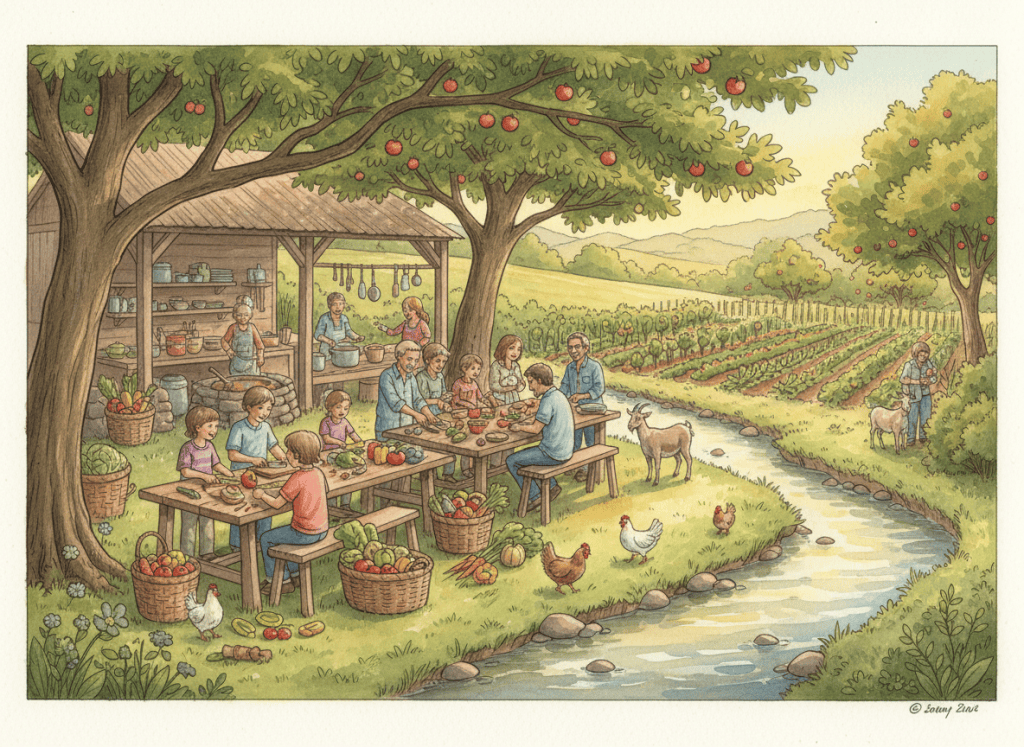
Around the world, a quiet movement is growing. People who care deeply about animals, the earth, and each other are asking a bold question: What if we didn’t just live vegan as individuals, but built whole communities around compassion?
That’s the heart of the vegan village idea — a place where people share land, meals, work, and purpose, and where animals are neighbors, not products.
What Is a Vegan Village?
A vegan village is an intentional community built on the belief that all beings deserve to be safe, happy, and free. No two look the same, but most share a few elements:
- A sanctuary at the center. Rescued animals live out their lives in peace, and caring for them becomes part of the community’s daily rhythm.
- Shared land and shared work. Gardens, orchards, and chores are tended together, so no one carries the whole load alone.
- Growing food with care. Many vegan villages grow their own food veganically, without animal-based fertilizers.
- Healing and learning. Retreats, workshops, and “earth schools” help visitors and residents reconnect with nature and with themselves.
- Living closer to the land. Water, gardens, and simple living matter more than square footage.
Dreamers Around the World
One inspiring example is Kris, who shares his journey on Instagram and on his YouTube channel, Art of Healing Earth. He’s working to create a vegan village, animal sanctuary, retreat space, and Earth School in Costa Rica. His videos follow the whole journey from the beginning: buying a van, driving from Canada to Costa Rica, searching for land, and building from scratch. He calls it “the messy middle of building something meaningful,” and anyone who has tried to start a community knows exactly what he means.
Closer to home, Peacebird in Ontario began as a farm sanctuary in 2005 and has been working to grow into a vegan intentional community — a sanctuary becoming a village. On community forums and in the Foundation for Intentional Community’s directory, you’ll find vegans everywhere looking for land and for each other, from the Appalachian Mountains to the Gulf Coast.
The longing is real, and it’s widespread. The hardest part is usually not the vision. It’s the land, the water, and the years it takes to build the basic infrastructure before the first animal arrives or the first garden is planted.
What If the Hardest Part Were Already Done?
Here in the Ozarks near Huntsville, Arkansas, we’re working on our own version of this dream: the Ozarks Vegan Think Tank. It’s a pilot where animal rights activists co-live on the land to build an animal sanctuary and a new community-centered animal rights organization, with the larger hope of helping heal the whole planet so all creatures can be safe, happy, and free.
Co-living is already an established model. Our hope is that this pilot can become something repeatable — a Vegan Think Tank in city after city.
The home for this vision is the Living Springs Log House:
- 14.75 acres of Ozark land, with 40 more acres for sale on the adjoining property
- A cave spring that has kept our cisterns full enough for our use since 2017, except when a hose was left running or technical difficulties arose
- A metal building for feed, supplies, volunteers, and gatherings. Nearby is land that was cleared years ago and has grown up over the past nine years. It could be cleared and made into pasture again, with a barn where the animals can live
- Established gardens, so no one has to start from bare dirt
- Quiet and distance from the pace of the city — the kind of place where people and animals can heal
For someone like Kris, building from zero is part of the adventure. For many others, especially people who want to begin now, starting with water, buildings, and growing ground already in place can make the difference between a dream and a working community.
A Few Insights
- The vision is rarely the hard part. Infrastructure is. Most vegan village dreamers already know why they want to build. What slows them down is water, shelter, and land.
- Sanctuary and community grow well together. Places like Peacebird show that a sanctuary can become the seed of a village, because caring for animals gives a community its shared rhythm.
- Co-living is a gentle first step. A full intentional community can take years to form. Co-living lets people start living the values right away and grow into something larger.
- The movement is scattered but searching. Vegans across the country are posting in forums and directories, looking for land and for each other. The need is not for more dreamers. It’s for places where they can gather.
Come See It
If the vegan village dream speaks to you — as a future resident, a partner, a buyer who shares the mission, or simply someone who wants to learn more — we’d love to hear from you. See the spring, the gardens, the metal building, and the land at livingspringsloghouse.com.
How we wrote this together: This article was written collaboratively by Patricia, a friend of Barbara’s and a resident of the Living Springs Log House, and Claude.ai, Anthropic’s AI assistant. Patricia brought the vision, the knowledge of the land, and the connection to Kris’s work. Claude researched other vegan village projects and helped shape the ideas into an article. One insight stood out along the way: people building vegan villages around the world, from Costa Rica to Ontario to the Ozarks, are all describing the same dream in different places. What separates them isn’t the vision but the starting point. Some begin with bare land and a van, and some begin with a spring that’s already flowing.
Written with the help of Claude.ai, an AI assistant made by Anthropic.


[…] Read more: The Ozarks Vegan Think Tank and The Vegan Village […]
LikeLike
[…] more: The Ozarks Vegan Think Tank, The Vegan Village, and An Adjacent Property is for […]
LikeLike