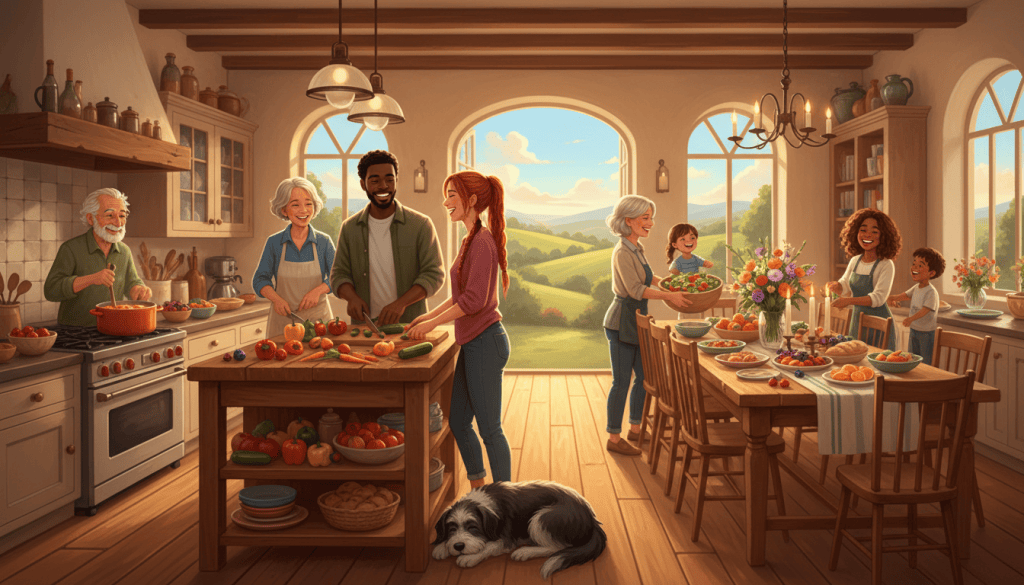
This handbook gathers what proven co-living and sober living homes have learned, and shapes it for a vegan co-living community at the Living Springs Log House. It covers house rules, how a home can govern itself, how to handle conflict and make decisions together, how an animal rights organization could grow out of shared life, and how a rented house could grow, step by step, into a land trust and a lasting intentional community.
The Short Version
- Few rules, firmly kept. Every source agrees: a short list of rules you actually enforce beats a long list you don’t.
- PadSplit, the largest rent-by-the-room platform in the U.S., shows the rules a business-style operator uses.
- Oxford House shows how a house can govern itself: one absolute rule, one vote per person, weekly meetings, officers who rotate every six months, and open books.
- Restorative circles let a community respond to conflict by restoring understanding and repairing harm, rather than by blame and punishment.
- Sociocracy lets everyone’s voice matter while decisions still get made, using consent: “good enough for now, safe enough to try.”
- Animal Think Tank in the UK shows how an animal rights movement can put community, care, and kinship at its core.
- Two pilots in one. A vegan co-living home can become the first step toward a true intentional community, owned in trust and governed by its members.
These summaries are in our own words. The original documents are free online (see Sources at the end). Anyone using these ideas should have an attorney review any rules before they go into a lease, and before any trust is formed.
Part 1: The Most Important Advice: Only Rules You’ll Enforce
Experienced co-living hosts give the same advice again and again: only add rules you will actually enforce. A long list of rules no one follows teaches everyone that rules don’t matter, and that undermines the few rules that truly do.
The Oxford House Manual says the same thing from a different direction. Its founders found that the fewer rules a house has, the more likely it is to succeed, and that new rules should be added only when they’re truly needed.
What this means for a vegan co-living home: start with a short list. Add a rule only when a real problem shows it’s needed, and decide it together.
Part 2: A Free Tool for Writing House Rules
Everything Coliving offers a free online House Rules Generator. You choose your property type, your policies, and your tone, and it writes a complete set of house rules you can edit. It covers guests, quiet hours, smoking and pets, cleaning, kitchen and shared spaces, parking, alcohol, repairs, conflict, and consequences. It offers five tones, from strict and formal to relaxed and friendly. For a vegan community, a warm but clear middle tone fits best. The tool itself recommends legal review before any rules go into a lease.
How to use it: generate a draft, then compare it with the draft house rules in Part 10 to catch anything missing.
Part 3: What a Large Operator’s Rules Look Like
PadSplit residents agree to a set of membership rules before moving in. Hosts can waive some and add their own. In brief, they cover:
- Conduct: keep your room and the shared spaces clean, be respectful, pay for damage you cause, and no violence or threats.
- Smoking and fire: no smoking of any kind indoors, and no candles, incense, or open flames.
- Safety: don’t let in strangers, don’t change locks or share door codes, no illegal drugs, and no weapons.
- Utilities: conserve power and water; only the host adjusts the thermostat.
- Vehicles: one registered vehicle per resident, parked only where allowed, and no car repairs on the property.
- Household: no cameras in common areas, take out the trash, nothing but toilet paper down the toilets, and stay in your own room.
What fits a vegan co-living home, and what doesn’t:
- Fits well: cleanliness, respect, no violence, paying for damage, no smoking indoors, no illegal drugs, no cameras in common areas, and care for toilets and drains, which matters even more on a septic system.
- Needs changing: a no-animals rule doesn’t fit a sanctuary. A no-business rule conflicts with remote workers, a co-working room, and a podcast studio, so it should only limit customer traffic. A rule letting the host enter any room at any time is too broad for a community built on respect; give notice except in emergencies. And a total ban on space heaters and flames should give way to safe, approved heat sources, such as wood stoves, with working detectors.
Part 4: Should a Community Use Fines?
PadSplit charges a set fine for each type of violation, usually $25 to $100, plus the actual cost of any damage. Residents can dispute charges, and serious safety violations can end a membership.
- For fines: they’re clear and quick, and everyone knows the cost ahead of time.
- Against fines: they can feel businesslike rather than communal, and they don’t fit a restorative approach, where the goal is to repair harm and rebuild trust.
- A middle path: no fines for everyday issues, which go through conversation and a restorative circle, but always charge the actual cost of damage and safety problems, such as a clogged septic line or a tampered smoke alarm.
- Either way, any charges must be written into the lease to be enforceable.
Part 5: The Oxford House System of Self-Governance
Oxford House began in 1975, when a group of men in recovery took over a halfway house that was about to close and learned to run it themselves, with no paid manager. Today there are more than 3,600 Oxford Houses, and the Oxford House Manual is the blueprint every house follows.
One absolute rule
- Every Oxford House has just one mandatory rule: no drinking or drug use. Everyone knows before moving in that breaking it means leaving.
- The vote is only about the facts. When a violation is suspected, the house meets right away and votes on one question: did it happen?
- The worst mistake, the manual says, is letting a violation slide, because it endangers everyone.
A vegan home can work the same way, with the vegan property as its one absolute rule.
Democracy and elected officers
Each member has one vote, and the majority decides, except that accepting a new member takes 80 percent approval. Houses must never exclude anyone for race, color, religion, sex, familial status, national origin, or disability. Every house elects five officers: a president, treasurer, secretary, comptroller, and chore coordinator. Each serves up to six months in a row, then steps down for at least six months, so no one becomes entrenched. Officers are “trusted servants,” not bosses.
The weekly house meeting
Every house meets at least once a week, and the manual warns that houses which skip meetings because “things are going well” soon run into trouble. A typical agenda: approve last week’s minutes, hear the money report, consider new applicants, resolve problems between members, handle complaints about the house, and consider new proposals.
Money
Members pay equal shares, a week or two in advance. The house keeps its own bank account, requires two signatures on every check, and reports its finances weekly to everyone. The manual calls transparency the best protection against theft. Most houses save a reserve of one month’s expenses.
Growing from one house to many
Oxford Houses in the same area form chapters, which share experience, lend start-up money, and help each other stay on track. Once a house is full with a waiting list, it helps open another. That’s a model for growing from one home into a network of communities.
Part 6: Restorative Circles: Handling Conflict and Harm
A restorative circle brings together everyone affected by a conflict or harm, so understanding can be restored, responsibility taken, and the community can agree on how to make things right. It was developed in Brazil by Dominic Barter and is used in schools, neighborhoods, and intentional communities around the world.
The core idea: when something goes wrong, the question isn’t “who’s to blame?” It’s “what happened, who was affected, and what do we need now to make things right?”
The three stages
- The pre-circle. A facilitator meets privately with each person first, so everyone feels ready and safe.
- The circle. Everyone sits together. Each person shares what they’re feeling and needing, and is heard until they feel understood. Each person reflects on their own part. Then the group agrees on specific actions: who will do what, and by when.
- The post-circle. A few weeks later, the group checks whether the actions were done and whether everyone feels the situation has been restored.
A simple example
A resident keeps leaving dishes after dinner, and another has started making sharp comments about it. In a circle, the first shares that they’ve been overwhelmed with work deadlines. The second shares that they felt their efforts to keep the kitchen clean weren’t respected. Both feel heard. They agree the first resident will take the Sunday deep-clean for a month, the second will speak directly instead of making comments, and the chore schedule will adjust around deadline weeks. They check in three weeks later.
When to use it: for everyday tension, hurt feelings, and broken agreements. For the absolute rules, the house still decides only whether it happened, and a circle can help everyone heal afterward. Violence or threats are always handled immediately, with a circle later, if at all.
Part 7: Sociocracy: Making Decisions Together
Sociocracy is a way for a group to govern itself so that everyone’s voice matters, decisions still get made, and no one person or faction takes over. It’s taught by the nonprofit Sociocracy For All.
Consent, not consensus
- Consensus asks whether everyone agrees this is the best choice. That can take forever, and one person can block everything.
- Consent asks: does anyone have an objection that would harm our shared aims? If no one does, the decision is made.
The guiding phrase is “good enough for now, and safe enough to try.” Every decision gets a review date, so it can be improved later. An objection isn’t “I’d prefer something else.” It’s a reasoned concern, welcomed as information that makes the proposal better.
Circles
Instead of everyone deciding everything, small circles each care for one area. A vegan co-living home might have a general circle for the whole house, plus circles for kitchen and meals, land and garden, animal care, finance, the well-being of residents (a care circle), and animal rights. Each circle sends a leader and a separately chosen delegate to the general circle, so information flows both ways.
How a decision is made
- Present the proposal.
- A round of clarifying questions, one voice at a time.
- A round of quick reactions; the proposer may adjust the idea.
- A consent round: each person says “I consent” or “I have an objection.”
- Work with any objection by changing the proposal, then consent again.
- Decide, record it, and set a review date.
- Celebrate. A small thing, but it builds goodwill.
An example
The kitchen circle proposes moving dinner from 6:00 to 6:30. A remote worker says 6:30 works better for their calls. A parent objects that it’s late for the children, which goes against the aim of shared meals for everyone. The circle adjusts: dinner moves to 6:30, with an early plate for the children at 5:30, and a review in one month. Everyone consents.
Oxford House and sociocracy together: the weekly meeting, rotating six-month roles, open books, and one absolute rule come from Oxford House. Consent decisions, small circles, and rounds so every voice is heard come from sociocracy.
Part 8: Growing an Animal Rights Organization From Shared Life
A vegan community doesn’t need to arrive with an animal rights organization already designed. The residents can design it together, as they learn to live together. The shared home, the dinners, the circles, and the care for the animals become the training ground.
Animal Think Tank, based in Lancaster, England, is doing something very close to this. Since launching in 2018 it has trained hundreds of changemakers through movement-building workshops in the UK, the US, and Canada. Some of what it teaches:
- Culture is half the work. A movement needs mutual support and care so people can keep going through hard times.
- Relationships build the movement. Its organizers use one-to-one conversations, drawing on Marshall Ganz’s public narrative approach, to grow local groups person by person.
- Kinship with animals. It speaks of animals as our “animal cousins.”
- Power is shared, not held. It designs structures that spread power among many volunteers.
- Everyone is welcome: young and old, religious and not, and people across the political spectrum.
- Words that open hearts. Its research tests which messages help people lean in and which make them shut down.
How a community could grow its own organization
- Learn together: form an animal rights circle, read and watch Animal Think Tank’s free materials, practice one-to-one conversations, and care for the sanctuary animals as a first shared act of animal rights.
- Design together: agree by consent on a purpose, values, and first projects; some residents attend training and bring it home; podcasters and writers begin sharing the story.
- Reach out together: help people across Northwest Arkansas form their own local groups, until the community becomes a hub and think tank for the Ozarks.
Part 9: From One Owner to a Land Trust to a Lasting Community
Diana Leafe Christian, author of Creating a Life Together, found that about 90 percent of forming communities fail, often because they try to do everything at once. A vegan co-living home can grow a different way: live together first, then govern together.
- Stage 1: Co-living pilot. The owner makes final decisions, and an on-site manager runs day-to-day life. Residents sign leases, run daily life through the weekly meeting and circles, and advise the owner on bigger decisions.
- Stage 2: Forming a trust. Once the pilot is steady, the owner works with an attorney to form a trust or nonprofit, with a board that could include the founders, elected residents, and outside advisors. Bylaws lock in the mission: a vegan property, an animal sanctuary, and a community built on integrity, respect, and compassion.
- Stage 3: Membership. After living there for a set time, residents can apply to become full members, elect the board, and make community decisions together through the circles.
- Stage 4: A lasting intentional community. The land is held in trust permanently, so it can never be sold for private profit, and the sanctuary and the animal rights organization grow into the full vision.
Legal structures to explore with an attorney
- Community land trust: a nonprofit owns the land permanently and leases homes or rooms to residents.
- Nonprofit corporation: owns the land for a charitable mission, such as a sanctuary and education, and may qualify for tax-deductible gifts and grants.
- Housing cooperative: members own shares in the property, with more ownership but less protection for the mission.
- Private trust: simpler to set up, but less democratic.
- A combination: a land trust or nonprofit protects the land and mission, while a residents’ association runs daily life.
Before any transfer, the owner’s mortgage and other obligations need to be settled or planned for. Once a trust owns the land, fair housing rules will almost certainly apply in full, so membership decisions must always use the same written criteria for everyone.
Part 10: A First Draft of House Rules
Items in [brackets] are choices each community makes for itself. “The owner” means whoever owns the property, and later the trust.
Our purpose
A vegan co-living community, growing toward a full intentional community, where people and animals are safe, happy, and free. We build bonds around shared values, with integrity, respect, and compassion at the heart of everything we do. Together, we grow an animal rights organization with community at its core. We keep our rules few and keep them faithfully.
A. The rules that aren’t negotiable
- The property is vegan. No meat, dairy, eggs, or other animal products are brought onto, cooked, stored, or eaten anywhere on the land. Residents don’t have to be vegan off the property.
- No gossip. If you have a problem with someone, go to them directly, or use the community process.
- No intentional division. No turning people against each other.
- No violence or threats toward any person or animal.
- No illegal drugs on the property.
- Pay your rent on time.
B. Community life
- Shared dinner each evening, included in the rent, with a posted rotation for cooking and cleanup.
- A weekly house meeting run as the general circle, using sociocracy’s rounds and consent.
- Every resident joins at least one circle, and takes turns in house roles for up to six months at a time.
- Shared work: each resident gives [number] hours a week to the gardens, animals, land, or community projects.
- New residents: current residents meet applicants and share their thoughts, and the final decision always uses the same written criteria for everyone.
C. Daily life in the house
- Quiet hours [10 p.m. to 7 a.m.], with reasonable noise near the co-working room and studio during work hours.
- Clean as you go in shared spaces, and do your assigned chores.
- Kitchen: no cooking in bedrooms; label personal food; shared staples are for everyone.
- Guests are welcome with a heads-up, follow all house rules including the vegan rule, and may stay overnight up to [number] nights per [week or month].
- Privacy: no cameras or recording in shared areas without everyone’s agreement. Rooms are private; the owner or manager enters only with [24 hours’] notice, except in emergencies.
D. Safety
- No smoking indoors of any kind.
- Wood stoves and approved heaters only, with smoke and carbon monoxide detectors always working. Never tamper with detectors.
- Don’t change locks or share codes or keys with non-residents.
- [Weapons and alcohol policies decided by the community.]
E. Water, septic, and utilities
- Water is precious. Turn taps off fully and report leaks right away.
- Septic care: nothing but toilet paper goes down the toilets, and food scraps go to the compost.
- Close outside doors and windows when heating or cooling.
F. Animals
- Sanctuary animals are cared for by the animal care circle on a posted schedule.
- Personal pets: [not allowed, or allowed with written approval and a pet agreement].
- Service and emotional support animals are always reasonably accommodated, as fair housing law requires.
G. Vehicles, RVs, and camping
[One] vehicle per resident, parked only in designated spots, never on gardens or pasture. No major vehicle repairs on the property. RV and camping residents follow the same house rules, plus site rules for water, power, and wastewater.
H. Money and property
Pay for any damage you cause. Renters insurance is strongly recommended. The finance circle reports shared expenses at every weekly meeting, and once a trust forms, its finances are reported to all residents regularly.
I. Running a business
Remote work, podcasting, and creative work are welcome. Businesses that bring customers or heavy traffic need the owner’s written approval.
J. When a rule is broken
- A direct, kind conversation between the people involved.
- A written note if the problem continues.
- A restorative circle, arranged by the care circle.
- For the non-negotiable rules, the house meets promptly and decides only whether it happened. If so, the house recommends that the person leave, and a restorative circle can still follow.
- Leaving follows Arkansas law. The owner gives written notice, typically 14 days to correct a lease violation or leave, or 30 days to end a month-to-month tenancy. No one is ever locked out or has belongings removed without a court order.
K. Changing the rules
The general circle proposes changes by consent. The owner approves them at first, then the board, and later the full members, within the bylaws. The non-negotiable rules are protected in the bylaws. Every rule change gets a review date, and a new rule is added only when a real problem shows it’s needed.
A Few Insights
- Live together first, then govern together. Most new communities try to do it all at once, and most fail. Growing in stages lets trust come before power.
- The strongest houses have the fewest rules. Both the business world and the recovery world learned this the hard way.
- Vote on facts, not feelings. Deciding only whether a rule was broken keeps hard decisions fair.
- Conflict is expected, not feared. With restorative circles, a conflict becomes a chance to understand each other better.
- Consent keeps things moving. “Good enough for now, safe enough to try” lets a group decide without waiting for everyone to love every idea.
- Culture is half the work. The care we give each other at home gives us the strength to care for the animals and the world.
- Protect the mission in the structure, not in any one person. Bylaws that lock in the vegan property and the sanctuary keep the dream safe long after the founders.
Sources
- PadSplit, Membership Rules, and Fines and Costs for Violations of the Membership Rules (padsplit.com help center)
- Oxford House Manual and Chapter Manual: oxfordhouse.org
- Everything Coliving, House Rules Generator: everythingcoliving.com
- Coliving with Purpose, “Host vs. PadSplit: House Rules and Handling Complaints”: colivingwithpurpose.substack.com
- Restorative Circles (Dominic Barter): restorativecircles.org
- Sociocracy For All: sociocracyforall.org
- Animal Think Tank: animalthinktank.org.uk
- Ulex Project, “2019: The Rise of Animal Think Tank”: ulexproject.org
- Diana Leafe Christian, Creating a Life Together (New Society Publishers)
- Foundation for Intentional Community: ic.org
- Grounded Solutions Network (community land trusts): groundedsolutions.org
This handbook is general information, not legal advice. Anyone forming a co-living home or trust should work with an attorney familiar with Arkansas law.
See the spring, the gardens, the metal building, and the land at livingspringsloghouse.com
How we wrote this together: This handbook was put together by Patricia Mikkelson, a friend of Barbara Hulley’s and a resident of the Living Springs Log House, and Claude.ai of Anthropic. Patricia chose the sources and the vision: a vegan home run with restorative circles and sociocracy, residents designing an animal rights organization together as they learn to live together, and a path from one owner to a land trust and a full intentional community. Claude read PadSplit’s rules, the Oxford House Manual, Everything Coliving’s House Rules Generator, and Animal Think Tank’s published materials, summarized them in plain words, and drafted house rules and stages that bring these practices together. One insight from the process: a community doesn’t have to be born fully formed. It can grow the way a garden does, one season at a time.


[…] I’ve put together a handbook that lays out how a vegan co-living home here could run day to day, from house rules and shared decision-making to growing into a land trust. You can read it here: Vegan Co-Living Handbook […]
LikeLike
[…] I’ve put together a handbook on how a vegan co-living home here could run day to day: the Vegan Co-Living Handbook. […]
LikeLike
[…] Read more: Vegan Co-Living at Living Springs Log House and the Vegan Co-Living Handbook […]
LikeLike
[…] Read more: Vegan Co-Living at Living Springs Log House and Vegan Co-Living Handbook […]
LikeLike