Part 4 of 5 in the series The Hidden Cost of Our Plates
A note from Patricia
Most of us love animals. We cuddle our dogs, cry at nature films, and would never hurt a living creature with our own hands. Yet we sit down three times a day to food that asks someone else to do the hurting for us, and asks us not to think about it. I believe we were made for mercy, and that compassion is not a pie to be cut into smaller and smaller slices but a spring that keeps flowing; the more we love, the more love there is. When we close our hearts to the animals on our plates, something closes in us too, and in the farmers and slaughterhouse workers we ask to do the work. These articles explore why good people eat and kill animals, what it costs all of us, and how our natural tenderness can wake up again.
A word about who wrote this: Barbara Hulley, my dear friend and the owner of this property, chose the initial topic of answering the question friends of hers had asked: Shouldn’t we focus on human well-being instead of animals? Grok, an AI, did all of the research and writing to answer the initial question, and then made suggestions for more in-depth articles. They are so full of facts and studies that we could never have put them together ourselves.
Moral injury refers to the lasting psychological, emotional, social, and sometimes spiritual harm that occurs when a person perpetrates, witnesses, or fails to prevent acts that deeply violate their own moral beliefs and expectations. Unlike classic PTSD, which is primarily organized around fear and threat to life or safety, moral injury centers on guilt, shame, betrayal of values, loss of trust in oneself or the world, and disruption of moral identity. It was first studied extensively in military contexts but has been applied to other settings involving systematic harm, including healthcare and animal-related work.
In slaughterhouses, the concept overlaps substantially with perpetration-induced traumatic stress (PITS), a form of trauma described by psychologist Rachel MacNair in which the stressor is being the agent who causes harm or death rather than being its victim or passive witness. Slaughterhouse work requires repeated, industrial-scale killing under high-speed production pressures. For many workers this creates ongoing exposure to acts that conflict with ordinary human aversion to violence and with any residual empathy they may feel toward animals.
How the injury arises
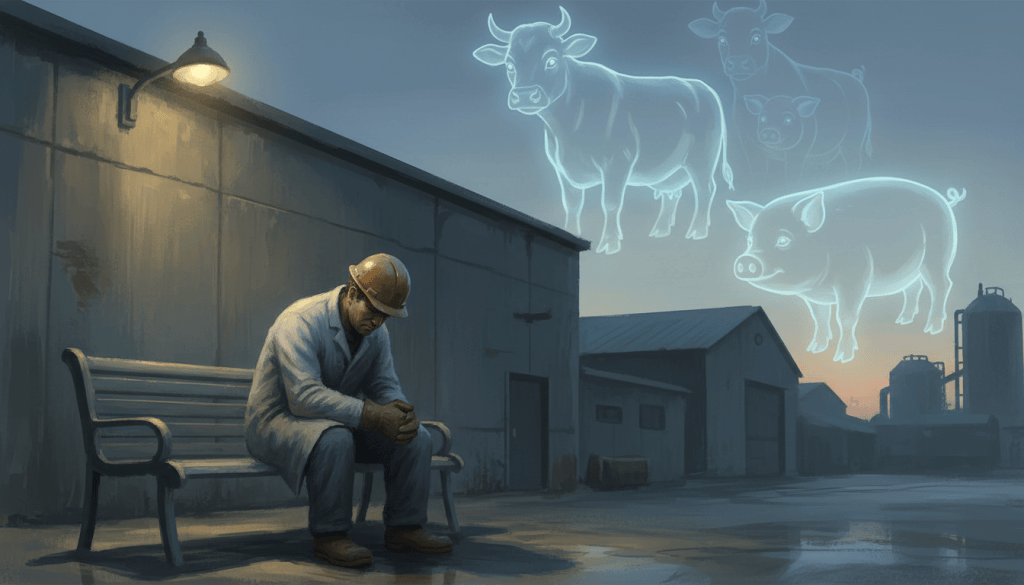
Workers often enter the job with ordinary moral intuitions. Initial exposure to the kill floor frequently produces intense reactions: shock, horror, guilt, shame, fear, and moral dissonance. Qualitative studies of slaughterhouse employees document these responses after the first kills. Over time, many adapt through emotional numbing, dissociation, cognitive distancing (“it’s just a job / just animals / part of the food system”), substance use, or rigid role identification. These adaptations allow the work to continue but exact a cumulative cost.
Because the exposure is continuous rather than a single past event, some clinicians and researchers describe the resulting condition as a form of present traumatic stress rather than purely post-traumatic. Public demand for meat ensures the conditions that generate the injury persist. Workers describe nightmares of animals, intrusive images of blood or killing, emotional detachment that spills into personal relationships, increased irritability or aggression, and a sense that the work “kills you on the inside.” Some report feeling they will have to answer for their actions, or that they have become people they no longer recognize.
The injury is compounded by structural factors: high line speeds that leave little room for careful handling, physical danger and injury rates among the highest in industry, limited job alternatives (especially for immigrant and low-income workers who predominate on the line), and social stigma or isolation when family and friends react with discomfort or disapproval to the nature of the work.
Relationship to moral distress and farmer experience
Related research on livestock farmers uses the language of moral dissonance, moral distress, and moral injury more explicitly. Farmers who form bonds with animals yet must send them to slaughter often report fighting with their conscience, feeling they have betrayed the animals, suppressing compassion, and experiencing guilt or trauma. When these conflicts remain unresolved under financial and cultural pressure, the cumulative effect is described as “death by a thousand cuts”—repeated small violations of care that coalesce into lasting moral injury. Slaughterhouse workers occupy the final, most concentrated stage of the same system.
Consequences and clinical implications
Documented associations include elevated rates of depression, anxiety, substance use, and symptoms consistent with PTSD/PITS. There is also evidence of increased propensity for aggression in some studies, though causation is complex and confounded by selection, working conditions, and socioeconomic factors. Therapy models designed for past trauma face a practical difficulty: the potentially injurious acts continue as long as the person remains in the job. Effective support may need to address real-time awareness of numbing and moral conflict, while larger solutions involve reducing the necessity of such work through changes in demand, production systems, or available alternatives.
Not every slaughterhouse worker develops clinical-level injury; individual resilience, prior experience, cultural framing, and degree of direct involvement on the kill floor vary. Yet the pattern of first-person accounts, elevated mental-health indicators relative to other manual occupations, and the theoretical fit with moral injury and PITS frameworks indicate that the work systematically places people in situations that can wound their moral and emotional integrity.
In the broader argument about helping animals and helping people, this matters. The same industrial systems that inflict suffering on animals also require human beings to override ordinary empathic and moral responses, often at significant personal cost. Recognizing moral injury in these workers does not romanticize the animals or the workers; it simply registers that the psychological mechanisms of empathy and conscience are not costlessly switched off, and that the human price of large-scale animal killing is paid daily by those on the line.


[…] Moral Injury in Slaughterhouse Workers […]
LikeLike
[…] Moral Injury in Slaughterhouse Workers […]
LikeLike
[…] Moral Injury in Slaughterhouse Workers […]
LikeLike
[…] Moral Injury in Slaughterhouse Workers […]
LikeLike