Part 2 of 5 in the series The Hidden Cost of Our Plates
A note from Patricia
Most of us love animals. We cuddle our dogs, cry at nature films, and would never hurt a living creature with our own hands. Yet we sit down three times a day to food that asks someone else to do the hurting for us, and asks us not to think about it. I believe we were made for mercy, and that compassion is not a pie to be cut into smaller and smaller slices but a spring that keeps flowing; the more we love, the more love there is. When we close our hearts to the animals on our plates, something closes in us too, and in the farmers and slaughterhouse workers we ask to do the work. These articles explore why good people eat and kill animals, what it costs all of us, and how our natural tenderness can wake up again.
A word about who wrote this: Barbara Hulley, my dear friend and the owner of this property, chose the initial topic of answering the question friends of hers had asked: Shouldn’t we focus on human well-being instead of animals? Grok, an AI, did all of the research and writing to answer the initial question, and then made suggestions for more in-depth articles. They are so full of facts and studies that we could never have put them together ourselves.
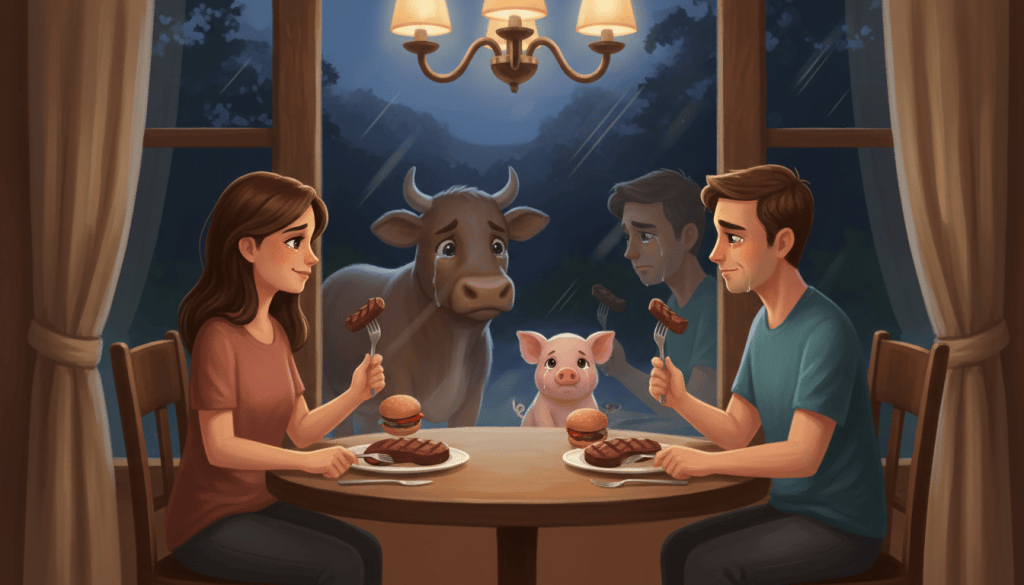
Most people who eat meat, dairy, and eggs hold positive attitudes toward animals—they report caring about them and not wanting them to suffer—while simultaneously participating in a system that causes large-scale animal harm. Psychologists call this contradiction the meat paradox. It generates meat-related cognitive dissonance (MRCD): an aversive state of tension that arises when one’s behavior (consuming animal products) conflicts with one’s values or self-image as a caring person.
This dissonance is not usually constant. Modern food systems and culture keep the animal origins of products largely invisible—through packaging, language (“pork” and “beef” instead of pig and cow), supermarket presentation, and physical distance from farms and slaughterhouses. When that distance is reduced—by footage of farming or slaughter, reminders that meat comes from a once-living animal, conversations with vegetarians, or simply thinking about the issue—many consumers experience discomfort, guilt, disgust, unease, sadness, or moral conflict.
How consumers manage the discomfort
People rarely resolve the paradox by changing their values or fully changing their behavior. Instead they deploy a range of psychological strategies, many of which overlap with moral disengagement:
- Dissociation: Mentally separating the product on the plate from the living animal. The more a piece of meat still resembles an animal (bones, skin, face), the more discomfort it tends to provoke; highly processed forms make dissociation easier.
- Avoidance and willful ignorance: Choosing not to look at or learn about production conditions. Studies show meat-eaters are more likely to avoid information about animal welfare or environmental impacts of the products they consume.
- Denial or minimization of animal minds: Attributing lower capacity for emotion, intelligence, or suffering to farmed animals, especially after eating or being reminded of meat.
- Justifications (often summarized as the “4Ns”): Claiming meat is natural, normal, necessary, and nice (tasty/enjoyable). Related tactics include trivializing the harm, diffusing responsibility (“everyone does it,” “the system is bigger than me”), or comparing it favorably to other harms.
- Perceived behavioral change or do-gooder derogation: Reporting (sometimes inaccurately) that one already eats less meat, or criticizing those who do not eat meat as extreme or judgmental.
These strategies reduce immediate negative emotion and protect a positive self-view. Experiments show that simply reminding people of the animal origin of meat increases negative affect and, in some cases, temporary intentions to reduce consumption—yet entrenched attitudes and attachment to meat often remain stable, and long-term dietary change is less common without repeated exposure or structural supports.
Gender differences appear consistently: women often show stronger emotional responses and greater willingness to reduce meat when the animal connection is made salient, while men more frequently increase attachment to meat or rely on entitlement-based justifications under the same conditions.
Broader psychological effects
For many consumers the impact remains mild or intermittent because the system is designed to keep dissonance low. When awareness rises (documentaries, undercover investigations, personal encounters), some experience genuine guilt or moral conflict that can motivate reduction, flexitarianism, or shifts toward plant-based options. Others respond with defensiveness, stronger rationalizations, or active avoidance. A minority report ongoing unease or “carnism”-related tension even while continuing to eat animal products.
There is no strong evidence that ordinary meat consumption itself causes clinical depression or anxiety in the way occupational exposure does for slaughter workers. Some correlational studies have linked higher animal-protein intake with greater reported depression, anxiety, or stress symptoms in specific populations, but causation is unclear and confounded by many lifestyle factors. The primary psychological burden for consumers appears to be the management of moral and emotional inconsistency rather than trauma comparable to PITS or moral injury on the production side.
Connection to the larger picture
Consumers sit at the demand end of the same system that requires workers and many farmers to suppress empathy and absorb moral injury. The psychological mechanisms that allow most people to continue eating animal products—dissociation, distancing, and motivated reasoning—also help keep the industrial system insulated from everyday moral scrutiny. When those mechanisms are interrupted, the resulting discomfort is real, even if it is usually resolved in favor of continued consumption. Understanding these processes helps explain both the persistence of current practices and the conditions under which individual or cultural change becomes more likely.


[…] The Psychological Impact of Eating Animals and Animal Products on Consumers […]
LikeLike
[…] The Psychological Impact of Eating Animals and Animal Products on Consumers […]
LikeLike
[…] The Psychological Impact of Eating Animals and Animal Products on Consumers […]
LikeLike
[…] The Psychological Impact of Eating Animals and Animal Products on Consumers […]
LikeLike