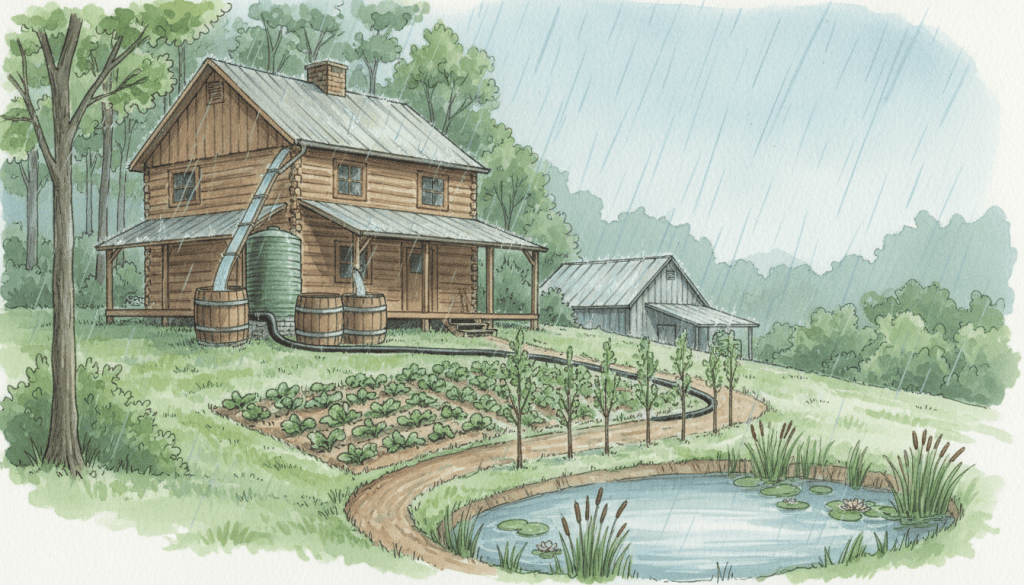
This is the start of a running checklist of improvements that would make this land even better. I’ll keep adding to it. Claude helped me put my notes into words.
In short: A walk in the rain showed where water runs off and goes to waste at the Living Springs Log House. This article lists seven ways to catch it: bigger gutters, downspout extensions, rain barrels, swales, a bigger pond, and fixing a few pipes, so every drop gets used before it leaves the land.
These are suggestions, not professional advice. Click here to read the full note.
The repairs and improvements described here are our best understanding from research and our own experience living on the property. We are not contractors, engineers, or licensed inspectors, and these may not be the best or only solutions. Before starting any repair or project, please consult a qualified professional, such as a contractor, drainage specialist, or home inspector, who can look at the site in person.
This morning I walked around the property in the rain. Rain is a wonderful teacher. It shows you exactly where water goes, and where it’s going to waste. Here, it’s a lot of water. Right now much of it pours off the roofs and runs away, when it could be watering gardens and filling a pond.
So the first section of this checklist is about water.
1. Bigger Gutters on the House
The house gutters can’t keep up in a heavy rain. Bigger gutters are possible. Most homes have 5-inch gutters, but 6-inch gutters are common and carry much more water. Larger downspouts help too. Often the real bottleneck is the downspout, not the gutter.
To do: have a gutter installer look at upgrading to 6-inch gutters with larger downspouts, and maybe adding an extra downspout or two.
2. Check the Metal Building Gutters
At the metal building, water seemed to be spilling over the top of the gutters. That doesn’t happen just because “that’s how gutters are.” It usually means one of these:
- The gutters are clogged with leaves or debris.
- The gutters are too small for that big roof.
- There aren’t enough downspouts, or they’re too small.
- The gutters don’t slope properly toward the downspouts.
To do: clean the metal building gutters first and watch them in the next rain. If they still overflow, consider bigger gutters and downspouts.
3. Downspout Extensions
At the bottom of each downspout, water just splashes out next to the building. An extension or a buried pipe can carry it away, toward the wet-weather creek or a growing area.
To do: add downspout extensions at the metal building and direct that water to the area behind it. So much water already flows there that it could become a great place to grow things.
4. Capture the Roof Water for the Garden
Instead of letting roof water run off, it can be stored and used:
- Rain barrels or a larger tank near the house to hold water for the garden.
- Overflow from the tank sent down to the garden, then on toward the pond.
To do: figure out how many gallons the roof can collect and where a storage tank would fit. Check local rules on rainwater systems before building anything big.
5. Swales and Berms
Swales are shallow ditches dug along the contour of the land, with a berm (a low mound) on the downhill side. They slow rainwater down and let it soak into the ground instead of rushing away. Trees and plants along a swale thrive on the extra moisture.
To do: map where water flows across the land in a hard rain, and mark spots for swales between the house, the garden, and the pond.
6. Dig Out the Pond, and Make It Bigger
The pond needs to be dug out. Bigger and deeper, it could hold all the extra rain flowing off the roofs and across the land. It would be a reservoir for dry summers, a home for wildlife, and a beautiful place to sit.
To do: get estimates from a local excavator. The local conservation district or USDA’s Natural Resources Conservation Service can often advise on pond design for free.
7. Follow the Pipes and Downspouts Around the House
Walking around the house in a hard rain showed me several places where water is going the wrong way.
The mystery pipe by the garage. As you face the garage, there’s a pipe set into the concrete at ground level, and nothing was coming out of it, even in heavy rain. It may be the end of a buried drain that’s supposed to carry roof water from the back of the house. If so, it’s probably clogged or disconnected.
To do: find out where that pipe starts. A plumber or drainage contractor can run a camera or a snake through it to see where it goes and whether it’s blocked.
The downspout behind the house. Behind the house, a gutter empties straight onto the concrete near the foundation. Water collecting near a foundation can cause dampness and damage over time, so it should be carried several feet away from the house. There’s a perfect place for it: the spot along the side of the house where I’ve been starting gardens.
To do: connect that downspout to a pipe or extension that sends the water to the side garden. It may be the same water that’s meant to reach the mystery pipe.
The front of the house. Water pours off the front roof and pounds the stairs and the garden below. Plants don’t like being beaten down by a waterfall.
To do: bigger gutters on the front, kept clean, with the downspout directing water where it can soak in gently.
Bring in someone who understands water. I’m not an expert, and this is a perfect job for someone who is. Permaculture designers are especially good at reading how water moves across land and putting it to work. Drainage contractors and landscape grading specialists can also help.
To do: invite a permaculture designer or drainage expert to walk the land, ideally during a rain, and map out a plan.
The Big Picture
Put together, this becomes one system: roof to gutters, gutters to storage, storage to garden, garden to swales, swales to pond. Every drop gets a chance to be useful before it leaves the land.
A Few Insights
- Walking the land in a hard rain is the best way to see where water goes and where it’s wasted.
- Overflowing gutters are a clue, not just a nuisance. Clogs, small gutters, or too few downspouts are usually to blame.
- Water near a foundation is a problem; the same water sent to a garden is a gift.
Related articles
- Water, Water Everywhere: The Water Story of the Living Springs Log House
- The Possible Springs and Other Potential Water Sources at the Living Springs Log House
- Water and Shelter for a Sanctuary Pasture: The Living Springs Log House Improvement Checklist, Part 3
- How Safe Is a Spring? Why What Lives Uphill Matters
How We Wrote This Together
This article was written together by Patricia Mikkelson, a resident of the Living Springs Log House, and Claude.ai, an AI assistant made by Anthropic. Patricia walked the property in the rain and brought her notes on where the water goes; Claude helped put them into words and added background on gutters, swales, and ponds. The illustration was created with AI.
The Living Springs Log House Improvement Checklist
- Part 1: Catching the Rain (this article)
- Part 2: From Cedar Thicket to Sanctuary Pasture
- Part 3: Water and Shelter for a Sanctuary Pasture
- Part 4: Rocket Stoves for Heat and Cooking
- Part 5: Rocket Stoves Beyond the House
- Part 6: Re-Screwing the Metal Roof, Safely
- Part 7: Staying Cool Without Air Conditioning
- Part 8: Staying Cool, Room by Room
- Part 9: Caring for the Cypress Siding
- Part 10: Forest Mulching
- Part 11: Small Gaps, Honest Fixes
- Part 12: A Quieter Log House: Soundproofing
To see more of the land, the gardens, and the spring, visit www.livingspringsloghouse.com


[…] Part 1: Catching the Rain […]
LikeLike
[…] Part 1: Catching the Rain […]
LikeLike
[…] Part 1: Catching the Rain […]
LikeLike
[…] Part 1: Catching the Rain […]
LikeLike
[…] the gutters clean and plants back from the siding so the wood can dry between rains. Our article Catching the Rain talks about gutters and […]
LikeLike
[…] Part 1: Catching the Rain […]
LikeLike
[…] Part 1: Catching the Rain […]
LikeLike
[…] A steady flow of water moves through the land year-round, fed by a beautiful cave spring emerging from the hillsides above the house — one of the property’s defining features for homesteading. Read more: Water, Water Everywhere, The Possible Springs, the Creek, and Storing Water, and Catching the Rain […]
LikeLike
[…] Part 1: Catching the Rain […]
LikeLike
[…] Part 1: Catching the Rain […]
LikeLike
[…] Part 1: Catching the Rain […]
LikeLike
[…] Part 1: Catching the Rain […]
LikeLike
[…] Catching the Rain: The Living Springs Log House Improvement Checklist, Part 1 […]
LikeLike