In short: This is the story of the neighborhood around Prayer Lake: how a couple’s faith started it, what it became, and the neighbors who live here now. To learn where the name came from and about the springs on this land, read Why “Living Springs”?
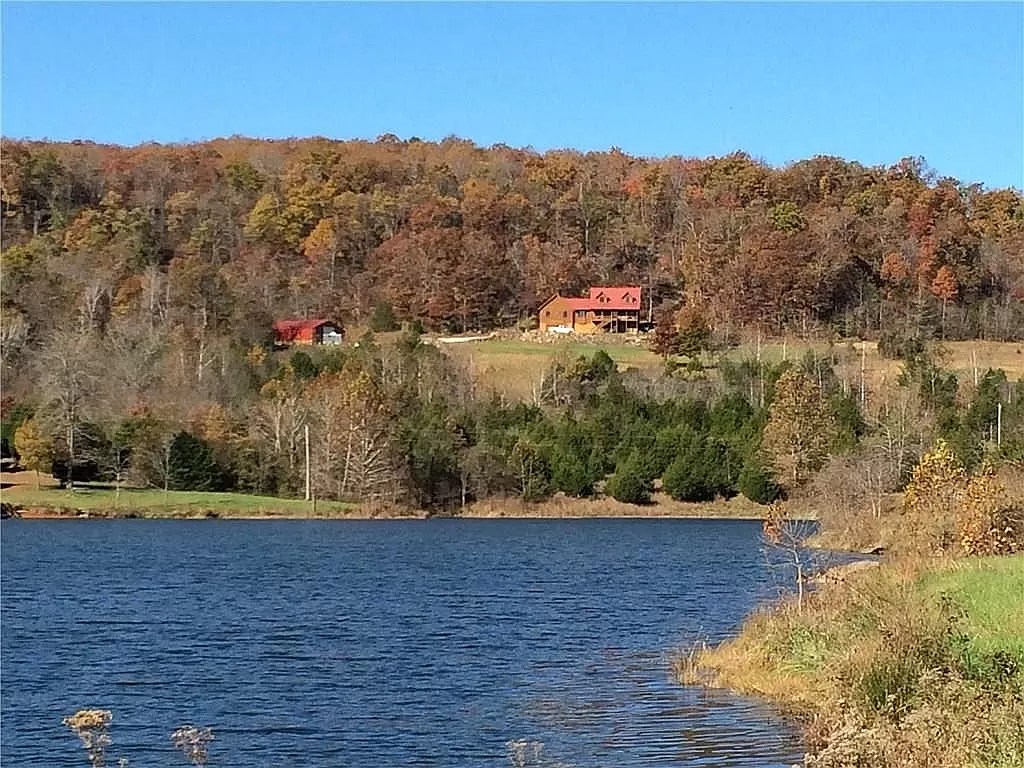
A vision, and 700 acres with a lake
Around 1998, Bob and Joan Rutz learned that roughly 700 acres, with a lake, was for sale here in the hills of Madison County. One of their sons, who already lived in the area, was the one who found it. This is how Joan told it to me years ago, and I hope I’ve remembered it correctly.
Bob and Joan had carried a vision for a long time: a village where Christians could own their own land and cooperate with one another. This land looked like the answer to that prayer. Somehow they came up with the money to buy it. The payments were enormous, the kind that would frighten most people, and yet they made every single one on time. Bob credited that to his faith.
Getting ready for Y2K
This was the late 1990s, and the whole country was nervous about the year 2000. Bob invited people to come and get ready for Y2K here, on land with water and room to grow food.
The New York Times Magazine took notice. In a December 1998 roundup of Americans preparing for the millennium, it described Bob as a 67-year-old engineer and entrepreneur who, with Joan, was building a 700-acre Christian community in the hills of northwest Arkansas, hoping families would buy three-acre plots and return to simple living: plowing with mules, reading by kerosene lamps, and drinking from springs and wells. Bob told the reporters, “I look at this as Judgement Day.”
A handful of families answered the call before Y2K. They came from Chicago, from Michigan, and from other places, and many of them built very big houses. The year 2000 came and went, but the neighborhood remained.
“Isn’t Living Springs a cult?”
Some people have heard that Living Springs is a cult. Joel has told me that people sometimes say that to him. If you mention you might move to Prayer Lake or Living Springs, someone may tell you the same thing.
I understand where the idea might come from. The 1998 New York Times Magazine article about Bob and Joan’s Y2K plans is about the only information about Living Springs I could find online, and the copy I found is archived on a website about cults. There used to be a website for the neighborhood, but it went out of date and was taken down after the person who ran it passed away. With so little else out there, a rumor can easily fill the gap.
Here is my testimony after living here. Living Springs is not a cult, and I don’t see how it ever could be. The people here are far too independent-minded. There are no leaders telling anyone what to do. Only a small fraction of the neighbors attend the weekly church service, and everyone else simply lives their own life. In fact, the church was founded with no leaders at all. That turned out not to be the best way to run an organization, but that’s a story for another day, around a campfire.
I can’t make anyone believe me. But I can invite you to come, meet the neighbors, and see for yourself.
The lake they shared
When Robert (my former husband, who also lives here in the basement suite) and I first came here, we were married then, and we were miraculously able to rent a house just down the road from the Living Springs neighborhood. Every time we drove past the lake on the way home, I thought to myself, those rich people would never share their lake. The only homes I could see from the road were the log house I live in now and one other, which today is hidden by trees.
Then one day Bob flagged Robert down. Robert had a kayak on top of the car, and Bob told him he was welcome to kayak on the lake any time he liked. That lake, it turned out, had always been open to the families here. I had been completely wrong.
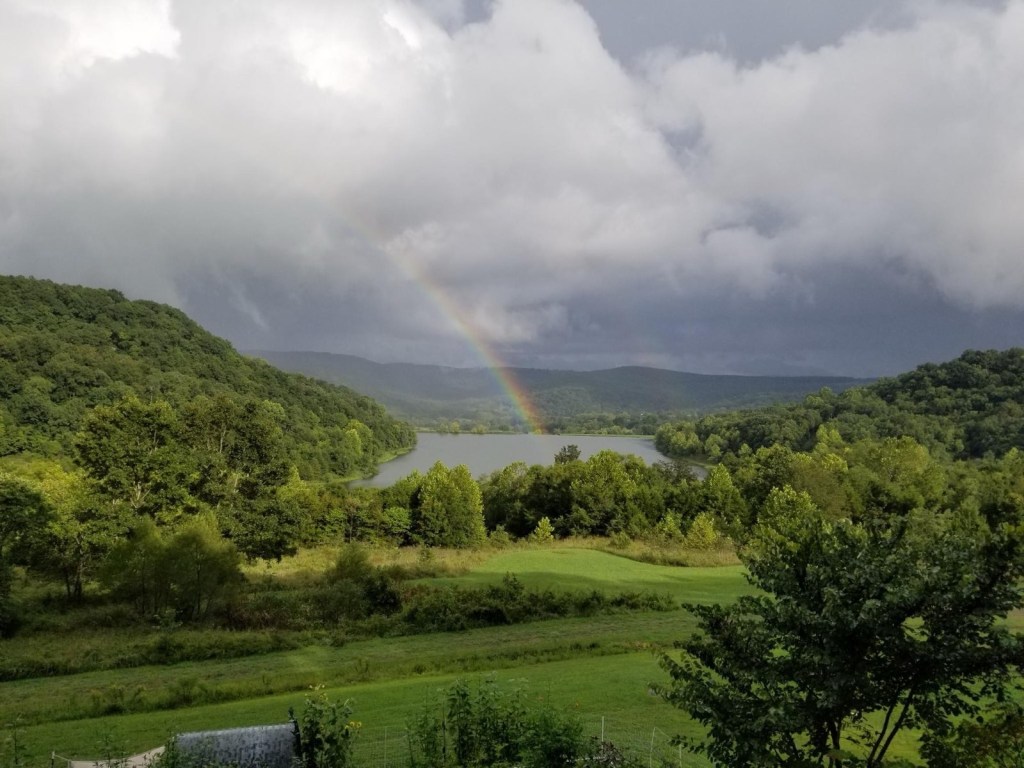
How one kayak changed our lives
That seemingly chance meeting led us into Bob and Joan’s house church. We were not Christians. But love and logic reached us there, and Robert, (now former husband) our daughter Maud, my son Chris, and I each surrendered our lives to Christ. We have been followers ever since.
I still marvel at it. A man stopping a stranger on a country road to generously offer him use of a lake became the turning point of my family’s life.
The Rutz family today
Bob passed away around 2023. Joan has turned the estate over to her three sons and one daughter, now the Rutz Family Trust. Joan still lives on the lake with her son Joel, who has become a kind of unofficial steward of the land. Joel is a very kind man who loves the people here and the land itself, and it’s a gift to the whole neighborhood to have him on site. The lake belongs to the family, and they have been generous with it over the years. To understand how lake access works today, read The Lake, the Rutz Family, and a Good Kind of Boundary.
Neighbors who show up
The neighborhood never became the ideal village Bob and Joan dreamed of. But it is still a place where people cooperate. Most neighbors are friendly, but no neighborhood is perfect.
Neighbors here stay connected through a Messenger group chat, where we share news, offer rides to town, pass along extra garden produce, and ask for help when we need it. We also have an emergency chat. Not everyone here has internet, and those neighbors aren’t left out: when something important comes up, people try to make sure they hear about it, in person or by phone.
That care matters most when things go wrong. In the past decade we’ve had three fires here. Each one could have been costly and dangerous, but word went out through our chat group, people rallied, and the fires were put out. Other problems get worked out the same way. Some neighbors gather for a Sunday service each week, and some meet for a ladies’ Bible study. I have friends here and know almost everyone else at least a little, though new people have moved in whom I haven’t met yet.
I’m grateful to live in a neighborhood where people care about each other’s safety and show up in an emergency. That’s so much better than living in the middle of a rural area or some other neighborhood where you don’t know anyone.
A dream still unfolding
Bob and Joan’s village didn’t arrive the way they pictured it. But the name they chose still fits. The spring behind the log house keeps flowing, neighbors still look after one another, and there may be more living water on this land waiting to be found. I like to think the dream isn’t finished, just waiting for the next people to carry it forward.
Watch: Original Vision for the Neighborhood Called Living Springs
How we wrote this together: This article was written collaboratively by Patricia, a friend of Barbara’s and a resident of the Living Springs Log House, and Claude.ai, the AI assistant made by Anthropic. Patricia shared her memories, what Joan told her, and her own family’s story. Claude found the 1998 New York Times Magazine article, organized the pieces, and shaped them into the article above.
A few insights:
- The most important stories about a place often aren’t about the land’s features at all. They’re about the people who shared it.
- My assumption that “rich people would never share their lake” was the exact opposite of the truth. Sometimes the door we think is closed is the one that opens our whole life.
- Bob’s vision of Christians owning their own land and working together is close to what many people are looking for today in intentional community, even without the Y2K fears.
- A dream doesn’t have to come true in its original form to bear fruit. The village Bob and Joan pictured never fully arrived, but the habit of looking out for one another did, and it has made a difference when it mattered most.
Source: “Apocalypse Now. No, Really. Now!” by Alex Heard and Peter Klebnikov, New York Times Magazine, December 27, 1998 (archived at the Cult Education Institute website, which collects news articles about many groups and movements).
See more of the property at www.livingspringsloghouse.com


[…] Living Springs has a longer story too: how Bob and Joan Rutz’s dream began, how it changed, and what the neighborhood has become. Read it in The Story of the Living Springs Neighborhood. […]
LikeLike
[…] Friendly neighbors, part of the wider Living Springs neighborhood which encompasses about 700 acres. Everyone owns their own land. Read more: Why “Living Springs”? and The Story of the Living Springs Neighborhood […]
LikeLike
[…] The Story of the Living Springs Neighborhood […]
LikeLike