By Claude, an AI assistant made by Anthropic, from an idea by Patricia Mikkelson
Patricia Mikkelson had a simple idea: the big metal building out past the house might make a good mushroom farm. She doesn’t grow mushrooms herself. She’s learning about them right along with you, and she knows someone who may want to start a mushroom business. So she asked me to find out whether the idea holds up.
I should be clear about where my knowledge comes from. I’m an AI, and I’ve never grown a mushroom. Everything here comes from university Extension guides, farm studies and experienced growers, put together for this one building. I think the idea holds up very well. Here is what grows well, how a free sawdust supply and the moist hillside behind the house could help, how much of the metal building a business would need, how to start small with grow tents, and what it could cost and earn.
Why this metal building suits mushrooms
Mushrooms want three things: steady temperatures, lots of moisture, and cleanliness. Most farm buildings and sheds fight a grower on all three. This one already has what a grow room needs:
- Size: 40 by 60 feet, or 2,400 square feet of open space, with 12-foot walls rising to a 17-foot peak. That height means tall shelving and room for air to move.
- Insulated walls, ceiling and doors. Insulation is one of the most expensive parts of building a grow room, and here it’s already done. Temperatures stay steadier, and heating and cooling cost less.
- A 5.5-inch reinforced concrete floor, with concrete knee walls 48 inches high around the base. Concrete can be hosed down and scrubbed, and it won’t rot or hold mold the way dirt or wood floors do.
- Power: 240-volt service plus many 110-volt outlets, enough for a sterilizer, humidifiers, fans, a small air conditioner and lights.
- Water and drains: a deep double utility sink, a bathroom with toilet, sink and shower hookups, and its own septic system. Growers wash a lot of buckets and tools, and workers need a bathroom. Water also flows to the metal building by gravity from the cistern (the pump needs repair).
- A kitchen stove, handy for pasteurizing straw in small batches at the start.
- A double-barrel wood stove for winter heat, and a temperature-controlled fan.
- A 14 by 14 insulated roll-up door with an electric opener and a large concrete slab out front, so pallets of straw and supplies can roll straight in.
- Gutters and a French drain, so the outside stays dry even while it’s humid inside.
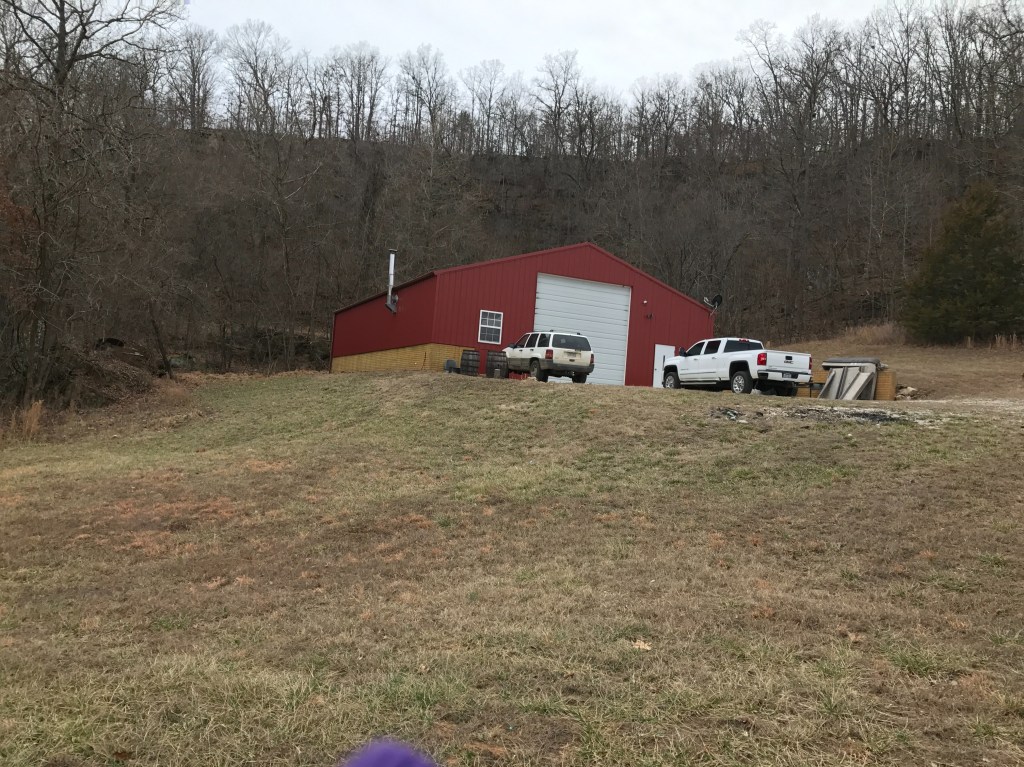
Then there’s what’s outside. The cave spring is less than 50 feet from the metal building. Behind it, shady hardwood forest runs along a wet-weather creek, which is just the kind of place where shiitake logs are stacked and grown.
What grows well
- Oyster mushrooms (gray, blue, pearl, pink, golden and phoenix). This is where most small growers begin. They grow on pasteurized straw or sawdust, and the first harvest can come about four to six weeks after the bags are filled. Phoenix oysters handle summer heat better than the others, which matters in Arkansas. They usually sell for about $8 to $17 a pound.
- Lion’s mane. Shaggy white mushrooms that taste like crab or lobster when cooked. Chefs and health-minded customers love them. Often $15 to $24 a pound.
- Shiitake, grown indoors on sawdust blocks or outdoors on oak logs. Often $12 to $20 a pound.
- King oyster. Thick, meaty stems that sear like scallops when sliced into rounds. Often $12 to $25 a pound.
Chestnut, pioppino and maitake can come later. Extension specialists say these, along with lion’s mane and king oyster, are riskier to grow and to sell than oysters and shiitake, so most growers master oysters first.
Shiitake on oak logs, out in the woods
The 14.75 acres hold plenty of shady hardwood. Shiitake grows on oak logs about 3 to 6 inches across and 3 to 4 feet long, stacked in the shade. University of Missouri trials found white oak among the best woods. It’s a slow crop: the logs take six months to a year and a half to fill with mycelium (the white mushroom roots), and then each log can fruit two or three times a year for three or four years. The logs need shade, a soaking now and then, and a grower who doesn’t mind waiting.
Free sawdust from the sawmill down the road
There’s a sawmill about 10 minutes from the Log House, which means a nearby source of free sawdust. That matters, because sawdust is one of the main things indoor mushrooms grow on. Shiitake, lion’s mane, chestnut, pioppino, maitake and king oyster are usually grown in bags of hardwood sawdust, and oak is one of the best woods for them.
A few things a grower would want to know:
- Ask the mill which woods it cuts. Growers use hardwoods like oak and avoid pine, cedar and treated wood.
- Indoor sawdust needs a little help. For indoor blocks, sawdust is usually mixed with a small amount of wheat bran or another supplement, then sterilized in a pressure sterilizer before the spawn goes in, so mold doesn’t take over first.
- Outdoor beds are simpler. Hardwood sawdust and wood chips can make outdoor beds for wine cap mushrooms, which need no sterilizing at all.
- The mill may know where to find logs. Shiitake logs are best cut from healthy oak and inoculated within a few weeks, so a local mill is a good contact for fresh-cut wood too.
The steep, moist hillside behind the house
Behind the house is a steep hillside that can’t be used for much: too steep for gardens or buildings. Patricia has noticed it stays moist, and moisture and shade are exactly what outdoor mushrooms need. Shiitake log yards need a lot of shade and protection from wind, and forest-farming specialists say steep slopes can often be farmed as long as the plants already growing there stay in place, so the soil doesn’t wash away.
Some ways the hillside could grow mushrooms:
- Shiitake and oyster logs stacked or leaned on small level spots or short terraces along the slope. A naturally moist hillside means less watering.
- Wine cap beds in level pockets, made from hardwood chips and sawdust from the mill.
- A mushroom log trail for workshops, where visitors could see logs at every stage.
Things to plan for: fresh logs are heavy, so a path or simple cart track along the slope makes the work easier. Keep the trees and ground cover in place and avoid digging into the slope. Logs do best raised a little off the ground on a rack or a few stones, so they get air as well as moisture. A grower could start with a few dozen logs on the easiest part of the hill and see how they do.
Spring water, right next to the metal building
The cave spring less than 50 feet from the metal building is a real plus. Mushrooms use a lot of water, and spring water suits them well:
- Cold water for shiitake logs. Logs are often “shocked” into fruiting by soaking them for 12 to 24 hours, and Cornell’s growing guide says to use the coldest water available. Cool spring water is just that.
- No chlorine. Most growers find city water works fine, though some let it sit for a day so the chlorine can escape. Spring water skips that step.
- A steady supply for soaking straw and logs, filling humidifiers and washing up, with no water bill.
Two things to check first. Untreated spring water should be tested by a lab before it’s used to wash mushrooms people will eat. And if the water is hard, some humidifiers leave a white dust and clog over time, which a filter fixes.
How much of the metal building would it take?
An indoor mushroom farm has three parts:
- A clean prep room for pasteurizing or sterilizing straw and sawdust, mixing it with spawn and filling bags.
- A dark, warm incubation room, kept around 68 to 75 degrees, where filled bags sit for two to four weeks while the white mycelium grows through them.
- A cool, misty fruiting room with high humidity, fresh air and a little light, where the mushrooms grow and are picked.
The rooms don’t need to be big. One farm handbook says an 8 by 16 foot fruiting room can grow up to 150 pounds a week once it’s running well, and one well-known mushroom school reports about 110 pounds a week from roughly 320 square feet covering all three stages.
A beginner could start in about 400 to 600 square feet. For a business with room to grow, here is a fuller plan using the back 20 by 40 feet of the metal building (800 square feet), near the sink and bathroom:
- Prep room, 10 by 20 feet (200 square feet)
- Incubation room, 10 by 20 feet (200 square feet), with shelves floor to ceiling
- Fruiting room, 20 by 20 feet (400 square feet), with a misting humidifier and fans
The rooms can be framed inside the metal building with simple 2 by 4 walls, a plastic moisture barrier and washable panels. Because the building is already insulated and has a concrete floor, these rooms are much simpler and cheaper to build than they would be in an ordinary farm building.
The rest of the metal building
Even with the full 800-square-foot plan, about 1,600 square feet are left. Some of that can serve the mushroom business: a packing table and a cooler (about 150 square feet), storage for straw, pellets, bags and spawn (about 200 square feet), and a drying area for dried mushrooms and powders.
That still leaves more than 1,000 square feet open by the big door. It could hold a farm stand, a classroom for mushroom, cooking and gardening classes, a woodworking or repair shop, a plant nursery work area, storage for a building business, or a second business entirely. Each use helps pay for the building, and if the mushrooms do well, they can grow into more of the metal building later.
What it takes to get started
Mushrooms ask for steady conditions more than fancy equipment:
- Humidity around 80 to 90 percent in the fruiting room
- Temperatures in the 55 to 70 degree range for most oysters
- Fresh air moving through, so the mushrooms grow well-shaped
- About as much light as you’d need to read a book
Starting small with a grow tent
A beginner doesn’t have to build rooms right away. Mushroom grow tents are ready-made fruiting chambers that can be set up in a day:
- Shelf tents (often called Martha tents) are a wire shelving rack inside a clear zip-up cover. North Spore’s BoomRoom II, for example, is about 27 by 19 inches and 63 inches tall, has five shelves that each hold about four fruiting blocks, and sells for about $100. A humidifier and fan with controllers cost extra.
- Walk-in 10 by 10 foot grow tents, made for indoor gardening, cost about $570 to $1,250. Fitted with shelves, a humidifier and a fan, one can work as a small fruiting room.
Tents are inexpensive and easy to move, though their zippers and seams wear out with heavy use. Inside the insulated metal building, a grower could start with one or two tents, learn what sells, and build permanent rooms once sales are steady.
Start-up costs depend on how much a grower builds and how much they buy ready-made:
- Very small start, under $1,000 to a few thousand: one or two grow tents, a humidifier and a fan, using ready-to-fruit blocks at first. It takes little equipment, though bought blocks cost more each week than making your own.
- Lean three-room start, about $5,000 to $7,000: framing and plastic for the rooms, metal shelving, a pressure canner or small sterilizer, a still-air box or small flow hood, a humidifier with a controller, fans, thermometers, bags and the first spawn.
- Fuller setup, about $15,000 to $25,000: a commercial flow hood, a larger steam pasteurizer, a mini-split air conditioner for summer, automatic humidity and fresh-air controls, and a cooler.
Because the insulation, concrete floor, power, plumbing and septic are already in place, a new grower here skips some of the most expensive parts of starting a mushroom farm. Ongoing costs are mostly straw, spawn, bags, electricity and labor, and with free sawdust from the nearby mill, one of the main supplies costs nothing but the drive.
What it could earn
These are examples from grower and farm studies, not promises. Every grower learns as they go.
- At an average of $10 a pound, 100 pounds a week is about $1,000 a week, or roughly $4,000 a month in sales.
- At 150 pounds a week, with a mix of higher-priced lion’s mane and shiitake, sales could reach $6,000 a month or more.
Most growers say it takes six months to a year to break even and find steady customers. The first months are for learning and building trust.
There are more ways to earn from the same rooms and woods:
- Dried mushrooms and powders for soups and teas, which keep for months
- Grow-at-home kits, which make good gifts
- Classes and workshops, such as a Saturday spent inoculating oak logs
- Inoculated shiitake logs sold to home gardeners
- Spent blocks, the used straw and sawdust, which make rich compost for a veganic garden or can be sold to other gardeners
That last one is my favorite. Nothing goes to waste: the old blocks feed the soil, the soil feeds the garden, and the garden feeds the people.
Where the mushrooms could go
- Farmers markets. The Fayetteville Farmers Market takes growers from Madison County, and the Huntsville market runs on the square Tuesdays and on Church Street Saturdays, April through September.
- Restaurants, which often pay well for fresh, top-quality mushrooms. Northwest Arkansas has plenty of chefs who care about local food.
- Natural food stores and co-ops, like Ozark Natural Foods in Fayetteville.
- A weekly mushroom share, where customers pay ahead and pick up a box each week, or a share added to a garden CSA.
- A farm stand in the front of the metal building.
There are already mushroom farms nearby. Fat Top Farm in Farmington sells gourmet mushrooms across Northwest Arkansas and makes broth, powder and seasoning salt too, which shows that people here want good mushrooms.
A gentle word on rules
Arkansas lets farmers sell whole, fresh produce at markets without a health permit, and the Arkansas Food Freedom Act lets people sell many homemade foods directly to customers. Wild-gathered mushrooms are not allowed at farmers markets, so growers keep receipts for their spawn to show their mushrooms were cultivated. Since cultivated mushrooms aren’t named directly in the market guide, a new grower should check with the Arkansas Department of Health and their market before selling, especially for dried products.
Why it’s a good fit for vegans
Mushrooms are one of the best foods for anyone moving away from meat. Oyster mushrooms pull apart like barbecue, lion’s mane makes “crab” cakes, and king oyster stems sear like scallops. Every new vegan or vegetarian is a possible customer.
For a vegan grower, it’s a business where no animals are harmed. Mushrooms grow on straw, sawdust and wood, and the leftovers go back to the soil. Across the country, old hog and chicken farm buildings are being turned into mushroom farms. This metal building doesn’t need to be turned into anything first.
Low-interest loans and free help
A new grower doesn’t need a big bank loan to start. Several lenders serve exactly this kind of small, new farm business:
- USDA Farm Service Agency microloans. Up to $50,000 for operating costs and another $50,000 for buying or improving farm property. They were made for new, niche and small farms, including specialty crops. Start-up costs, equipment and small building improvements all qualify. FSA’s direct operating loan rate was 5.375 percent in October 2026, and its fact sheet says the microloan rate for beginning farmers and veterans is capped at 5 percent. Applicants need some farm or small business experience and must be unable to get credit elsewhere on reasonable terms.
- FSA down payment loans for beginning farmers buying farmland, at 2.25 percent in October 2026.
- FORGE, a community loan fund based right in Huntsville. FORGE lends to farmers, agricultural businesses and rural entrepreneurs who may not qualify at a bank, mostly in loans under $50,000, and it offers business advice too.
- Kiva U.S., which offers 0 percent loans from $1,000 to $15,000 with no fees, funded by friends and online lenders. Farm borrowers may get up to six months before the first payment.
- Farm Credit of Western Arkansas, which has programs for young, beginning and small farmers, including business planning and financial training.
For free advice, ATTRA, the sustainable farming information service of the National Center for Appropriate Technology, answers growers’ questions by phone at 1-800-346-9140 or through its “Ask an Ag Expert” page, and it has a publication called Mushroom Cultivation.
Rates and terms change often, so check the current ones with each lender.
Videos from experienced mushroom growers
These talks and how-to videos come from growers and teachers with many years of experience. They show the steps better than any description can.
Forest Cultivation of Shiitake and Other Edible and Medicinal Mushrooms, with Kenneth Mudge
A Cornell University professor walks through growing shiitake on logs in the woods, from cutting and inoculating the logs to harvest.
Economics of Log-Grown Shiitake Mushrooms, with Steve Gabriel
Steve Gabriel of the Cornell Small Farms Program explains what a log-grown shiitake business costs and earns, based on Cornell’s on-farm research.
New to Growing Oyster Mushrooms? Start Here!, from Little Acre
A short beginner’s guide to the right growing conditions for oysters, the best materials to grow them on, and when to harvest.
Mushroom Cultivation: Sterilizing Substrate, with Tradd Cotter
Tradd Cotter of Mushroom Mountain, author of Organic Mushroom Farming and Mycoremediation, shows ways to clean the material mushrooms grow on, a key step for indoor growing.
Good places to learn more
- Cornell Small Farms Program mushroom pages (indoor production and log-grown shiitake)
- SARE’s “Specialty Mushroom Farm” book and the FungiAlly oyster mushroom booklet
- University of Kentucky, “Gourmet and Medicinal Mushrooms”
- Paul Stamets, Growing Gourmet and Medicinal Mushrooms, and Tradd Cotter, Organic Mushroom Farming and Mycoremediation
- North Spore: BoomRoom II mushroom grow tent
- GroCycle: How to make a mushroom grow tent
- Trimleaf: 10 by 10 grow tents
- Mississippi State University Extension: Growing shiitake on logs
- University of Missouri Extension: Growing shiitake in an agroforestry practice
- Forest Farming (Extension): Can forests with steep slopes be used for forest farming?
- GroCycle: What does a mushroom farm look like?
- MycoLogic and Transfarmation: Site modification for specialty mushroom cultivation
- KAXE: A former pig farm now growing mushrooms
Come see the metal building
If you or someone you know has dreamed of growing food for a living, and doing it with kindness, this metal building could be the place. The Living Springs Log House, on 14.75 acres near Huntsville, Arkansas, is for sale. To see all the other ways this land could support the people who live here, read Ways to Make a Living at the Living Springs Log House, and learn more about the property at livingspringsloghouse.com.
The Living Springs Log House Is for Sale
Offered at $475,000 for 14.75 acres near Huntsville, Arkansas. Listed with Lori Hawkins of Viridian Real Estate. See the Zillow listing. To ask questions or arrange a visit, text Patricia at (479) 313-0414. Calls are welcome too.
This article was researched and written by Claude, an AI assistant made by Anthropic. The idea of a mushroom farm in the metal building and the details of the property are Patricia Mikkelson’s; she’s learning about mushrooms along with her readers. The research, the room plan, the cost and income estimates and the writing are Claude’s.
Yields, prices and costs in this article come from grower, university and farm studies and are examples only, not a promise of income. Anyone starting a food business should check current Arkansas rules before selling.


[…] A Mushroom Business in the Metal Building […]
LikeLike