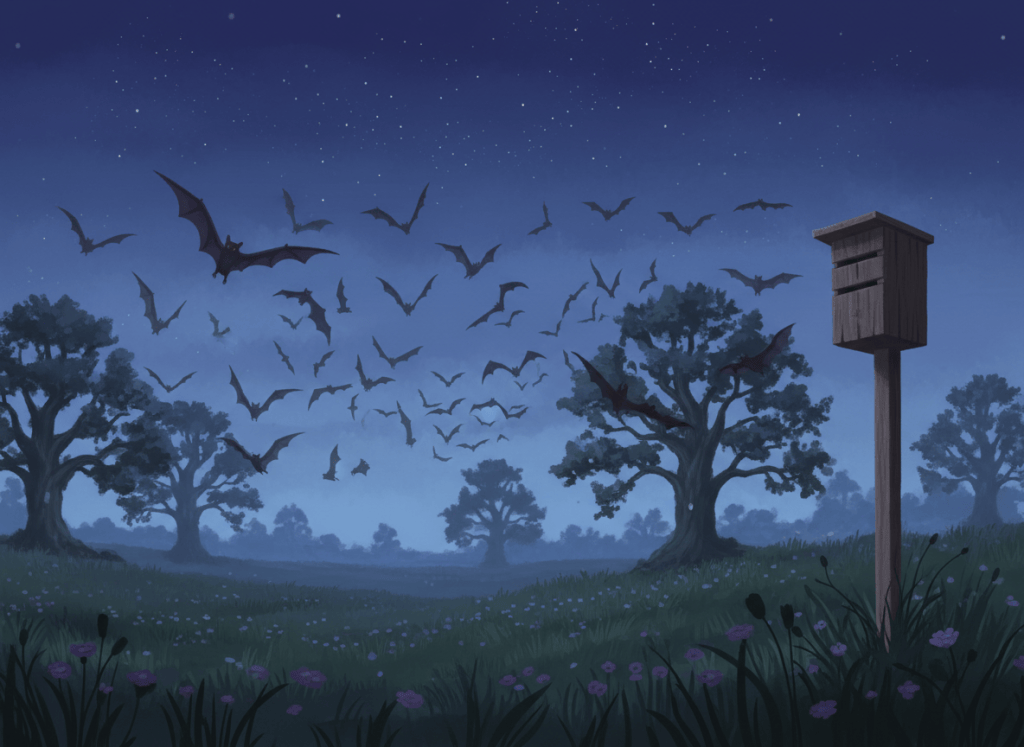
About five years ago, Robert, my former husband and a resident here at the log house, started noticing bats — more and more of them every evening. They were slipping out of a small attic vent on the front of the log house (on the left side as you face it) and heading out into the dusk.
Robert came to love that hour so much he gave it a name: “bat thirty.” Around twilight he’d go out and watch them pour from the vent and swoop, dive, and dance across the sky, catching insects on the wing. Some evenings they’d swoop close enough to make you duck, but they never once touched or harmed anyone. I would often join him. Being out under the stars as the dark descended was wonderful. Fine conversations were had. We liked the bats a lot. And we can tell you this much from experience: mosquitoes were not a problem.
Every year there seemed to be more of them. We used to wonder how on earth they stayed cool up in that attic through an Ozark summer.
Then, Fewer Bats
About two years ago, something changed. The evening flights thinned out to just a few bats. We still don’t know exactly why.
This year Robert asked David, our wonderful handyman, to clean out the attic. He brought down about four 5-gallon buckets of bat guano. There wasn’t much left after that, but the home inspector noticed signs of the bats, and he’s probably right that the insulation up there may need to be replaced. We wanted to get out as much as we could. (And bat guano is wonderful garden fertilizer, so none of it went to waste.) David also put up hardware cloth to keep out future bats. We are so sorry — but attics just aren’t the best homes for bats.
The Bats Come Back — to a House of Their Own
Then this year I noticed guano on the front upper deck. Looking up, I found several bats huddled together in a corner of the eaves.
Robert had been saving a bat house for years, waiting for exactly this moment. In about two minutes, David, our handyman, gently brushed the bats away from the eaves with a broom and put the bat house up in that same spot. The guano that now drops into the container below tells us the bats have moved in. I don’t know whether they love their new home, but I’d like to think so.
Why Did So Many Leave?
We can’t say for certain, but there is one big possibility that bat lovers across Arkansas know well: white-nose syndrome. It’s a fungus that grows on bats while they hibernate and wakes them too early; since there are no insects to eat in winter, waking burns through the fat they need, and they essentially starve. The fungus has been in Arkansas since 2012 and has turned up in counties across the Ozark and Ouachita Mountains. Some species have been hit very hard — little brown bats in Arkansas have been nearly wiped out, and tricolored bats have dropped more than 88 percent since 2010.
Not every species suffers equally. A study in Arkansas’s Ouachita Mountains found that while northern long-eared and tricolored bats declined sharply after the disease arrived, evening bats were actually caught far more often, and big brown bats somewhat more often. We don’t know which species lived in our attic, so the disease is only one possible explanation. Bats also shift roosts on their own, and changes in weather or insect numbers can play a part.
Do Bats Like Bat Houses?
Often, yes, though usually it takes patience. Bats may take several months to a few years to move into a new bat house. Ours were luckier: the house went up right where they were already roosting. Location matters a great deal too. Bat houses mounted under the eaves of a building are considered ideal, since they get sun while staying sheltered from rain and predators. That is just where ours is.
A Prettier Way to Catch the Guano
Experts suggest that a potted plant or a shallow tray or plant saucer can sit under a bat house to collect guano for use in flower beds or gardens. I am so glad to find this out, because I am going to do this tomorrow! One important safety note: don’t use a bucket or any deep container, because a baby bat that falls from the house could get trapped with no way out. Attractive options include a wide terracotta plant saucer, a long shallow window-box tray, or simply a low pot of herbs or flowers right under the house that gets fertilized as it goes.
Are Bats Useful? Are They Dangerous?
Bats are among the best neighbors a garden can have. They eat enormous numbers of night-flying insects, and an Arkansas Game and Fish Commission spokesman has noted that bats may save the agriculture industry as much as $3 billion a year by removing unwanted insects.
As for danger, bats that swoop close are chasing insects, not people. The real cautions are simple: never handle a bat with bare hands (a bat on the ground may be sick), and wear gloves and a mask when cleaning up guano in an enclosed space like an attic. Watched from the deck at bat thirty, they are pure delight.
How We Wrote This Together
This article was written collaboratively by Patricia, a friend of Barbara’s and a resident of the Living Springs Log House, and Claude.ai, Anthropic’s AI assistant. Patricia shared the story as it happened — Robert’s evenings at “bat thirty,” the attic cleanout, the bats huddled in the eaves, and David’s two-minute bat house installation. Claude organized the story and looked up current information on white-nose syndrome in Arkansas, bat house success, and safe guano collection.
A few insights:
- A bat house works best where bats already want to be. Ours went up exactly where they had chosen to roost.
- Fewer bats doesn’t always mean something went wrong at home; a disease spreading through the whole region may be part of the story.
- Guano is a sign of life here, and with a shallow saucer or a potted plant it becomes a gift to the garden.


[…] Before closing the attic up again, seal the gaps where the bats got in, such as openings at the eaves, ridge, and vents. Bats are wonderful neighbors, eating huge numbers of mosquitoes and other insects. A bat house under the upper-deck eaves now gives them a home nearby, outside the house. Read their story in Bat Thirty. […]
LikeLike
[…] Wildlife that makes its home here. Read more: The Swallows of Living Springs Log House and Bat Thirty […]
LikeLike
[…] Bat Thirty: The Story of the Bats at Living Springs Log House […]
LikeLike