A note on these suggestions: The ideas here come from research and from our own experience living on the property. We are not pest-control professionals or wildlife experts, and these may not be the best or only solutions.
In short
- Like any wooded Ozark property, the Living Springs Log House has venomous snakes, ticks, and chiggers. Mosquitoes are scarce, but there are a few.
- The goal here is to discourage these creatures rather than kill them, by shaping the land so the area around the house is less inviting to them.
- The approach is permaculture: keep the zone nearest the house open, sunny, and tidy, and leave wild habitat at the outer edges of the property.
- For personal protection, there are natural options: plant-based repellents, smart clothing, a “boot station” by the door, and daily tick checks.

The big idea: habitat at the edges, not at the door
Permaculture divides a property into zones based on how often people use them. Zone 1 is the area right around the house, where you walk every day. The outer zones are the wilder places you visit less often.
Snakes, ticks, and chiggers all prefer shade, cover, tall grass, and humidity. So the most effective, gentle solution is to make Zone 1 sunny, open, and somewhat dry, and to let the wild zones stay wild. Creatures still have a home, just not on your doorstep. Nothing has to be poisoned. The land itself does the work.
Venomous snakes
The Ozarks are home to copperheads and timber rattlesnakes, and cottonmouths can live near water. Snakes are an important part of the ecosystem, and they eat mice and rats. Most snakes would much rather avoid people. The goal is simply to give them fewer reasons to come close to the house. I was bitten by a copperhead once, so I take these precautions seriously. That was a painful and expensive experience.
Take away their hiding places
- Keep woodpiles, brush piles, lumber, and rock piles well away from the house, ideally at the far edge of Zone 1 or beyond. Stack firewood up off the ground on a rack.
- Keep grass short within about 30 feet of the house, the deck, and the metal building.
- Trim shrubs so there is open space underneath them, rather than a dense, shady tangle at ground level.
- Close gaps under the deck, steps, and foundation with 1/4-inch hardware cloth, buried a few inches into the ground.
Take away their food
Snakes follow mice. Fewer mice means fewer snakes.
- Store animal feed, birdseed, and dry goods in metal bins with tight lids.
- Clean up spilled seed under bird feeders, or move feeders away from the house.
- Keep compost in an enclosed bin and make the composed pile near the garden. Cover well with organic material. .
Create a “clear-view” border
A creative permaculture touch is a border of gravel or flat stone around the house and along the main paths. Snakes don’t like crossing open, exposed ground where predators such as hawks can see them. A clear border also lets you see anything on the path before you step there.
Let the animals help
Hawks, owls, and other birds of prey naturally keep snake numbers in balance, so leaving tall dead trees standing at the edges of the property gives them places to perch and hunt. Dogs are often the first to notice a snake. For a farm animal sanctuary, rescued guinea fowl are well known for loudly announcing snakes and for eating ticks.
Staying safe on foot
- Wear boots and long pants when walking in tall grass, the woods, or near the spring.
- Carry a flashlight at night. Copperheads are often out on warm summer evenings. That is when i got bit–the one and only time ever I got bit by a snake.
- Look before you put your hands or feet somewhere you can’t see, such as under boards, into woodpiles, or over logs. Carry a stick to poke around in the garden or other places you can see what is underneath something.
- If you see a snake, give it space and let it move on. If you choose to kill a rattlesnake or copperhead, I can understand. As a vegan, I want to do least harm. However, poisonous snakes propagating around the property is something I actually would not like myself.
Ticks
.I have never gotten sick from a tick bite. After living in the Ozarks for decades, I am used to them. However, I can understand why people might be very concerned about getting bitten and wanting to prevent that from happening so I am supplying you with this information.
Arkansas has several kinds, including the lone star tick, the American dog tick, and the blacklegged (deer) tick, and they can carry illnesses such as ehrlichiosis and Rocky Mountain spotted fever. The good news is that ticks are very sensitive to sun and dryness.
Shape the land
- Make a dry border. Spread a 3-foot-wide band of wood chips or gravel between the garden areas and the woods. Ticks are less likely to cross this dry, open strip into the area around the house.
- Keep lawns mowed. If you have grass paths, keep them mowed as well. Ticks wait on tall grass and brush for something to brush past. Wide, mowed paths keep you away from them.
- Clear leaf litter near the house. Rake leaves away from the house, deck, and play areas, and use them as mulch in the outer garden beds instead.
- Put sitting areas in the sun. Place chairs, hammocks, and picnic tables in open, sunny spots rather than along the shady woods’ edge.
- Make the area around the house less inviting to deer and mice, which carry ticks, by fencing gardens and storing food securely.
- Most of these actions double for keeping snakes away as well, so hurray for that!
A creative touch: the “aromatic walkway”
I love this idea. Apple mint grows crazy around here, and so does peppermint and spearmint when they are nurtured.. I just have never cut them back adequately. The other plants listed below are wonderful for all kinds of uses and relatively easy to grow.
Line the paths you use most with fragrant herbs such as rosemary, lavender, lemon balm, and mint (mint is best kept in pots so it doesn’t take over). The evidence that these plants keep ticks away is limited, so think of them as a pleasant bonus rather than a barrier. They attract pollinators, smell wonderful when you brush past, and lemon balm leaves can be crushed and rubbed on your skin for a light, fresh scent.
Protect yourself
- Plant-based repellent: Oil of lemon eucalyptus (and its active ingredient, PMD) is a plant-derived repellent for ticks and mosquitoes. Another option is 2-undecanone, which comes from wild tomato plants. Look for products registered with the EPA, and follow the label. Oil of lemon eucalyptus is not recommended for children under 3.
- Dress for it: Light-colored clothing makes ticks easier to spot. Tuck your pants into your socks and your shirt into your pants.
- Use the dryer: When you come in, put your outdoor clothes in the dryer on high heat for 10 minutes before washing them.
- Shower and check: Shower within two hours of coming indoors, and check your whole body, especially behind the knees, the waistline, the armpits, behind the ears, and along the hairline. Check pets, too.
- Remove ticks properly: Use broad-tipped tweezers, grasp the tick close to the skin, and pull straight up with steady pressure. Clean the area afterward.
The “boot station”
Set up a small station by the main door: a bench, a boot tray, a lint roller for picking off ticks, a hand mirror for tick checks, tweezers, and a bottle of plant-based repellent. Making the habit easy is half the battle.

Chiggers
Chiggers are tiny mites that live in tall grass, weeds, and berry patches, and their bites cause intense itching. Like ticks, they love shade and humidity and dislike sun and short grass.
- Keep grass mowed in the areas you walk and sit, and keep berry patches away from the main paths.
- Avoid sitting directly on the grass or on logs in summer. Bring a blanket or chair.
- An old Ozark remedy: Many people dust powdered sulfur on their socks, shoes, and pant cuffs before going into the grass. Sulfur is a natural mineral, but it has a strong smell and can irritate some people’s skin, so try a small amount first.
- The same clothing habits that work for ticks (pants tucked into socks) work for chiggers too.
- When you come inside, take a warm shower and scrub your legs and waistline. This can wash chiggers off before they bite.
- What works for me: If chiggers do bite, the most important thing is not to scratch. I keep a little spray bottle of white or apple cider vinegar, and I spray or dab it on the bites whenever they itch. It really helps. (Chiggers don’t actually burrow into the skin, despite the old rumor, but scratching can break the skin and lead to infection. Vinegar may sting on skin that’s already scratched open but it can’t hurt.)
- A cold shower relieves the itching at well. Just like poison ivy, don’t scratch whatever you do!
Mosquitoes
Mosquitoes are scarce at Living Springs Log House, but there are a few. A big part of the reason is that the land already supports their natural predators.

- Swallows: The swallows that nest under the deck floor, in front of the basement suite, eat huge numbers of flying insects. They are some of the best pest control you could ask for.
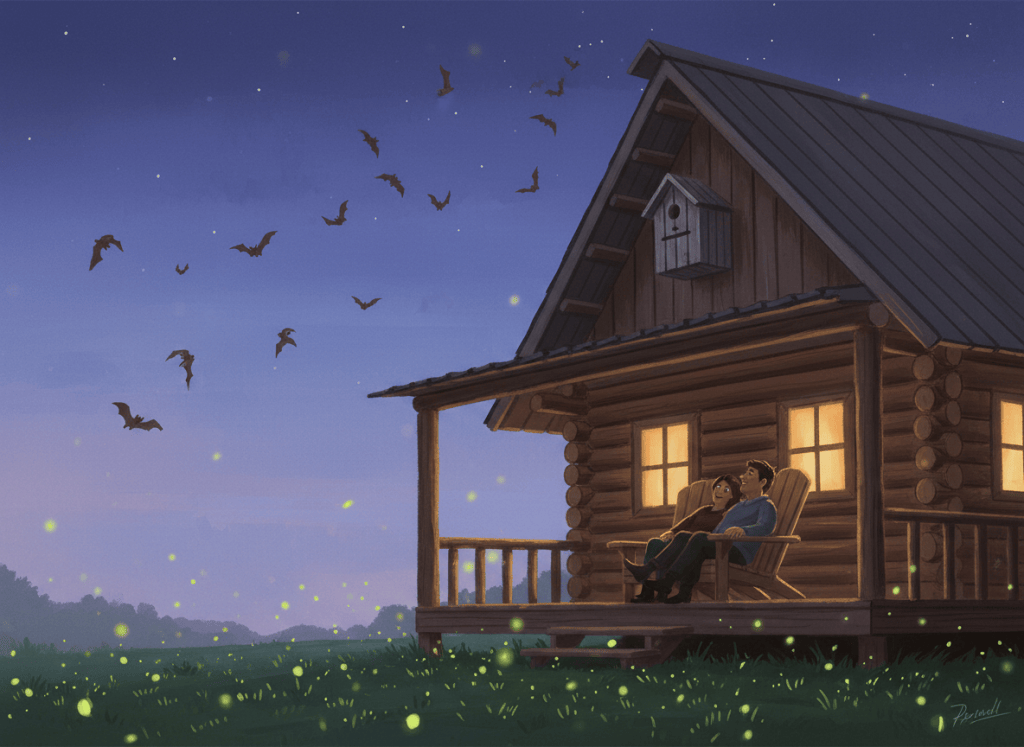
- Bats: There is a bat house under the eves to the right of the front door on the first floor, where the wooden deck is. Bats eat mosquitoes and other night-flying insects.
- No standing water: Mosquitoes breed in still water. Empty buckets, saucers, and anything that collects rain once a week, keep gutters clear, and make sure cisterns are tightly covered or screened.
- Moving water: If you add a pond, include a small pump or fountain to keep the water moving, and native plants to attract dragonflies, which eat mosquitoes.
- A breeze on the deck: A simple fan on the deck makes it hard for mosquitoes to fly near you.
- The same plant-based repellent recommended for ticks (oil of lemon eucalyptus) also works on mosquitoes.
Our Own Upper Garden: What I’m Learning: From Patricia
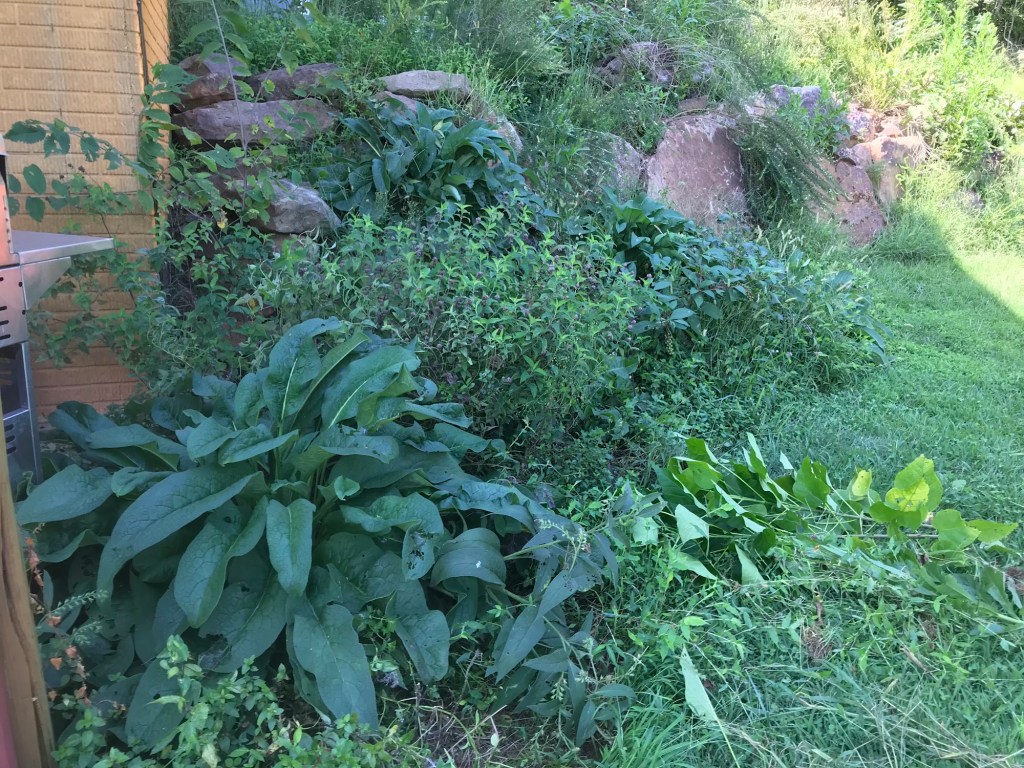
After I read these recommendations that Claude wrote, I realized I had made some mistakes. There isn’t a lawn in front of the log house. Instead, there’s a small area where, over nine years, I’ve built up the soil and planted all kinds of things: comfrey, herbs, flowers, bulbs, and plants grown from saved seed. They love it up here. But while working on this article, I learned that a garden like this is almost the opposite of what’s recommended right next to a house. Big, leafy plants close to the door give snakes, ticks, and chiggers just the shady, damp cover they like.
I didn’t know this about landscaping before. Now I know that I should:
- Plant more aromatic herbs along the paths, like rosemary, lavender, thyme, and lemon balm. They grow lower and more open than comfrey. There is already plenty of apple mint. These other herbs are wonderful, too!
- Make the paths much wider, about 3 to 4 feet, so you can see the ground clearly and plants don’t brush your legs.
- Line the paths with a clear edge of gravel or wood chips. About 45 minutes away you can get woodchips for free. There is also a saw mill where you can get cut wood for lining paths.
- Keep the comfrey cut back. Its big leaves make a cool, shady cover where a snake could hide. Cutting it several times a season keeps it low, and the leaves make good mulch.
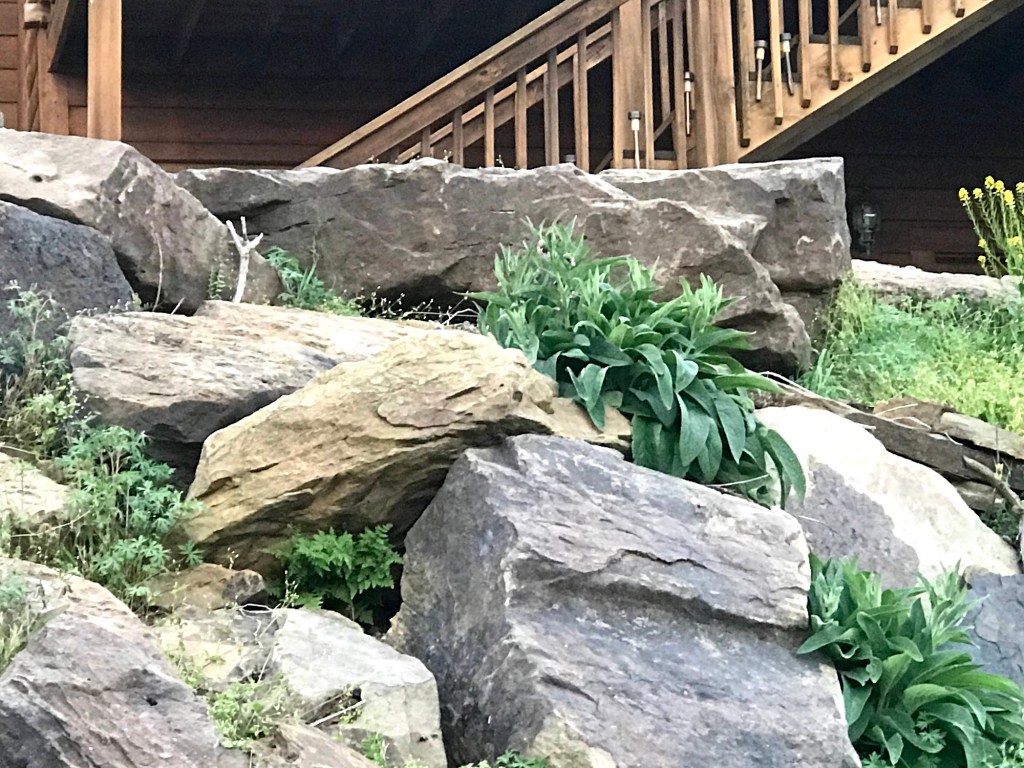
- Fill in the nooks and crannies of the rock cascade so snakes don’t have places to live. Read more: From Rock Pile to Rock Garden
A future owner may decide to move the big, leafy plants and the saved seeds down to what I call the butterfly garden, which is farther from the house, and keep the low herbs and bulbs up near the door. That choice will be theirs.
Why we’re telling you this
Every country property in the Ozarks has snakes, ticks, and chiggers. With a few changes to the land and a few daily habits, they are very manageable.
Related articles
How we wrote this together
This article was written together by Patricia, a resident of the Living Springs Log House, and Claude.ai, an AI assistant made by Anthropic. Patricia shared what life on the property is like and the natural, permaculture-based approach she wanted, and Claude researched the options and helped organize them into a practical guide.
A few insights
- The same simple change, keeping the area around the house sunny, open, and dry, discourages snakes, ticks, and chiggers all at once.
- The swallows and bats already living here are a big reason mosquitoes are scarce. Protecting wildlife can be the best pest control there is.
- Some popular “natural repellents” for snakes don’t hold up to research. Use your best judgement.
- Good habits, like a boot station by the door and a daily tick check, matter as much as anything you do to the land.
See more about the property at livingspringsloghouse.com.
This article shares my own experience and isn’t medical advice. Please make your own health decisions with whoever you trust.

