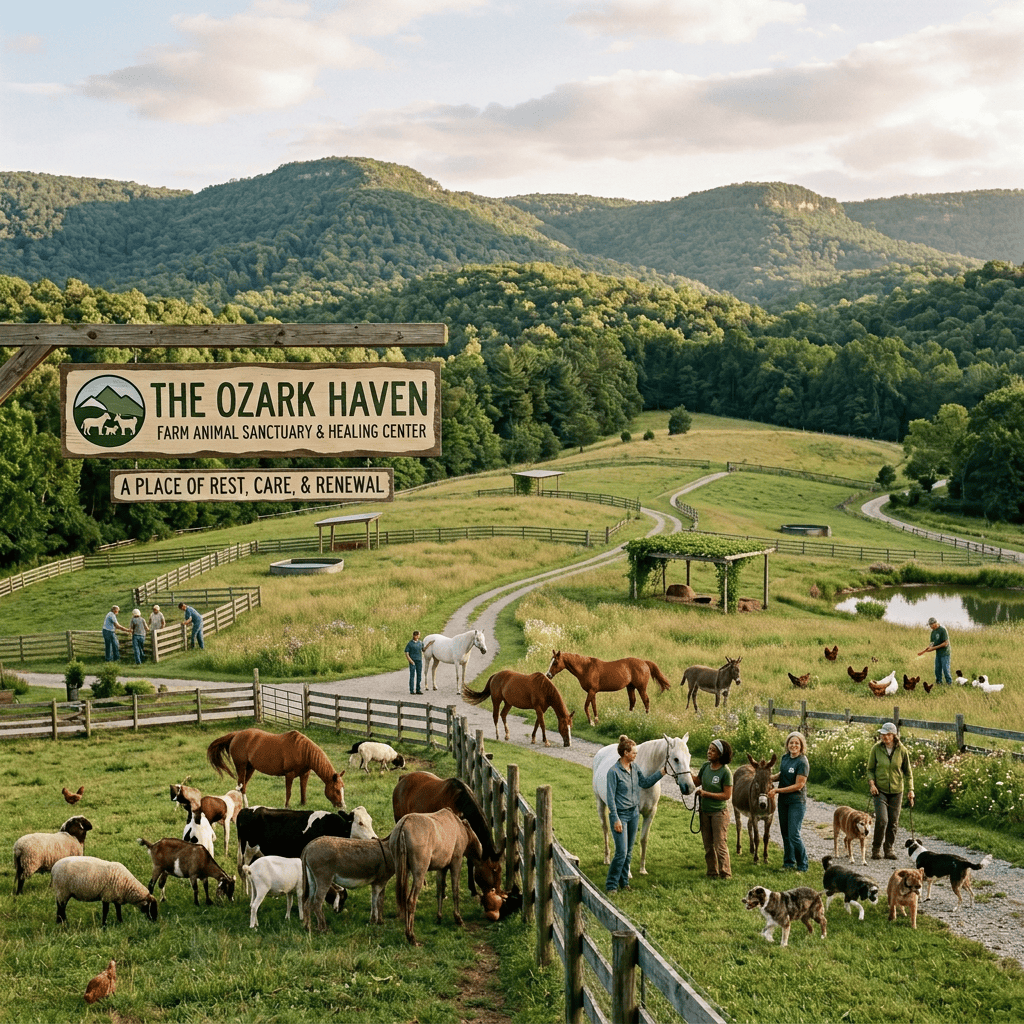
How to Create a Small Farm Animal Sanctuary
Claude.ai wrote this entire article for me. I hope it might help someone who wants to learn how to build a farm animal sanctuary, and it certainly will help me!
There is a special kind of peace in watching a rescued goat bask in the sun, a hen take her first dust bath, or a pig flop contentedly into a bed of straw. Farm animal sanctuaries offer animals who were never meant to be safe a place to live out their full, natural lives, and they invite people to see these animals as the individuals they are.
You don’t need hundreds of acres to make a difference. Many of the most meaningful sanctuaries begin small. Living Springs Log House, a 14.75-acre homestead near Huntsville in the Arkansas Ozarks, has many of the features a small to medium sanctuary needs. This guide walks through how to plan one wisely, drawing on the experience of established sanctuaries and sanctuary experts.
Start With the Right Size: Microsanctuary to Small Sanctuary
A microsanctuary is a small community of people and rescued animals living together, sometimes as few as one animal and one caregiver. Microsanctuaries can thrive in rural, suburban, or even urban settings, and they avoid many of the heavy demands of running a large sanctuary.
A small to medium sanctuary might care for a few dozen birds and a modest group of goats, sheep, or pigs, often with volunteers and visitors, and is usually organized as a nonprofit.
Sanctuary experts are united on one point: start small and grow as your resources, knowledge, and support grow. The Open Sanctuary Project calls this one of the best ways for a sanctuary to build a sustainable future. Sanctuaries close every year when founders take in more animals than they can care for, leaving animals worse off than before.
Step 1: Count the Cost
Before welcoming the first resident, think carefully about the lifelong commitment involved.
- Lifespans: Chickens can live around 10 years, cows around 20, and horses around 30. Each animal you accept is a commitment for their whole life.
- Daily care: Feeding, fresh water, health checks, and clean bedding happen every single day, in every season. Experts recommend that a qualified caregiver see each resident at least once a day.
- Money: Budget for feed, hay, bedding, fencing, shelter repairs, routine and emergency veterinary care, and a reserve fund for the unexpected.
- Your well-being: Sanctuary work is deeply rewarding, but caregivers face real risks of burnout and compassion fatigue. Plan for help and time off.
Best first step of all: volunteer or work at an established sanctuary, ideally for a year, to learn the daily realities firsthand.
Step 2: Choose Your Residents Wisely
On 14.75 acres, smaller animals make the most sense to start. Good candidates include:
- Chickens, ducks, and turkeys: They need little space, but they need excellent predator protection.
- Goats and sheep: Social, affectionate, and well suited to Ozark terrain. Goats in particular love to browse brush and woody plants. They might be a solution for clearing the land, which has grown up since we arrived nine years ago.
- Pigs: Intelligent and loving, but they need sturdy fencing, shade, and mud wallows, and some breeds grow very large.
- Donkeys: Gentle companions who can also help protect smaller animals from predators.
Large animals like cows and horses need much more pasture and much more expense, so most small sanctuaries take them only in limited numbers, if at all.
Step 3: Use What the Living Springs Log House Already Offers
Pure, gravity-fed spring water. Clean water every day is one of the most important needs of any sanctuary, and the property’s spring delivers water by gravity, which can keep flowing even during a power outage. Plan how to route it to troughs or waterers, keep lines from freezing in winter, and test the water regularly. The Arkansas Department of Health tests private water for bacteria for $17 a sample.
An insulated metal building. The metal building is insulated and has a woodstove. It could become a warm space for caregivers and volunteers and a feed and supply room. It isn’t a good home for the animals themselves, though. They would have to cross the driveway to reach it, and most animals don’t like being closed in a metal building with a concrete floor. Much of the land was cleared years ago and has grown up over the past nine years; it could be cleared and made into pasture again. We recommend building a barn out there, ideally near the pond site, though of course the new owners will decide where it goes. Important safety note: wherever hay and bedding are stored, keep them well separated from any woodstove, since fires where hay and bedding are stored are a serious danger.
A natural help for goats: sericea lespedeza. The property has sericea lespedeza, an invasive plant that’s hard to control. Goats happen to eat it far more readily than most other livestock. According to the University of Arkansas Cooperative Extension, this plant contains natural compounds called condensed tannins that reduce internal parasites in goats and sheep, including the barber pole worm, one of the biggest health threats to goats in warm climates. There are cautions: feeding it heavily for more than about six weeks can tie up minerals like zinc and selenium, experts suggest it make up no more than 60% of the diet, and most research has studied a specially bred grazing variety. Work with your veterinarian, but goats could help manage this plant while it helps them.
Housing for volunteers and guests. Volunteers are the heart of most sanctuaries. The property’s basement suite could house a live-in caregiver, an intern, or volunteers who stay overnight. The insulated metal building offers additional space, and the main log house, with its open, gathering-friendly layout, can welcome volunteer meals, workdays, and community events.
Spaces for visitors and education. An open lawn, a fire ring, and a deck overlooking the land make natural spaces for tours, open-house days, potlucks, and educational programs that help people meet animals as individuals.
Gardens. The established gardens can grow treats and greens for residents and food for volunteers.
Room for quarantine. New arrivals should be kept apart for a time to protect the health of the existing animals. A separate stall in the new barn, or a small shelter of its own nearby, could serve as a quarantine or recovery space.
Step 4: Build Safe Shelter and Fencing
For goats and sheep
- Indoor space: Sanctuaries recommend about 20 to 25 square feet of shelter per goat.
- Shelter: A solid, four-sided structure with good drainage, dry bedding such as straw, and protection from drafts while still allowing fresh air. A simple shed open to the south is a classic design for pasture goats.
- Outdoor space: Recommendations range from about 150 square feet per goat at minimum to half an acre per pair. Rotating among several pasture areas lets plants recover and reduces parasites.
- Climbing: Goats love to climb. Give them ramps, platforms, stumps, and sturdy bales.
- Fencing: Goats tend to crawl under fences rather than jump them, so keep the bottom wire close to the ground. One common design uses 4 to 5 strands of high-tensile electric wire at least 42 inches high, with wires spaced closer together near the bottom. Use heavy-duty gates with secure double latches.
- Hot weather: Ozark summers are humid. Provide shade, fans, and plenty of cool water.
For chickens, ducks, and other birds
- Predator-proof night housing is essential. Coyotes, raccoons, bobcats, foxes, weasels, hawks, owls, and roaming dogs all live in the Ozarks.
- Use hardware cloth, not chicken wire. Chicken wire keeps birds in but doesn’t keep predators out. Cover windows and vents with 1/4-inch or 1/2-inch hardware cloth, and protect against digging predators.
- Close birds in before dusk and let them out after dawn. Experts advise against relying on automatic doors.
- Safety and enrichment can go together: include perches, dust baths, and plants inside secure runs.
Guardians
Roaming dogs are often the most common threat to goats. Many farms and sanctuaries use guardian animals such as donkeys, llamas, or livestock guardian dog breeds, and bring animals into secure shelter at night.
Step 5: Line Up Veterinary Care First
Find a veterinarian who treats goats, sheep, pigs, and poultry before your first animal arrives. Many farm animals bred for agriculture have health problems created by that breeding, and not every vet is familiar with caring for them as lifelong companions. Ask about emergency availability, and plan how you’d transport animals in a crisis.
Step 6: Write Your Policies Before You Rescue
- Capacity: Decide how many residents you can truly care for, considering space, money, caregiver time, and quarantine room. Keep empty stalls for emergencies.
- Intake: Decide which species you’ll accept and how you’ll say no when you’re full. You can’t save every animal, and protecting the residents you have comes first.
- Emergencies: Make an evacuation plan for every resident, including trailers and a place to go, in case of fire, flood, or ice storm.
- Succession: Plan who will care for the animals if you can’t.
Step 7: Set Up Your Nonprofit (When You’re Ready)
A microsanctuary can be run privately. If you plan to accept donations and grow, a nonprofit structure helps.
- Incorporate as a nonprofit corporation with the Arkansas Secretary of State.
- Apply for 501(c)(3) status with the IRS so donations are tax-deductible.
- Charitable registration: Arkansas requires most charities to register with the Secretary of State before soliciting donations. There’s no fee. Very small, all-volunteer charities that don’t raise more than $25,000 a year may be exempt. Registered charities file an annual financial report by August 1.
- Build a board, written policies, and diverse funding sources. Individual donors provide most nonprofit funding, so plan for sponsorships, events, and monthly giving.
- Get insurance for visitors and volunteers.
Step 8: Check Local Rules
Madison County has historically had few rules for rural land, but the county has been discussing planning and zoning. Before you buy or build, ask the county whether any current or proposed rules affect keeping animals, hosting visitors, or running a nonprofit on rural land.
Step 9: Become Part of the Movement
Organizations like The Open Sanctuary Project, Microsanctuary.org, and the Global Federation of Animal Sanctuaries offer free guides, care standards, and community for new sanctuaries. As you grow, accreditation or verification through the Global Federation of Animal Sanctuaries can build trust with donors.
A Place Ready for Compassion
Living Springs Log House already offers what so many sanctuary founders search for: clean spring water, an insulated metal building for supplies and volunteers, land that was cleared years ago and could be made into pasture again with room for a barn, established gardens, room to house volunteers, open spaces for gathering, and a peaceful Ozark setting where animals and people can heal together. With careful planning and a heart for animals, this could be the beginning of a sanctuary that changes lives, one rescued animal at a time.
This article is general information, not veterinary, legal, or tax advice. Consult a veterinarian experienced with farmed animals, an attorney or accountant familiar with nonprofits, and Madison County officials before starting a sanctuary.
A Few Insights
- Starting small and growing slowly is the surest way to keep a sanctuary going for the long haul.
- The metal building is best used to support the work: supplies, feed, and a warm place for people. The animals belong in a barn out where a pasture can be made again.
- Lining up a vet, written policies, and an evacuation plan before the first rescue protects every resident who comes later.
This article was written by Patricia Mikkelson, a resident of Living Springs Log House and friend of its owner, in collaboration with Claude.ai of Anthropic. Patricia brought her vision and love for animals; Claude helped with research and shaping the words.
Sources
- So, You Want To Start A Farmed Animal Sanctuary, The Open Sanctuary Project
- Determining Your Animal Sanctuary’s Capacity for Responsible Care, The Open Sanctuary Project
- “So You Want to Start a Sanctuary” Brochure, The Open Sanctuary Project
- Building a Good Home for Your Goats, The Open Sanctuary Project
- Predator Protection for Domestic Birds, Microsanctuary.org
- Starting a Sanctuary, Kim Sturla, Animal Place (Global Federation of Animal Sanctuaries)
- Shelter, Fencing and Predator Control Needs on Pasture, Langston University
- Sericea Lespedeza, University of Arkansas Cooperative Extension
- Charitable Registration in Arkansas, Arkansas Secretary of State
- Water Microbiology Laboratory, Arkansas Department of Health
Written with the help of Claude.ai, an AI assistant made by Anthropic.


[…] more: A Farm Animal Sanctuary Already Written Into the Property, From Dream to Sanctuary, From Cedar Thicket to Sanctuary Pasture, and Water and Shelter for a Sanctuary […]
LikeLike
[…] more: A Farm Animal Sanctuary Already Written Into the Property, From Dream to Sanctuary, From Cedar Thicket to Sanctuary Pasture, and Water and Shelter for a Sanctuary […]
LikeLike
[…] From Dream to Sanctuary: Creating a Farm Animal Sanctuary at Living Springs Log House […]
LikeLike
[…] From Dream to Sanctuary: Creating a Farm Animal Sanctuary at Living Springs Log House […]
LikeLike