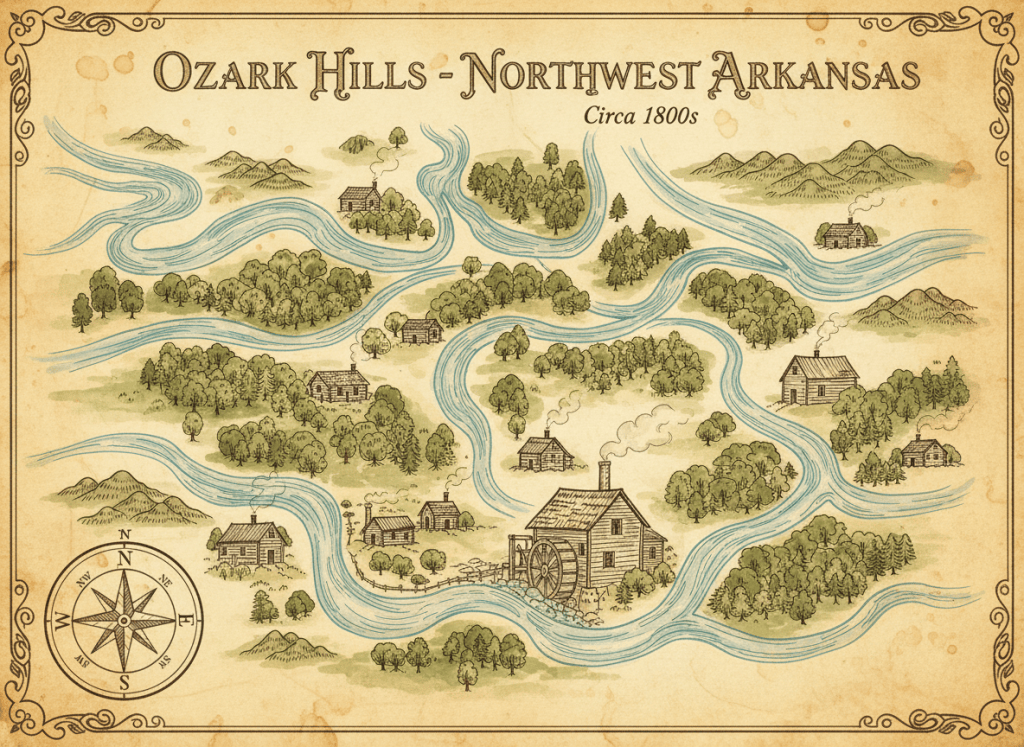
People sometimes ask what it’s really like to live out here in Madison County. Madison County has had a bad reputation in a lot of ways. But I am not going to focus on that, because I believe things are changing! So here it is, from someone who has had a home here for almost two decades. This last decade is when I really got to know the area best, since before that I was mostly working in Fayetteville and living there at times. I’m glad to set down roots now. I feel at home here.
When I go to town and shop, I just have a blast. I love chatting with the cashiers, and I often meet people I know. I prefer not to shop at Walmart, but it is the place where most of my needs are met at a reasonable price. The staff there are as friendly as can be! I like the local Harps as well. It has some items I can’t get at Walmart, like healthy kimchi and natural apple cider. The Pantry has great stuff too. Owned by Mennonites, with most of the staff going to the same local church, it is a super friendly, clean, and efficient place to shop for healthy foods and other products.
Huntsville and Kingston aren’t perfect. No place is. But they are full of people who show up for each other, and there’s a lot of good growing here.
The Land and the People
Madison County is big, rural, and beautiful — rolling Ozark hills with beautiful forests, creeks, wildflowers lining even the highways, hayfields, and long gravel roads. Huntsville, the county seat, is 25 minutes away, and Kingston is a small community tucked into the hills to the east, only ten minutes away.
What strikes most newcomers first is how friendly people are. Folks wave from their trucks. Strangers chat in the checkout line. If your car breaks down on a county road, someone will likely stop. I’ve had that happen at least four times that I can remember. Yes, I had an old car that often had problems!
Our Mennonite neighbors add something special to the area. They are known for hard work, simple living, skilled hands, and good food. Their quiet example of neighbors helping neighbors is part of what makes this place feel grounded. I attend their yearly Thanksgiving feast, always held in the evening a week before Thanksgiving, where hundreds of locals show up for a huge potluck, with a cappella singing afterward. My son, his wife, and their kids always show up, along with my son’s in-laws!
And yes, there are lots of churches. This is the Bible Belt. But whatever your faith or background, you’ll find that people here are mostly just kind. Even visiting the post office and the county courthouse is enriching!
A Little History: Why They Call It “Booger County”
When I researched this article, it hit me hard. I knew Madison County and even Northwest Arkansas had some hard history. Now I have some facts to share that are tragic. Bear with me — I know this article is long. But perhaps knowing all this will help you pray with me.
Madison County has an old nickname: Booger County. Nobody knows for sure where it came from. Some say the land and the people were rough as an old booger. Others say “booger” means boogeyman, after the ghost stories told about our secluded hollows. Either way, the name has stuck with a wink and a smile.
The county’s story goes back a long way. This was once Osage hunting ground. Madison County was formed in 1836, a few months after Arkansas became a state, and settlers from Madison County, Alabama, named it, along with our county seat, Huntsville. Just two years later, about 1,200 Cherokee and enslaved people passed through Huntsville on the Trail of Tears.
The Civil War left deep scars here. Isaac Murphy of Madison County was the only delegate at Arkansas’s Secession Convention to vote against leaving the Union, and he later became the state’s first Reconstruction governor. Loyalties in the county were divided, guerrillas roamed the hills, many lives were lost, and the town’s economy was all but destroyed. The first courthouse and much of Huntsville burned.
One of the darkest days came on January 10, 1863. Nine local men were taken from a guardhouse to a field about a mile northeast of town and shot by Union soldiers. One survived. To this day, no one knows exactly why. The commanding officer was arrested, but the charges were later dropped. It’s known as the Huntsville Massacre, and most of the men were buried here in Huntsville.
It’s a hard history, but an honest one. Knowing it helps us understand the deep roots, independence, and toughness of the people who still call these hills home.
A Community That Feeds Its Own
One of the things that touches me most about Madison County is how people take care of each other. There are lots of food pantries here, and around Thanksgiving and Christmas the help really pours in — meals, food boxes, gifts, and so many services for families who need a hand. Churches, volunteers, and local groups all pitch in. There are an increasing number of recovery support groups, mostly at churches.
In a county that isn’t wealthy, that generosity says everything.
Open Arms at the Old Skating Rink — Many locals still remember the Great Adventure Skating Rink on West Street. Decades ago, my now-grown children attended a weekly homeschooling group there. When they were in their teens, the Christian youth group they belonged to took over leadership of a Friday night event that served kids ages 5 to 12, many of them at risk. Now most of those youth group members are married and have children of their own — too busy to volunteer right now.
Today that much-loved building is home to Open Arms, a Christian ministry that runs a food pantry and a pregnancy center under one roof. The pantry serves families across Madison County with USDA commodities and emergency food, and the pregnancy center offers support, resources, and a warm, welcoming family room for mothers and families. It’s a wonderful example of an old community gathering place continuing to serve.
Growing Things Together
If you love to garden, you’ll find your people here.
Master Gardeners — Madison County has an active Master Gardener group. They share know-how, beautify public spaces, and are always happy to talk soil, seeds, and what’s blooming. A yearly plant sale raises money for local charities, and it is a sight to behold. Their Facebook page is full of great resources. You will find native plants at many of the government buildings and offices, which are overseen by the Master Gardeners.
The Yearly Seed Swap — Every year, gardeners gather to trade seeds, stories, and advice. It’s one of those events that tells you a lot about a community: people giving freely what they’ve grown.
The Farmers Market — Huntsville’s farmers market is active and lively. Local produce, homemade goods, plants, and the chance to meet the people who grew your food. It has kept growing since it almost died about five years ago.
Places That Make a Town Feel Like Home
The Kingston Fair on the Square — Kingston’s fair on its historic square is a highlight of the year. It’s small-town gathering at its best: neighbors, music, food, and handmade things.
The Pantry — A local favorite, the kind of place where you run in for one thing and leave with three things and a conversation.
Madison County Recycling Center — This one makes me proud. The Madison County Recycling Center in Huntsville has long called itself Arkansas’ original resource recovery park, and it’s an award winner. The Arc of Madison County has run recycling and paper-shredding businesses that have employed over 100 people with disabilities. That’s recycling with a heart.
A Wonderful Facebook Group — Our local community Facebook group is one of the best I’ve seen anywhere. The admin takes such good care of it — keeping it helpful, kind, and useful. Lost dogs get found, questions get answered, and neighbors stay connected.
The Basham Community Center and Activity Center
When folks around here talk about the “new community center,” they’re usually pointing to the Basham Community Center right in downtown Huntsville. Seeing that historic downtown building brought back to life as a vibrant civic space gives me a lot of hope. I know that a good community center where people can gather makes a huge difference in how people can get involved to make their town and county a better place. I hope to host some networking events I call “Community Connect!” at some point when I have more time.
Through local partnerships and support, the building was restored and updated with state-of-the-art teleconferencing and audio-visual equipment. In fact, it was the first public space in our area specifically set up for hybrid meetings and community events — an effort that even earned Huntsville an Arkansas Business Trendsetter City Award. It’s a great place for local gatherings, classes, and civic events, and it really shows that people here are committed to investing in our town’s future.
For larger sports events, youth activities, and district gatherings, we also rely on the Huntsville Activity Center. It’s a massive 54,000-square-foot facility built to host school athletics and bring the broader community together under one roof.
Not Perfect, But Working on It
Fewer restrictions. Madison County doesn’t have a lot of rules about what you can do with your land. That can be wonderful — freedom to build, grow, and live the way you want. It can also mean your neighbor can do things you don’t love. It cuts both ways.
Small-town history. Like a lot of small towns, we’ve had our share of the “good old boy” ways and local politics that weren’t always clean. But I’ve watched people step up to change that.
The schools. Kingston’s school district has a good reputation, and many families choose it. Huntsville went through a very hard time. In 2021, a scandal broke over sexual abuse among boys on the junior high basketball team, and the school board’s handling of it angered many families. But the community responded. In 2022, seventeen candidates ran for seven school board seats, and many said the scandal was part of why they ran. In the end, six new members were elected to the seven-member board. Many people feel the district is in a better place now because ordinary folks got involved.
That’s the lesson I want to leave you with.
Our County Newspaper: The Madison County Record
These days, many rural counties have lost their local newspapers entirely. Madison County still has one, and it’s a remarkable one. The Madison County Record has been publishing local news since 1879, and it’s one of the largest weekly papers in Arkansas. It even has a colorful past: former Governor Orval Faubus once co-owned and edited it with his first wife, Alta, who went on to run the paper for more than 50 years.
Like any newspaper, the Record has its leanings. I’ve sometimes felt its point of view tilts more to the left than many of its readers. But I can forgive a paper for its imperfections when it does what the Record did for our community.
When parents became worried that the school district would not be open about its review of the junior high basketball scandal, they shared documents with the Record’s staff. The paper’s small team, led by then-publisher Ellen Kreth and general manager Shannon Hahn, kept digging and reporting despite facing court challenges and harsh criticism from school officials.
Their work was honored nationally. The Record won the Taylor Family Award for Fairness in Journalism from the Nieman Foundation at Harvard, beating out much larger finalists, including The Washington Post and Miami Herald/ProPublica. It also won the Tom and Pat Gish Award for courage, integrity, and tenacity in rural journalism. One judge noted that the paper clearly lacked the resources for such an investigation, and did it anyway.
Without that reporting, many of the facts might never have come to light. That’s what a local newspaper is for. Subscribe, read it, write letters to the editor, and disagree when you disagree. A town that reads its own paper is a town that can hold its leaders accountable.
Come On In — and Get Involved
If you move here, don’t just watch from the sidelines. Go to a school board meeting. Attend city council. Run for something. Volunteer at a food pantry during the holidays, join the Master Gardeners, or show up at the seed swap and the Kingston fair.
Being involved in local politics isn’t about picking a side — it’s about caring for the place you live. In a small town, one person really can make a difference. We’ve seen it happen.
Huntsville and Kingston have room for people who want to roll up their sleeves and help make a good place even better. Come on in.
How We Wrote This Together
This article was written collaboratively by Patricia, a friend of Barbara’s and a resident of the Living Springs Log House near Huntsville, and Claude.ai, an AI assistant made by Anthropic. Patricia shared what she loves about the area and what she has seen over the years. Claude checked facts where it could and helped shape her thoughts into an article.
A Few Insights
- The school story is really a story about citizens. The biggest change came because ordinary people ran for office and voted — and because a small local newspaper kept asking questions.
- You don’t have to agree with your newspaper to value it. A paper with a point of view can still do the hard, fair reporting a community needs.
- Generosity is a measure of a place. All the food pantries and holiday help in a rural county say more than any statistic.
- Community shows up in small things. A skating rink with a mission, a seed swap, a fair on the square, and a recycling center that employs people with disabilities tell you who a town really is.
- History shapes character. A county that came through war, division, and hardship still carries an independent, self-reliant spirit.


[…] the Northwest Arkansas metro area; 25 minutes to hardware stores, lumber, and groceries. Read more: Huntsville and Kingston, Arkansas, Care Within Reach, Natural Healing in Northwest Arkansas, and Homeschooling in the Arkansas […]
LikeLike