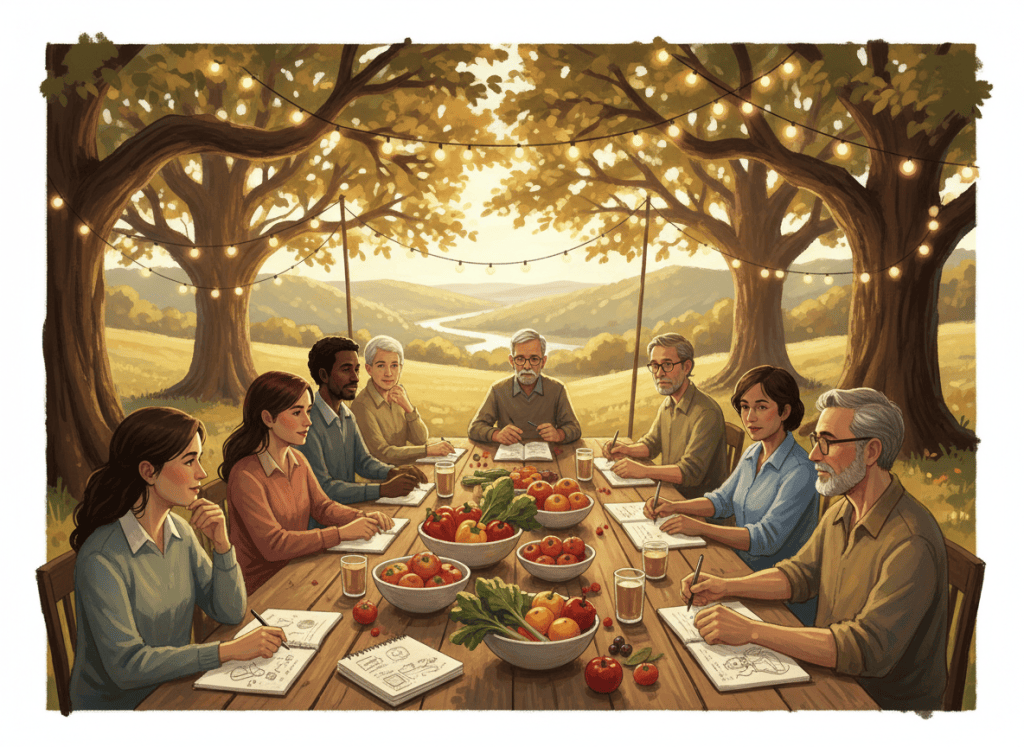
Most of us came to animal rights alone. We saw something we couldn’t unsee, and we changed our lives, often while the people around us didn’t. We found each other at marches, vigils, online groups, and sanctuaries. Then we went home to lives that didn’t reflect what we believe.
Around the world, a quiet movement is trying to change that. People who care deeply about animals, the earth, and each other are asking a bold question: What if we didn’t just live vegan as individuals, but built whole communities around compassion?
What Is a Vegan Village?
A vegan village is an intentional community built on the belief that all beings deserve to be safe, happy, and free. No two look the same, but most share a few things:
- A sanctuary at the center. Rescued animals live out their lives in peace, and caring for them becomes part of daily life.
- Shared land and shared work. Gardens and chores are tended together, so no one carries the whole load alone.
- Food grown with care. Many vegan villages grow their own food veganically, without animal-based fertilizers.
- Healing and learning. Retreats, workshops, and “earth schools” help people reconnect with nature and with themselves.
- Living close to the land. Water, gardens, and simple living matter more than square footage.
Dreamers Around the World
One inspiring example is Kris, who shares his journey on Instagram and on his YouTube channel, Art of Healing Earth. He’s building a vegan village, animal sanctuary, retreat space, and Earth School in Costa Rica. His videos follow it all from the start: buying a van, driving from Canada to Costa Rica, searching for land, and building from scratch. Anyone who has tried to start a community knows how messy that middle stretch can be.
Peacebird in Ontario began as a farm sanctuary in 2005 and has been growing into a vegan intentional community, a sanctuary becoming a village. On community forums and in the Foundation for Intentional Community’s directory, vegans across the country are looking for land and for each other.
The longing is real and widespread. The hardest part usually isn’t the vision. It’s the land, the water, and the years it takes to build basic infrastructure before the first animal arrives or the first garden is planted.
The Vision: The Ozarks Vegan Think Tank
Here in the Ozarks near Huntsville, Arkansas, this is the dream I hold for the Living Springs Log House: animal rights activists living together on the land and creating three things.
- A sanctuary where rescued animals live out their lives and can be adopted, starting small and growing over time.
- A new animal rights organization, centered on community, modeled in part on the UK’s Animal Think Tank, and designed by the people who live it.
- A living example: gardening, cooking, caring for animals, podcasting and writing, and showing the world that a compassionate life is joyful, practical, and possible.
My hope is that this could be a pilot, and that if it works here, it could be repeated as a Vegan Think Tank in city after city.
Why Community Is the Missing Piece
Activists burn out when they carry this work alone. In community the work is shared, the grief is held, and the joy is multiplied. The foundation is a simple idea I call Community Connect: people building bonds around shared values, with integrity, respect, and compassion at the center.
There’s a larger reason too. Research on social change suggests that when a committed minority reaches about 10 percent of a population, its ideas can spread into the mainstream. The vegan movement doesn’t only need more arguments. It needs visible proof that this way of life works. Every household where it’s simply working brings us closer to that tipping point.
Co-Living: The Practical Way to Begin
Big dreams of community often stall because they try to do everything at once: buy land together, write bylaws, and agree on every decision before anyone has even shared a kitchen. Many forming communities never make it past that stage.
Co-living offers a simpler, proven way to start. It’s already an established model across the country, and it works because it’s practical:
- Everyone has their own room or suite, and shares the kitchen, common rooms, gardens, and land.
- Costs are shared. Each person pays rent for their own space, so living here costs each person much less than owning a home alone, and the rent covers the property’s costs.
- Clear written agreements are signed before anyone moves in, so everyone knows what to expect.
- Daily life runs on simple routines: a weekly house meeting, rotating chores, and shared meals. Sober living homes have used this kind of structure successfully for decades.
- Live together first, then govern together. People get to know one another and build trust under simple, clear leadership. Over time, decision-making can widen until the members themselves help guide the community’s future.
For vegans, co-living can also fit modern life. Many people now work remotely, so a podcaster, a writer, or an online worker can live on the land while keeping their income.
I’ve put together a handbook that lays out how a vegan co-living home here could run day to day, from house rules and shared decision-making to growing into a land trust. You can read it here: Vegan Co-Living Handbook
Why This Place Is Made for Co-Living
The Living Springs Log House already has the bones co-living needs. The large log house has spacious bedrooms, a big kitchen and dining area for shared meals, and a walk-out basement suite with its own separate entrance. The 40 x 60 foot metal building offers room for more living space, a common kitchen, or gathering space. There’s land for individual and shared gardens, and room to grow.
A Sanctuary That Can Pay Its Own Way
Many sanctuaries struggle because they depend entirely on donations. But a sanctuary on land like this can be designed to earn its own income, and even turn a profit, while the animals remain the heart of it. Some of the ways it could earn:
- Guest rooms and overnight stays, including space in the metal building, for visitors and volunteers
- Tours and visits, so people can meet the animals and see the gardens
- Sponsor-an-animal programs and memberships, which help cover care costs month by month
- Events, workshops, and retreats, in the metal building or near the cave spring
- Produce from the gardens, to feed residents and guests and share the surplus
The sanctuary itself could be a nonprofit, while the guest stays, events, and other income-producing activities are run as a business that supports it. Or it could all be one mission-driven business. An attorney and an accountant should help design the right structure, and some uses, like guest lodging, may need permits. But nothing about a sanctuary requires it to lose money when the land around it is working.
You can read more here: A Farm Animal Sanctuary Already Written Into the Living Springs Log House Property
What If the Hardest Part Were Already Done?
The Living Springs Log House already has much of what a vegan village needs:
- 14.75 acres of Ozark land
- A cave spring that has fed the household’s two cisterns for the nine years it has been observed. They have always had water, except when there was a mechanical problem or a hose was left running.
- A metal building for feed, supplies, volunteers, and gatherings. Nearby is land that was cleared years ago and has grown up over the past nine years. It could be cleared and made into pasture again, with a barn where the animals can live. (The metal building itself isn’t a good home for animals: they would have to cross the driveway to reach it, and most animals don’t like being closed in a metal building with a concrete floor.)
- Established gardens, so no one starts from bare dirt
- Quiet and distance from the pace of the city, the kind of place where people and animals can heal
For someone like Kris, building from zero is part of the adventure. For people who want to begin now, starting with water, buildings, and growing ground already in place can make the difference between a dream and a working community.
Room to Grow: The 40 Acres Next Door
Right alongside the Living Springs Log House property, 40 more acres are for sale. For a buyer with a larger vision, the two pieces of land together would offer more than 54 acres, with room for a bigger sanctuary, more homes, more gardens, and one day perhaps a hiking trail connecting it all.
The 40 acres don’t have to come first. The log house land can be where things begin, with the neighboring land joining later as the community grows. You can read more here: An Adjacent Property is for Sale!
What We’re Looking For
Barbara, who owns the property, is looking for someone who shares this vision to buy the land and make it their own. It isn’t a partnership or an investment arrangement. It’s a sale to a buyer who wants to carry the mission forward.
Here is where I come in. I’ve been vegetarian since I was 17 and vegan for the past decade, and I’ve spent much of my life learning about and living in intentional community. I’d be glad to offer my help as an on-site manager, getting the co-living home, the sanctuary, and the gardens up and running. I’m not attached to living in the house. I plan to live in my van, so I wouldn’t take up a room. I can simply be support.
Neighbors in a Larger Vision
I also have my own land nearby, which I call All Beings Sanctuary. One day I hope it will become a vegan village too. You can read about it at wellspringcommunityblog.wordpress.com.
So the main thing I hope for is simple: that whoever comes to the Living Springs Log House and I can be neighbors, or work together in whatever way feels right. Two places of compassion close together could support each other, share work and ideas, and show more people that this way of living is possible.
A Few Insights
- The vision is rarely the hard part. Infrastructure is. Most vegan village dreamers already know why they want to build. What slows them down is water, shelter, and land.
- Practical beats perfect. Co-living lets people start living their values right away, and grow into something larger, instead of waiting years to agree on everything.
- The animals are the mission, and the income keeps the mission alive. A sanctuary that plans its income from the start is a sanctuary that is still open in ten years.
- The strongest argument for veganism may not be an argument at all. It may be a household where it’s simply working.
- Villages grow best near other villages. One place of compassion is a start. Two nearby, cooperating as neighbors, begin to look like a movement.
Come See It
If this speaks to you, as a buyer who shares the mission, a future neighbor, or someone who knows the right person, I’d love to hear from you. A text is the best way to reach me.
Patricia Mikkelson · (479) 313-0414
See the spring, the gardens, the metal building, and the land at livingspringsloghouse.com
How we wrote this together: This article was written collaboratively by Patricia Mikkelson, a friend of Barbara Hulley’s and a resident of the Living Springs Log House, and Claude.ai of Anthropic. Patricia brought decades of vegan living and community experience, her knowledge of the land, and the ideas from her earlier articles on co-living and sanctuaries. Claude helped research other vegan village projects and bring several pieces together into one. One insight stood out as we worked: co-living, sanctuary, and vegan village aren’t three separate ideas. They’re one idea at different sizes: beings sharing land, water, and shelter, with no one used up. Whether it’s Costa Rica, Ontario, or the Ozarks, people are describing the same dream. What changes is the starting point.
Written with the help of Claude.ai, an AI assistant made by Anthropic.


[…] more: The Ozarks Vegan Think Tank and The Vegan […]
LikeLike
[…] more: The Ozarks Vegan Think Tank, The Vegan Village, and An Adjacent Property is for […]
LikeLike
[…] more: The Ozarks Vegan Think Tank, The Vegan Village, and An Adjacent Property is for […]
LikeLike
[…] The Ozarks Vegan Think Tank: A Vegan Village That Doesn’t Have to Start From Zero […]
LikeLike