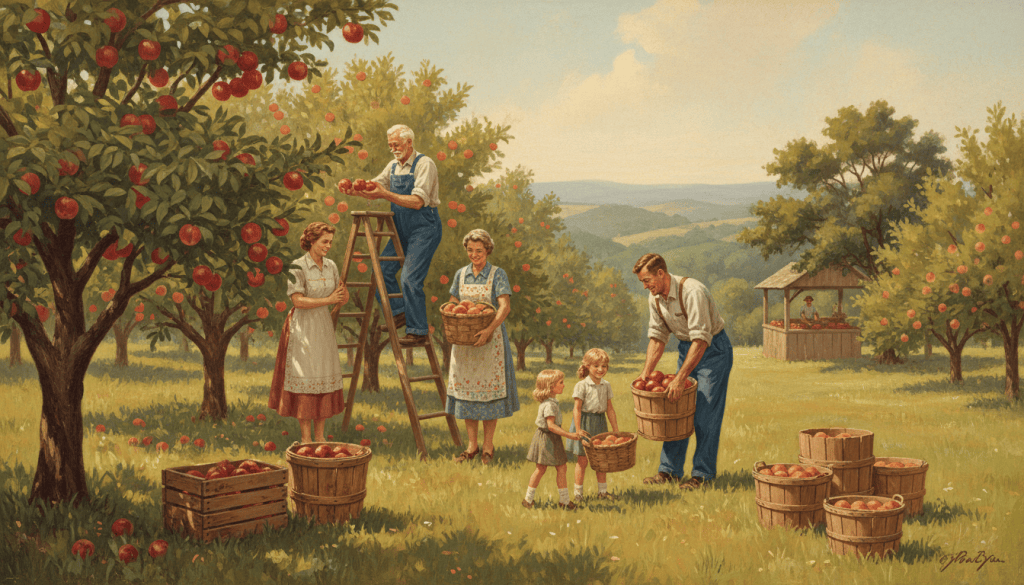
A century of fruit, family, and neighbors who showed up: the Edward Gay Family Farm in Springdale
By Patricia Mikkelson
Drive east on Robinson Avenue in Springdale and you pass the kind of Northwest Arkansas that is changing fast: new rooftops, new roads, new traffic lights. Then, almost like a door opening into an older room, there are fruit trees. Rows of them. A farm stand. A family that has been growing food on the same ground for more than one hundred years.
The Edward Gay Family Farm was here before most of the streets around it had names. In a real sense, Springdale grew up around this orchard, not the other way around. I want to tell you about this place, because it is one of the quiet treasures of our region, and because its story says something important about who we are as neighbors.
What a century farm actually holds
A hundred-year-old farm is more than old trees. It holds knowledge you cannot buy: which corner of the field frosts first, which variety still bears in a dry year, how the soil smells when it is ready to work. That knowledge is passed hand to hand, generation to generation. The Gay family is multigenerational in the truest sense, with Edward and his wife still living, and children and grandchildren carrying the work forward, including a grandson who is ready to take up the torch.
Northwest Arkansas was once serious apple country. In the early 1900s, orchards covered these hills, and the Arkansas Black apple was a point of regional pride. Drought, disease, and the Depression took most of those orchards away. The ones that remain, like the Gay farm, are living links to that history, and they are rarer every year.
The day the community stood up
Places like this do not survive by accident. Some years ago, the farm faced a serious threat. The Springdale School District moved toward using eminent domain to take the Gay property. Eminent domain is the legal power of a government body to take private land for public use, with payment, even when the owner does not want to sell. It is lawful, and sometimes it is necessary. But it is also a blunt instrument, and when it is aimed at a century-old family farm, the cost cannot be measured only in dollars.
It started with a conversation. A client of mine told me about the Gay family’s trouble and gave me the number of someone who was worried about it. A few of us who cared decided to meet at the library for a strategic planning session. We brainstormed how to move forward, made a plan, and invited the press. The news carried our decision: we would pack the school board meeting, which was the very next day.
And we did. The room was full. One after another, people stood up and spoke about what the orchard meant to them, to their families, and to Springdale.
And the board listened. The decision was overturned, and the orchard stayed with the family who had tended it for generations.
My role was simple to describe, if not to do. There was so much love and concern for this orchard scattered across our community. I took all of that energy and focused it, getting people together in the same room, at the same time, with a clear plan. It worked.
The miracle is how fast it happened. From the first phone call to the board’s reversal, the whole effort lasted about ten days. That was all the time I had to give, and it was enough, because when one person is free to focus and coordinate, scattered good will becomes a force. That makes all the difference.
Even the timing was a gift. During exactly those ten days, my husband and my daughter were out of town visiting relatives, so I had the rare freedom to give this my full attention. I shared that with Ryan’s mother recently at the farm stand. She smiled and said that God can work through us if we listen, but we need to listen. Then she gave me a hug.
I share this not to take credit. The real credit belongs to the Gay family for their steadiness, and to every person who took an evening away from home to stand up and speak. I share it because it is a lesson worth passing on: ordinary people, organized and respectful and persistent, can change an outcome. If a place you love is ever threatened, you are not powerless. Find each other. Learn the process. Show up.
Why local produce matters
When you buy fruit from a farm like the Gays’, a few good things happen at once:
- It is fresher. Fruit picked ripe and sold nearby has not spent a week on a truck.
- Your money stays home. Dollars spent at a local farm stand support local families rather than distant shareholders.
- Farmland stays farmland. A farm that can pay its way is a farm that does not have to be sold to developers.
- You learn the seasons. Local produce teaches children (and grown-ups) that food comes from somewhere, and that each fruit has its time.
A dream for the next hundred years
The next generation is already here. Edward’s grandson, Ryan, is a college senior about to graduate, and he is ready to help the orchard and the family business thrive. He is full of ideas, and his mother, who is at the stand as always, is so proud of him. I met him at the farm stand not long ago and told him the story of the day the community packed the school board meeting. When I finished, he gave me a big hug. That hug told me a great deal about this family’s future.
When I think about what that future could hold, I get excited. These are my own hopes, offered with love and with full respect for the family’s choices. Here is what I would love to see:
A centennial celebration. A hundred years of growing food in one place deserves a party: a harvest day with music, family stories, old photographs, and the whole region invited to say thank you.
Hugelkultur beds. Hugelkultur (a German word meaning “hill culture”) is an old method of building raised beds over buried logs and branches. As the wood slowly breaks down, it holds water like a sponge and feeds the soil for years. Fruit trees thrive in hugelkultur beds, which makes this a natural fit for an orchard: prunings and fallen limbs become the foundation for a new generation of fruit trees.
Food forests. A food forest is an orchard designed to work more like a natural woodland, with layers of fruit and nut trees, berry bushes, herbs, and ground covers all supporting one another. Built on hugelkultur beds, a food forest holds moisture deep in the soil, which helps it resist drought through our hot Arkansas summers. And more growing layers means more food to sell at the stand.
Fruit spreads without refined sugar. Jams and jellies sweetened with fruit itself, or with dates or apple juice concentrate, and set with pectin or chia seed, let the fruit shine and are a healthier treat. They would make beautiful gifts and a lovely product for the farm stand.
A community lunch counter. Imagine a lunch counter that is more than a place to eat: a true community gathering place, with bulletin boards for local news and events, board games on the tables, and planned activities that bring neighbors together. On the menu, plant-based options and healthy food made from what grows right there, such as apple and greens salads, vegetable soups, and fruit crisps. More and more people are looking for wholesome food, and a farm is the most natural place in the world to find it.
Interns and learning days. Young people interested in farming need places to learn by doing. Seasonal internships, school visits, and “know your local produce” days could help raise the next generation of growers in Northwest Arkansas.
How you can help
- Visit the farm stand and buy your fruit and produce there. The farm is at 4737 E. Robinson Avenue in Springdale.
- Tell a friend. Word of mouth is still the best advertising a family farm can have.
- Bring your children or grandchildren and let them see where food comes from.
- If you have skills to offer, whether carpentry, gardening, cooking, or event planning, ask the family how you might help.
A gift to all of us
The Gay family has cared for their land for over a century, right in the middle of one of the fastest-growing regions in the country. Their orchard is a gift to Northwest Arkansas. Let’s make sure it is still blooming for the next hundred years.
The same hope is close to my own heart. I live at Living Springs Log House, a 14.75-acre homestead in Madison County, and the land is now for sale. Watching the Gay family’s story unfold, I can’t help dreaming of a similar future here: a long-term project where all life can thrive. I picture a farm animal sanctuary where rescued animals live out their days in peace, gardens and fruit trees that feed the people who tend them, and one family, or several families, building this land to its full potential across generations.
A place like that is not built in a season. It is built by people who stay, who learn the land, and who hand it on in better shape than they found it. That is what the Gay family has done for a hundred years, and it is what I hope the next stewards of the Living Springs Log House will do too.
Read more about land, homesteading, and rural life in the Ozarks at www.livingspringsloghouse.com.
This article was written by Patricia Mikkelson with the help of Claude.ai, an AI writing assistant created by Anthropic.

