Part 9 of the Living Springs Log House Improvement Checklist
In short: Some of the log house’s cypress siding boards are starting to warp, and spare siding is already stored in the garage. An expert recommended replacing the warped piece, caulking all the siding, re-staining with a better stain, and reaching the high places. This article explains each step.
These are suggestions, not professional advice. Click here to read the full note.
The repairs and improvements described here are our best understanding from research and our own experience living on the property. We are not contractors, engineers, or licensed inspectors, and these may not be the best or only solutions. Before starting any repair or project, please consult a qualified professional, such as a contractor, drainage specialist, or home inspector, who can look at the site in person.
An expert looked at the outside of the log house and found that some siding boards are starting to warp and bend outward. A warped board opens a gap, and gaps let moisture in. He recommended replacing the warped piece, caulking all of the siding, using a better stain, and reaching the high places that haven’t been re-stained because they’re too hard to get to.
There’s good news for the first job: replacement siding is already here, stored under the stairs in the garage.
Is It Really a Log Home?
Yes, in part. The Living Springs Log House is a hybrid log home. The living room and master bedroom have solid cypress log walls, while the rest of the house, including the upstairs and the basement, is conventionally framed with sheetrock inside and siding outside. Many log homes are built this way, with logs where people gather most and framing elsewhere. The siding on the framed sections is what needs the care described below.
How Long Does Cypress Last?
Cypress has been prized for centuries because it resists rot. Its heartwood, the darker inner wood, contains natural oils that help it stand up to decay and insects. Even unfinished, cypress siding is often expected to last roughly 25 to 40 years. Kept sealed, fastened tight, and dry, it can last far longer.
Why Boards Warp
Wood swells when it gets wet and shrinks as it dries. Over the years, especially once the stain wears thin, that back-and-forth can twist a board out of shape. Warping usually starts where water collects most: at corners, where the siding meets the roofline, around windows and doors, and near the bottom of the walls where rain splashes up.
Replacing and Re-Fastening Boards
- Find the water source first. Look for missing caulk, worn stain, or water running down from the roof or a gutter. Otherwise the new board will warp too.
- Check for rot. Press a screwdriver into the boards near the warped one, especially at the bottom and ends. Wood that’s soft should be replaced too.
- Replace the warped piece with a board from the garage. Check that its profile matches, and stain it before putting it up so it blends in and is protected on every side.
- Re-fasten boards that have pulled away with stainless steel screws (or hot-dipped galvanized) driven into the wall framing. Plain steel rusts and leaves dark streaks on cypress. Pre-drill near the edges so the wood doesn’t split, and drive screws snug but not so tight they crush the wood.
Caulking the Gaps
The expert recommended caulking all of the siding, not just the worst spots, so this is a whole-house job. For gaps about ⅛ inch or wider, press foam backer rod into the gap first, then apply a flexible caulk made for log homes, which stretches as the wood moves. Narrower cracks are too thin to hold caulk, so brush sealer into them instead. Work wall by wall, paying special attention to board ends, corners, and the edges around windows, doors, and the roofline.
Re-Staining
A good stain is the siding’s raincoat and sunscreen. It’s time to re-stain when the wood looks dull or gray, water soaks in instead of beading up, or the stain is chipping.
- Clean gently with a cleaner and a light rinse. Never pressure wash cypress; it can chip and splinter the wood.
- Let it dry for at least three days.
- Make repairs first: replace, re-fasten, and caulk all the siding.
- Test the color on a small hidden spot.
- Stain in mild weather, about 55°F to 100°F, out of direct sun, using a quality penetrating stain made for log homes.
Log-sided homes usually need re-staining every 2 to 5 years. Sunny walls, like the front of the house, need it sooner.
Reaching the High Places
The high places are often the ones that get skipped, and they need it most because they take the most sun and weather. Scaffolding or a rented lift is much safer than a ladder for high walls. Extension poles help with walls just out of reach. It’s wise to hire a professional for the riskiest sections and do the reachable parts yourself. Our article How to Re-Screw a Metal Roof Yourself (Even a High One), Safely covers ladder safety.
Once a Year
Walk around the house and look for warped or loose boards and cracked caulk. Splash a little water on each wall: if it beads, the stain is still working; if it soaks in, that wall needs re-staining. Keep the gutters clean and plants back from the siding so the wood can dry between rains. Our article Catching the Rain talks about gutters and downspouts.
A Few Insights
- A warped board is a warning sign, not just a cosmetic problem.
- The spare siding in the garage makes the most urgent repair easy.
- Cypress lasts a very long time when water is kept out.
Related articles
- Our Log House Is a Hybrid: Clearing Up Some Confusion
- Foundation Edge Disclosure and Repair Guide
- Small Gaps, Honest Fixes: The Living Springs Log House Improvement Checklist, Part 11
- How to Re-Screw a Metal Roof Yourself (Even a High One), Safely: The Living Springs Log House Improvement Checklist, Part 6
How We Wrote This Together
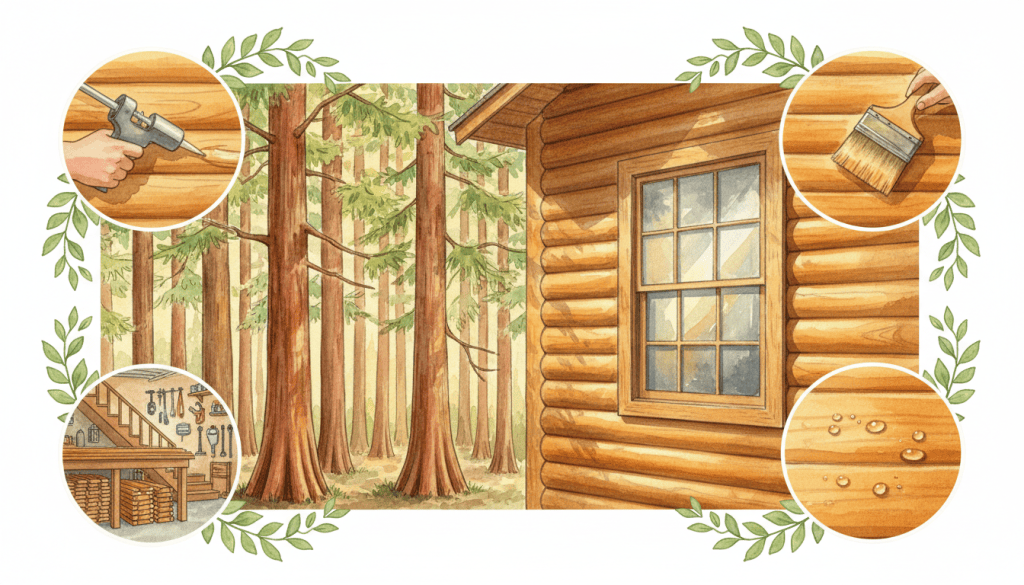
This article was written together by Patricia Mikkelson, a resident of the Living Springs Log House, and Claude.ai, an AI assistant made by Anthropic. Patricia brought what the expert found on the siding, the spare siding stored in the garage, and the question of why a house with siding is called a log home. Claude researched how to care for cypress siding and shaped it into an article. The illustration was created with AI.
The Living Springs Log House Improvement Checklist
- Part 1: Catching the Rain
- Part 2: From Cedar Thicket to Sanctuary Pasture
- Part 3: Water and Shelter for a Sanctuary Pasture
- Part 4: Rocket Stoves for Heat and Cooking
- Part 5: Rocket Stoves Beyond the House
- Part 6: Re-Screwing the Metal Roof, Safely
- Part 7: Staying Cool Without Air Conditioning
- Part 8: Staying Cool, Room by Room
- Part 9: Caring for the Cypress Siding (this article)
- Part 10: Forest Mulching
- Part 11: Small Gaps, Honest Fixes
- Part 12: A Quieter Log House: Soundproofing
To see more of the log house and the land, visit www.livingspringsloghouse.com


[…] Part 6: Caring for the Cypress Siding […]
LikeLike
[…] Part 6: Caring for the Cypress Siding […]
LikeLike
[…] Part 6: Caring for the Cypress Siding […]
LikeLike
[…] Part 6: Caring for the Cypress Siding […]
LikeLike
[…] Part 6: Caring for the Cypress Siding […]
LikeLike
[…] Part 6: Caring for the Cypress Siding […]
LikeLike
[…] Part 6: Caring for the Cypress Siding […]
LikeLike
[…] is solid, although it does need some help very soon. We just learned from a log house expert that the cypress siding needs to be re-stained and some parts re-screwed. The tradesman will be submitting an estimate soon, and it will be added to the disclosure […]
LikeLike
[…] It’s a hybrid log home. The living room and master bedroom are built with solid cypress logs. The rest of the house is framed, with cypress siding outside that matches the logs, so from the outside it looks like a log house all the way around. Read Our Log House Is a Hybrid: Clearing Up Some Confusion and Caring for the Cypress Siding. […]
LikeLike
[…] Built from cypress logs and cypress log siding, with all trim, double-pane windows, and stairs crafted from solid cypress — a wood prized for its longevity, beauty, and workability. Read more: Caring for the Cypress Siding […]
LikeLike
[…] Part 9: Caring for the Cypress Siding […]
LikeLike
[…] Part 9: Caring for the Cypress Siding […]
LikeLike
[…] Part 9: Caring for the Cypress Siding […]
LikeLike
[…] Part 9: Caring for the Cypress Siding […]
LikeLike