In short: Bats roosted in the log house attic for about five years, and the insulation has to come out. This article explains how to clean it out safely, why to decide the attic’s future before re-insulating, and what to measure. Part 2 covers turning the attic into living space.
These are suggestions, not professional advice. See the full note at the end.
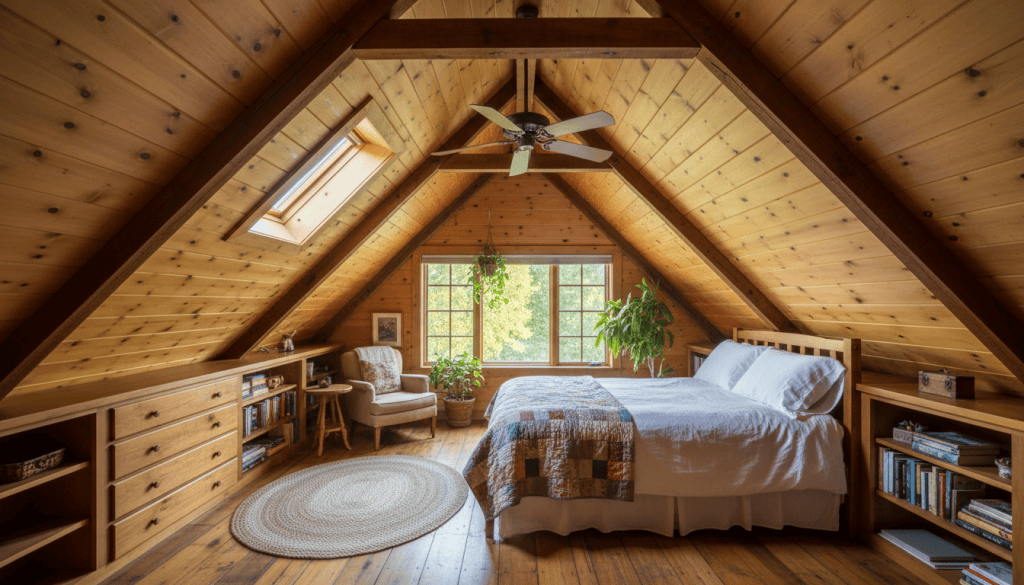
The attic at the log house is a big, unused space waiting for a new life. The inspector said the attic insulation needs to be replaced, and I agree. Since it has to come out anyway, this is the moment to ask a bigger question: could the attic become a warm, cool, comfortable place to live?
What We Found Up There
For a long time I didn’t go up into the attic. When I finally did, the smell was not good.
Bats had made their home there for about five years. Unfortunately, I didn’t think about the guano building up. I had too many other things on my mind. Fortunately, the bats left on their own a few years ago. Our handyman and longtime friend, David DeGroot, removed six 5-gallon buckets of guano that were sitting on top of the fiberglass insulation.
- The insulation is ruined. The fiberglass is practically soaked in guano and smells bad. The smell doesn’t come down into the house, but it’s time to clean it out.
- There’s a lot of room. At the highest point, the attic is about 8 feet tall. There may be room for one or even two bedrooms.
- There are two attics. There is an attic on each side of the house. One side opens through pull-down stairs in the laundry room. The other side opens from an upstairs bedroom, and I haven’t been able to get in to see it yet.
- There are ducts. Heating and air ducts run into the attic, and the inspector didn’t think they were good.
- The roof is metal, and the attic side of it is not insulated. Right now, the insulation lies on the attic floor, on top of the ceiling below.
Step One: Cleaning Out the Guano and the Old Insulation
This step comes first, whatever we decide to do with the attic.
Why care is needed
Dried bat guano can hold the spores of a fungus that causes a lung infection called histoplasmosis. A few scattered droppings carry very little risk, but the risk rises when guano piles up. Cleaning up a large amount of droppings is considered high-risk work, and pulling out old insulation stirs up a lot of dust, so a paper dust mask isn’t enough. Critter Control has a helpful article on bats in the attic, the health risks, and safe cleanup: Bats in the Attic.
Hiring it out
Wildlife cleanup and insulation companies do this work regularly. Crews wear full protective gear, pull the old material out with large HEPA vacuums or bag it by hand, carry it out in heavy contractor bags, and then clean and sanitize the attic wood. In one 2026 price guide, removing insulation heavily contaminated with bat guano costs about $3.00 to $5.40 per square foot. Removing it and blowing in new cellulose insulation runs about $3.00 to $6.00 per square foot. Prices vary by region, so it’s worth getting two or three local quotes.
If you do it yourself
- Protect your lungs. Use a NIOSH-approved respirator: a full-face respirator with P100 filters, or a powered air-purifying respirator. A half-face respirator with P100 filters is a step down but far better than a dust mask. Respirators work best when they fit well, so try it on before you start.
- Cover up. Wear disposable hooded coveralls, shoe covers, goggles, and disposable gloves under work gloves. Attics get very hot, so work in the cool early morning and take breaks.
- Keep the dust down. Lightly mist the insulation and any leftover droppings with water before moving them, so spores don’t float into the air.
- Bag it carefully. Roll or scoop the insulation into heavy contractor bags, seal them, and carry them straight outside. Seal your coveralls and shoe covers in a bag too when you’re done.
- Protect the house. Close the door to the laundry room, and turn off the heating and air system while you work so the ducts don’t pull attic air into the house.
- Clean and freshen. Once the insulation is out, vacuum with a HEPA shop vacuum, then clean the wood with an enzyme cleaner made for animal waste. Let the attic air out well.
Keep the bats outside
Before closing the attic up again, seal the gaps where the bats got in, such as openings at the eaves, ridge, and vents. Bats are wonderful neighbors, eating huge numbers of mosquitoes and other insects. A bat house under the upper-deck eaves now gives them a home nearby, outside the house. Read their story in Bat Thirty.
Step Two: Decide Before You Re-Insulate
Here is the most important money-saving idea in this article: decide what the attic will become before putting new insulation back in.
- If the attic stays an attic, new insulation goes back on the attic floor, and the roof above stays cool and ventilated. This is the simplest and least expensive choice.
- If the attic becomes living space, the insulation moves up to the underside of the roof instead. Putting new insulation on the floor first, only to tear it out later for a room, means paying twice.
Getting into the Other Side
The second attic opens from an upstairs bedroom. Before planning anything, someone needs to open it up, take photos, and measure. Here is a checklist for a visit to each side:
- The height at the peak and the width of the floor where the ceiling is 5 feet and 7 feet tall
- The length of each attic
- The size and spacing of the floor joists (for example, 2×6 boards set 16 inches apart)
- Whether the roof is held up by rafters (open space) or trusses (boards crossing in a W pattern)
- The depth of the rafters, which sets how much insulation can fit
- What’s under the metal roof: solid wood decking or open strips of wood
- Where the ducts come from and where they go
- Any wiring, leaks, water stains, or openings where light shows through
Continue Reading
Headroom, the floor, the ducts, insulation under a metal roof, a reflective roof, stairs, and costs are in From Bat Roost to Bright Room, Part 2: Turning the Attic Into Living Space.
A Few Insights
- The cleanup has to happen no matter what, so start there, and do it safely.
- Decide what the attic will become before re-insulating, so the work is only done once.
- The bats did us one favor: they sent us up into a space we might never have thought about.
Related articles
- From Bat Roost to Bright Room, Part 2: Turning the Attic Into Living Space
- Bat Thirty: The Story of the Bats at Living Springs Log House
- Staying Cool Without Air Conditioning: The Living Springs Log House Improvement Checklist, Part 7
- Small Gaps, Honest Fixes: The Living Springs Log House Improvement Checklist, Part 11
A note on these suggestions: The repairs and improvements described here are our best understanding from research and our own experience living on the property. We are not contractors, engineers, or licensed inspectors, and these may not be the best or only solutions. Before starting any repair or project, please consult a qualified professional, such as a contractor, drainage specialist, or home inspector, who can look at the site in person.
How we wrote this together: This article was written together by Patricia Mikkelson, a resident of the Living Springs Log House, and Claude.ai, an AI assistant made by Anthropic. Patricia brought the story of the bats and the guano, the inspector’s advice to replace the insulation, the measurements she has so far, and the two attics and how to reach them. Claude researched safe cleanup and shaped it into an article.
To see more of the log house and the land, visit www.livingspringsloghouse.com


[…] Turning the attic into a living space is a big project, and it has its own article: From Bat Roost to Bright Room: Reimagining the Log House Attic. […]
LikeLike
[…] Turning the attic into a living space is a big project, and it has its own article: From Bat Roost to Bright Room: Reimagining the Log House Attic. […]
LikeLike
[…] In short: Once the old insulation is out, the attic at the log house could become one or two rooms. This article covers headroom, the floor, the ducts, insulation under a metal roof, a reflective roof, stairs, and what it might cost. Start with Part 1: Cleaning Out the Attic. […]
LikeLike
[…] with room to grow. Read more: From Bat Roost to Bright Room, Part 1 and Part […]
LikeLike
[…] From Bat Roost to Bright Room, Part 1: Cleaning Out the Log House Attic […]
LikeLike