By Patricia Mikkelson and Claude
Claude and I wrote this together. I shared my own experiences and what I’ve learned living in the Ozarks, and Claude dug up facts and research to add to them.
Poison ivy grows all over the Ozarks. It climbs our trees, creeps along fence lines and trails, and loves the sunny edges of the woods. Over the years I’ve learned a lot about living alongside it. Here is what we know, plus what we found when we went looking for the best natural ways to deal with it.
Poison ivy here at Living Springs Log House
We have a lot of poison ivy here at Living Springs Log House, especially behind the house, and in other places too. That’s because there is so much dampness and so much water on this property, and poison ivy loves water. So everything in this article comes from real life on this land. But it will help you wherever you live.
How to recognize it
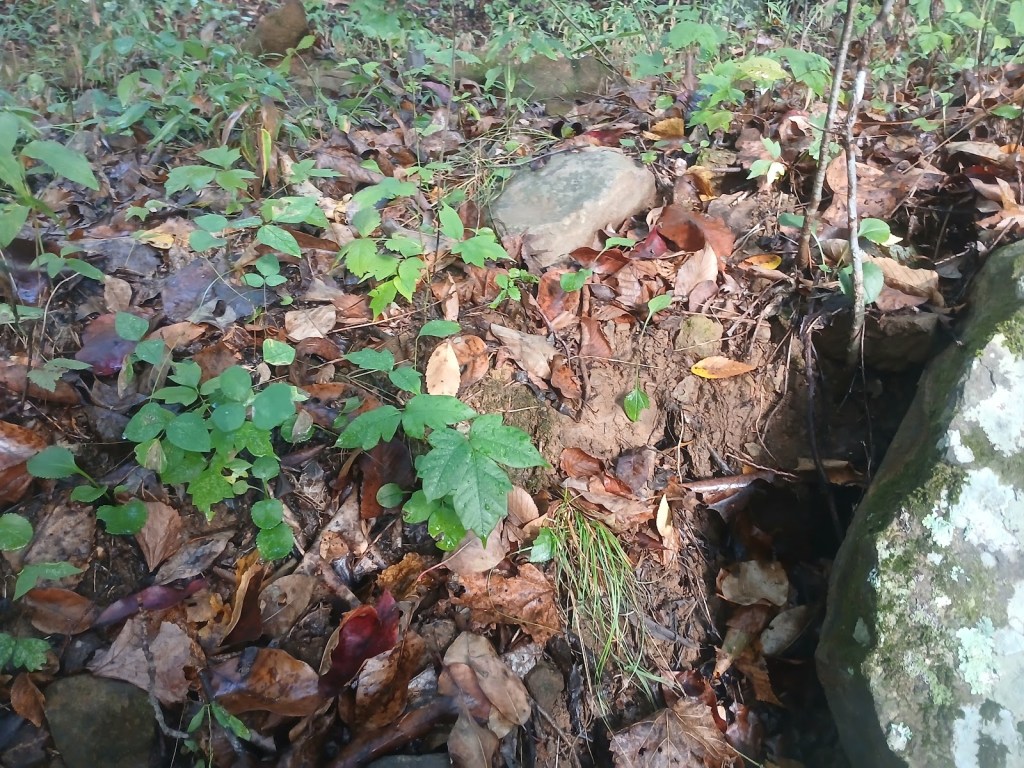
The old saying is still the best one: “Leaves of three, let it be.” Each leaf is made of three leaflets. The middle one has a longer little stem than the two on the sides.
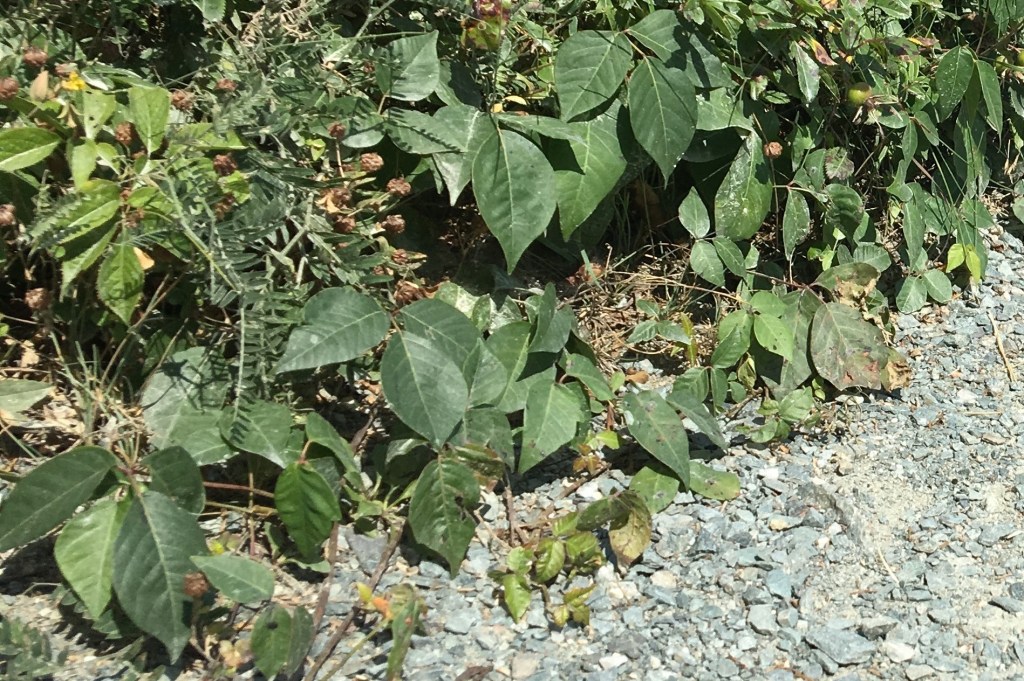
- The leaflets can be shiny or dull, with smooth, toothed or lobed edges. The plant changes its look a lot.
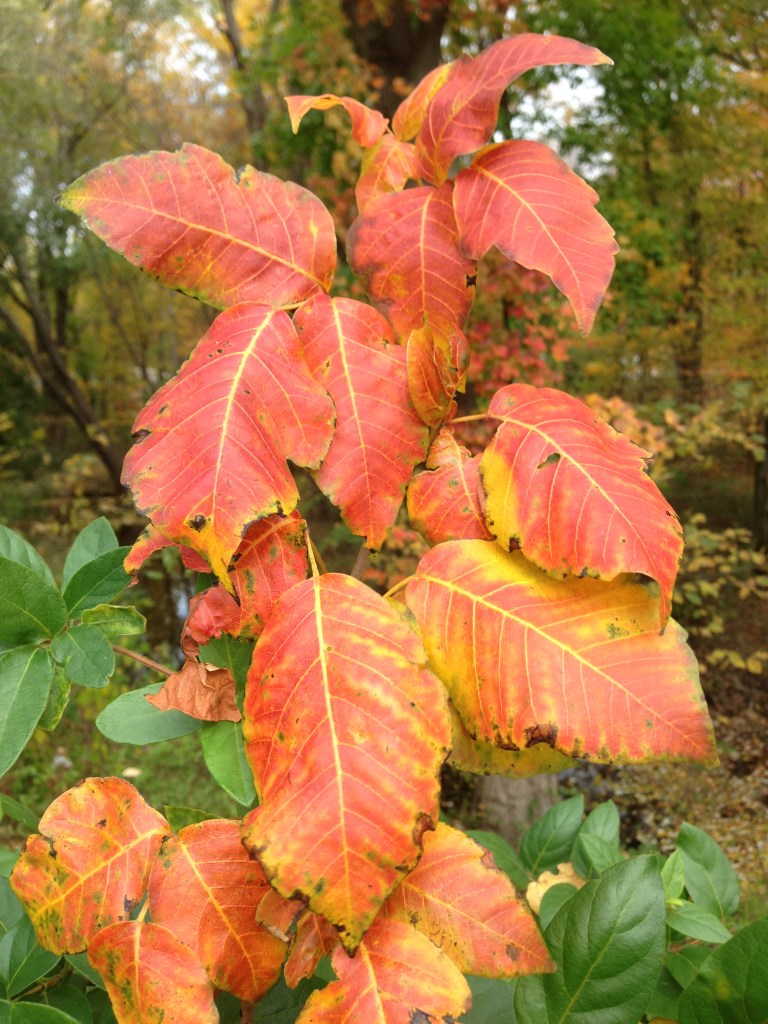
- In spring the new leaves are often reddish. In summer they’re green. In fall they turn brilliant red, orange and yellow, which is beautiful, and fools many people into picking them.
- It grows as a low ground cover, a small shrub, or a thick vine climbing a tree.
- An old vine is covered in fuzzy, hairy rootlets that grip the bark. If you see a “hairy rope” on a tree, don’t touch it. That’s poison ivy too, even in winter with no leaves.
- In late summer and fall it has small clusters of whitish berries. Birds love them, which is how poison ivy gets planted in new places.
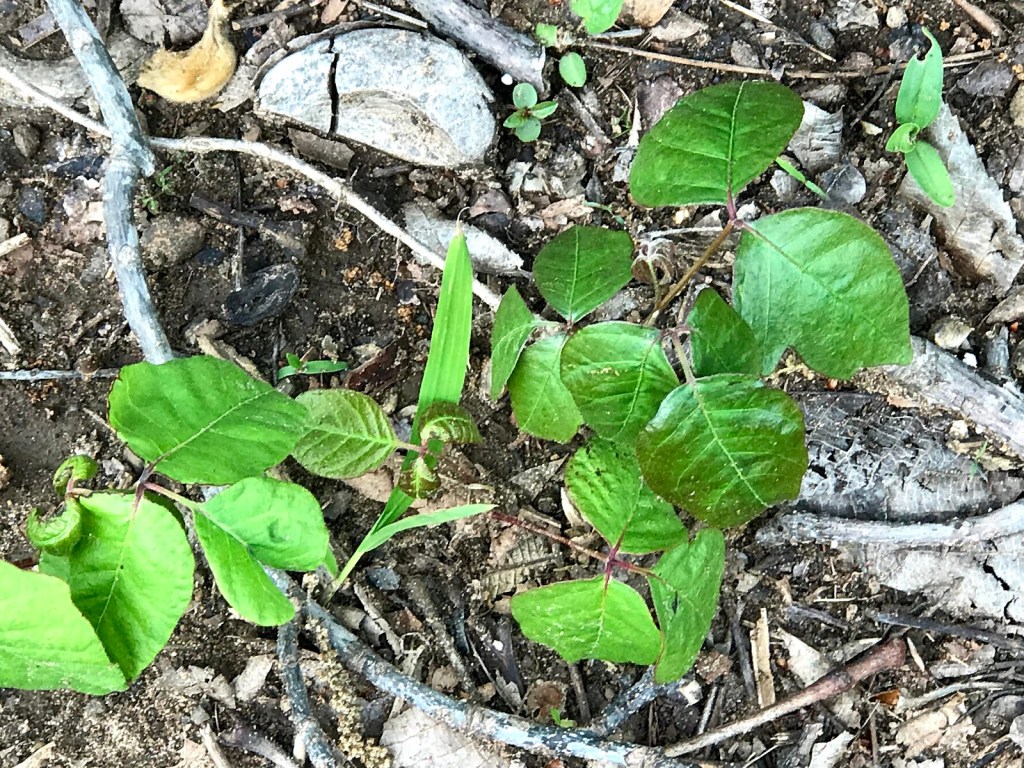
A few plants get mixed up with it. Virginia creeper has five leaflets, not three. Box elder seedlings have three leaflets, but the leaves grow in pairs opposite each other on the stem, while poison ivy’s leaves alternate.
The worst case I ever had
One time, my five-year-old daughter and I were playing happily in the woods on a big rock. There were roots all over the rock, and we decided to clear them away. Those roots turned out to be poison ivy roots. I got just about the worst case of poison ivy I’ve ever had in my life. It was horrible.
Here’s what I learned. When you pull roots out of the ground and you don’t know what they are, you might not see the poison ivy leaves at first. You might only find out later. And when you pull poison ivy roots with bare hands, you get the oil deep into your skin, because you’re gripping and pulling hard, not just brushing against a leaf. So wear gloves whenever you pull up roots you don’t know, even in winter when there are no leaves.
How it works, and how it spreads
Poison ivy isn’t really a poison. Every part of the plant (leaves, stems, roots and berries) holds an oil called urushiol. Most people’s immune systems react to that oil. That reaction is the rash.
The oil sinks into the skin quickly, within about 10 to 20 minutes. It doesn’t travel in the blood. It binds to the skin, and the body’s immune cells see it as an invader and attack, which brings the redness, itching and blisters. That’s why the rash usually shows up a day or two after contact, sometimes later.
Here are some surprising facts:
- The rash isn’t contagious. The fluid in the blisters doesn’t contain the oil, so breaking a blister doesn’t spread poison ivy.
- New patches that show up later don’t mean it’s “spreading.” Thin skin, like the inner arm, reacts first. Thicker skin reacts later. Places that got less oil may also show up later.
- What does spread it is the oil itself. It clings to gloves, clothes, shoes, garden tools, doorknobs, and the fur of dogs and cats. The oil can stay active on things for a very long time, even years. Our dogs don’t get the rash, but they can carry the oil right to us.
- Never burn it. The smoke carries the oil into the air, and breathing it can harm the lungs and throat badly.
What to do right after you touch it
Speed matters most. The sooner you wash, the less oil soaks in.
- Rinse the area with lots of cool running water as soon as you can. A creek or a garden hose will do in a pinch.
- Wash gently with soap. A natural dish soap works well because it cuts oil. Don’t scrub hard, and use a fresh washcloth for each area so you don’t move the oil around.
- Clean under your fingernails.
- Take off your clothes carefully and wash them in hot water, apart from other laundry.
- Wipe down your tools, gloves, shoes and anything else you touched. Bathe your dog if he’s been running through it, wearing gloves while you do.
Please don’t scratch
I know. The itch is maddening, and scratching feels so good for a moment. But scratching breaks the skin, lets in germs, and can lead to infection and scars. It also makes the itch worse in the long run.
Here are some ways to cool the itch instead:
- Cool compresses, or a cool shower. Heat feels good at first but makes the itch flare afterward.
- An oatmeal bath. Grind plain oats into a fine powder and stir it into lukewarm bathwater.
- Calamine lotion, or a paste of baking soda and water.
- Keep your nails short, and wear soft cotton gloves at night so you don’t scratch in your sleep.
Natural remedies
These are the natural remedies people use most, and what the research says about them.
Jewelweed. This lovely orange-flowered plant often grows near poison ivy, in moist, shady spots. Folk healers have long rubbed the crushed stems on skin after contact. In 2012, researchers tested it. Fresh jewelweed mash did reduce the rash. But plain soap and water worked even better, and jewelweed soaps worked no better than dish soap. Their later work suggests jewelweed helps because of its natural soap-like compounds, called saponins. So jewelweed is a good thing to reach for when you’re out in the woods with no soap. At home, soap and water is your best friend.
Aloe vera. The cool gel from an aloe leaf soothes hot, itchy skin. It’s such a good thing to have on hand for emergencies. Keep an aloe plant, or a few of the big aloe leaves. Even Walmart carries the big leaves, which amazed me, and they keep for weeks in the refrigerator. Fresh aloe saved me once when I had a serious burn.
Apple cider vinegar or witch hazel. These help dry out weepy blisters and calm the itch. Try putting them in a spray bottle and misting them on. Dabbing or rubbing anything on poison ivy can make it itch even more, and spraying avoids that.
Plantain. Our common plantain, which grows all over Living Springs Log House, has been used for generations for bites, stings and rashes. You can chew a leaf and lay it on the skin as a poultice.
The homeopathic remedy. Someone told me a homeopathic remedy really helped them. The one most often used for poison ivy is called Rhus toxicodendron, or “Rhus tox.” It’s made from poison ivy itself, diluted many, many times, and comes as tiny pellets that melt under the tongue. You can find it at health food stores and online, often in a strength called 30C.
People use it two ways. Some take it ahead of time, before poison ivy season. Others take it once a rash has started.
Here’s how a few people say they used it:
- A nurse practitioner wrote to The People’s Pharmacy that they had suffered poison ivy every summer for about 20 years, often needing steroid shots and pills. They started taking two small pills under the tongue twice a day for one week in March, then again for one week in April, before the leaves came out. Now, if they’re exposed while weeding, they get only one or two small blisters that fade quickly.
- Another reader with severe reactions followed the same plan: two tablets twice a day for a week in March, and again a month later. That summer, poison ivy gave them only a few small blisters. Their words: “It works!”
- A doctor writing in a dermatology journal described two small studies and patients’ experiences, and suggested it as a gentle, affordable way to help prevent the rash.
If you try it, follow the directions on the package for how much to take.
Can you build up immunity?
This is something many of us wish for. Here is what we found.
Please don’t eat poison ivy leaves. You’ll hear stories of old-timers who ate a tiny leaf each spring to “get immune.” It’s a dangerous idea. The oil can cause a severe reaction inside the mouth, throat and stomach. Also, each exposure can make the body more sensitive, not less. Many people react worse each time.
Some people do become less sensitive as they get older. About 15 percent of people seem to be naturally resistant. Even they can become allergic later in life.
What I can say is this: a body that is well rested, well nourished with plenty of fresh greens and fruit, and not run down by stress heals faster from everything, including rashes. I can’t promise it will keep poison ivy from bothering you. But it’s never wasted.
The most reliable “immunity” is simply avoiding the oil and washing quickly.
If you’re super allergic
Some people swell up and blister terribly from even a light brush with the plant. If that’s you:
- Let someone else do the poison ivy clearing.
- Before going into the woods, use a barrier cream on exposed skin. Some products are made just for this.
- Wear long sleeves, long pants tucked into socks, and closed shoes. Use waterproof gloves when working outside.
- Keep a bottle of water and a little dish soap in your car or backpack, so you can wash right away.
- Be careful with clothes and tools that may carry old oil.
- Read the safety note at the end of this article. It lists the signs that call for urgent care.
Keeping children safe
Little ones love to explore, and poison ivy can grow right where they play.
- Walk the play areas and paths before the children do. Pull or mark any poison ivy you find.
- Teach them “leaves of three, let it be” with a fun game. Have them point to the plants with three leaves (from a safe distance) and say the rhyme.
- Show them the hairy vines on trees, and explain they shouldn’t touch those either.
- Dress them in long pants for woods walks, and wash their hands and clothes when they come in.
- Remind them that dogs and cats can carry the oil on their fur.
- Teach them that if they touch it, they should tell a grown-up right away and wash.
Getting rid of it, the natural way
I prefer to clear poison ivy without poisons. It takes patience, but it can be done.
Dress for it. Wear long sleeves, long pants, waterproof gloves (or plastic bags over cotton gloves), boots and eye protection. Throw away disposable gloves afterward, and wash everything else right away.
Pull it when the ground is wet. After a good rain, the roots slide out more easily. Get as much root as you can, because broken roots grow back.
Cut climbing vines at the base. Cut a section out of the vine near the ground, so the top part dies. Then dig out the roots. The dead vine overhead still holds oil, so leave it alone or take it down very carefully.
Smother it. Cover small patches with thick layers of cardboard and mulch, or black plastic, for a full growing season. Watch the edges, because it likes to creep out around them.
Keep mowing or cutting it back. Cutting it down again and again wears out the roots over time.
Goats. Goats happily eat poison ivy without getting a rash, and cities from Texas to New York have used them to clear it. For a farm animal sanctuary, rescued goats could be a gentle helper.
Don’t burn it, and don’t compost it. Bag the pulled plants and send them out with the trash.
Boiling water, salt and vinegar don’t give lasting results, and salt and vinegar can harm the soil and the plants around them.
A thought to end on
Even poison ivy has a place in the web of life. Birds and deer eat its berries and leaves, and its roots hold soil on stream banks. I’ll admit I do hate it! But I’m learning not to. I give it a respectful distance, and I teach the little ones to do the same.
Health note: This article shares my own experience and what we’ve read. It isn’t medical advice. Please make your own health decisions with whoever you trust. Get urgent medical care right away if there is trouble breathing or swallowing, swelling of the face or eyes, a rash near the eyes or mouth or on the genitals, a rash covering much of the body, fever, signs of infection (pus, yellow crusts, spreading redness), or if someone has breathed in smoke from burning poison ivy.
Sources
- How to identify and kill poison ivy (The Old Farmer’s Almanac): https://www.almanac.com/how-to-kill-poison-ivy
- Jewelweed and soap studies (The Field Guides): http://www.thefieldguidespodcast.com/writeups/2016/8/2/jewelweed-poison-ivy-and-homer-simpson
- The 2012 jewelweed study: https://pubmed.ncbi.nlm.nih.gov/22766473/
- Homeopathic Rhus tox to prevent poison ivy rash: https://pubmed.ncbi.nlm.nih.gov/28329482/
- Rhus tox reader stories (The People’s Pharmacy): https://www.peoplespharmacy.com/articles/homeopathic-remedy-for-poison-ivy and https://www.peoplespharmacy.com/articles/homeopathic-remedy-helped-poison-ivy-sufferer
- Can you build immunity by eating it? (Backpacker): https://www.backpacker.com/gear-reviews/can-you-build-immunity-to-poison-ivy-by-eating-it/
- Medical treatment of poison ivy (Medscape): https://emedicine.medscape.com/article/817671-treatment
- Goats clearing poison ivy in Austin: https://spectrumlocalnews.com/tx/austin/news/2023/07/27/austin-non-profit-brings-in-goats-to-solve-poison-ivy-problem


