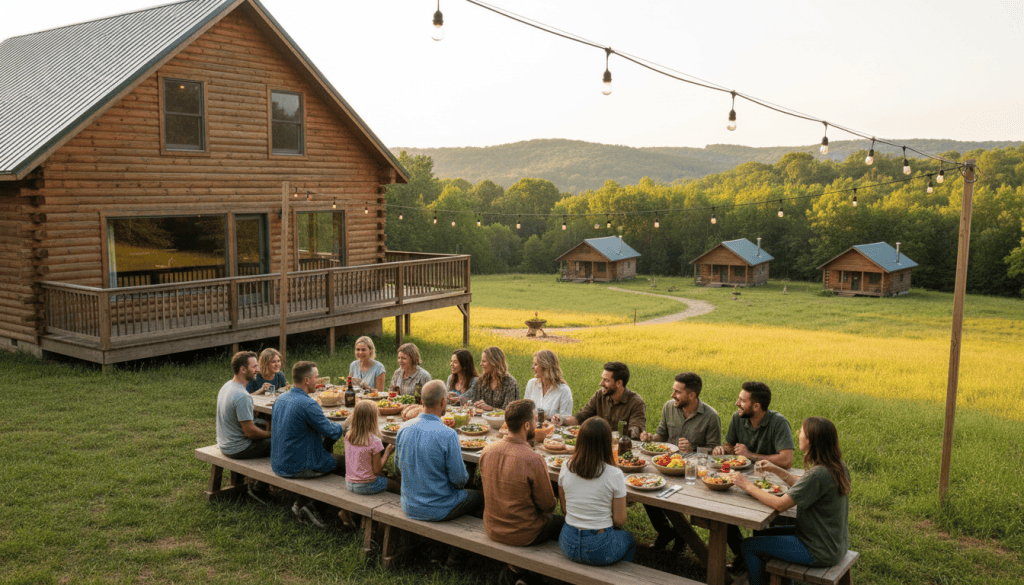
By Patricia Mikkelson, a resident of the Living Springs Log House since 2017
I first fell in love with co-housing nearly 40 years ago. I was living in San Diego when I bought the first edition of the book that brought the idea to America, Cohousing: A Contemporary Approach to Housing Ourselves by Kathryn McCamant and Charles Durrett, and I joined a co-housing group there. Later I was part of a co-housing group in Fayetteville, Arkansas. I also went on a number of co-housing tours in the San Francisco Bay Area, and they were very inspiring.
Years later I house-sat in a co-housing community, and I loved it. Each person had their own home, but everyone shared a common house just a short walk away. It had a big kitchen, a living room, a guest room, a library and a co-working space. People cooked together a few nights a week, kids ran between houses, and nobody had to be lonely. When I think about what the Living Springs Log House could become, that picture comes back to me again and again.
What Is Co-Housing?
Co-housing is a neighborhood designed on purpose. Each person or family has their own private home, with their own kitchen and front door. Then the community shares a common house and the land around it. Neighbors usually share some meals, make decisions together, and help each other out, while still having all the privacy they want.
It’s different from co-living, where people share one big house. Both ideas are gaining momentum all over the country, as more people look for a way to live that’s less isolated and less expensive. This property could work for either, or for a mix of both.
See Co-Housing for Yourself
The Bay Area tours I went on showed me how warm and practical this way of living can be. These two short videos give a feel for it: a news story about Bay Area co-housing communities, and an introduction from the Cohousing Association of the United States.
The Log House as the Common House
Most co-housing groups spend years and a lot of money building their common house. Here, it’s already standing. The Living Springs Log House could become the heart of a co-housing community:
- The kitchen and living room for shared meals, potlucks and gatherings
- The two large upstairs bedrooms as guest rooms for visiting family and friends, or as homes for one or two members
- A library and reading nook in a quiet corner
- A co-working space, with high-speed internet, which is unusual this far out in the country
- The deck overlooking the lake and the valley, for morning coffee and evening talks
The Basement Suite as a Home
The walk-out basement suite has its own entrance and its own heating and cooling. It could be one household’s private home right from the start, close to the common house but separate from it. (Why do I call it a suite and not an apartment? A home without a full kitchen is called a suite. This one is ready to be wired up for a kitchen, so it could become an apartment.)
A Building Site Close By
Near the log house, there’s an area that has grown up in brush and young trees over the years. It’s clearable and fairly flat, which could suit a cluster of small homes. Forestry mulching could open it up, and the homes would be a short walk from the common house, the way co-housing is meant to be.
Building more homes here would need permission from the county, even if the homes were connected to each other. I don’t know yet what the county would say. But I feel hopeful that co-housing could be a great model for our county to embrace: neighbors sharing land and a common house, and looking out for one another.
There may also be a simpler path. The metal building already has its own septic system, so it could be expanded upward with a second story, or outward, into homes for a number of people living simply. That might not need the same kind of permission as building new houses. Regulations here aren’t strict, but it’s always wise to check with the county before you start.
Beyond that, the rest of the 14.75 acres offers forest, a walking path, gardens and room to grow. The 40 acres next door are for sale too, which would make 54.75 acres together.
The Metal Building as a Shared Workshop
The 40-by-60-foot insulated metal building could be the community’s workshop, tool library, storage, or even more living space. It has 240-volt power, a bathroom, a wood stove and a 17-foot peak with room for a second story.
Water and Gardens Already Here
A cave spring has filled two cisterns since 2017. There’s a 40-by-55-foot fenced organic garden, and the gardens around it come back every year with medicinal herbs, wild greens and flowers. A co-housing group could share the big garden, plant an orchard and food forest, and start eating from the land.
Why I Think It Would Work Here
The hardest parts of starting co-housing are finding the land and building the common house. Here, both are already done. A group of friends or families could move into the log house and basement suite together, then, with the county’s permission, build their own homes nearby at their own pace.
Related Articles
- Vegan Co-Living at Living Springs Log House
- Six Ways to Belong, the Vegan Way: Ideas for Whoever Comes Next
- Forest Mulching: The Living Springs Log House Improvement Checklist, Part 10
- The Metal Building: 40 x 60 Feet With Many Possible Uses
- The 40 Acres Next Door Is for Sale: 54.75 Acres Together
Learn More
- The Cohousing Association of the United States: cohousing.org
- The Foundation for Intentional Community: ic.org
The Living Springs Log House Is for Sale
Offered at $475,000 for 14.75 acres near Huntsville, Arkansas. Listed with Lori Hawkins of Viridian Real Estate. See the Zillow listing. To ask questions or arrange a visit, text Patricia at (479) 313-0414. Calls are welcome too.
How We Wrote This Together
This article was written by Patricia Mikkelson, who has lived at the Living Springs Log House since 2017, together with Claude.ai, an AI assistant made by Anthropic. Patricia brought nearly 40 years of interest in co-housing, from the San Diego and Fayetteville groups and the Bay Area tours to house-sitting in a co-housing community, along with her vision of the log house as a common house and her knowledge of the land. Claude helped write the article and find the videos. The picture was created with AI. Patricia is a friend of Barbara Hulley, the owner of the Living Springs Log House.


[…] Each person or family in their own small home, sharing the log house as the common house. Read more: A Common House Already Built: Co-Housing at the Living Springs Log House […]
LikeLike
[…] and intentional community. Members share costs and can start shared businesses. A Common House Already Built and Room for a […]
LikeLike