By Patricia Mikkelson, a resident of the Living Springs Log House since 2017
I’ve lived at the Living Springs Log House since 2017, and I’ve grown food, hauled mulch, built hugelkultur beds and watched the seasons turn on this land. So when people ask whether it’s a good place to homestead, I want to give a straight answer: the good parts and the hard parts.
The Hard Parts First
It’s close to the road. The house sits near the county road, not tucked at the end of a long private lane. If your dream is total seclusion, this isn’t it. You’ll hear the occasional car and see neighbors pass. On the other hand, it means year-round access, no long driveway to grade, and help is close by.
It isn’t a bargain. Homesteaders often look for cheap raw land and build slowly. This is a finished home with a large insulated building, a spring system, cisterns and established gardens, and it’s priced like it. You’re paying for years of work that’s already done.
The land needs mulching. About 55 percent of the 14.75 acres was cleared years ago and has grown back in brush and young trees. To turn it back into open pasture, orchard or garden, you’d want to invest in forestry mulching, a machine that grinds brush down into mulch right where it stands. It’s an expense up front, but it’s faster and gentler on the soil than bulldozing, and it leaves the ground covered. I wrote a whole article about it, listed at the end.
The Good Parts
Water that’s already working. A limestone cave spring on the hillside above the house has filled two cisterns since 2017. It’s our only water source, and it has carried the household through the seasons. For a homesteader, water is everything, and here it’s already flowing.
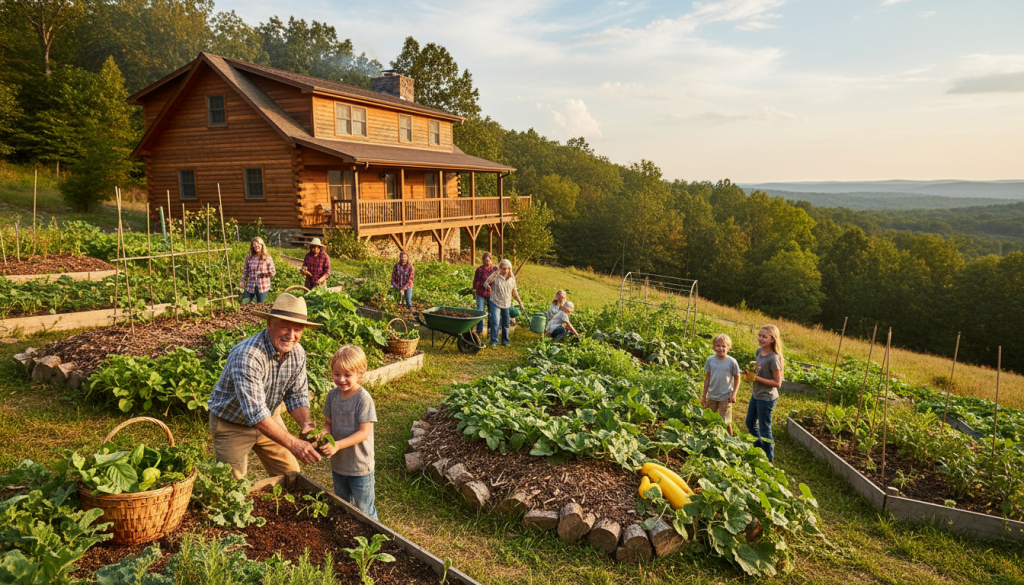
Gardens with a head start. There’s a 40-by-55-foot fenced organic garden ready to plant. Medicinal herbs like echinacea, comfrey and yarrow, wild greens, native flowers and pollinator plants come back on their own every year. There are established garden beds and hugelkultur mounds already building soil.
Land with options. About 40 percent of the land is forest, about 55 percent could be opened back up, and the rest is gardens and lawn. A walking path circles the property. And the 40 acres next door are for sale too, which would make 54.75 acres together.
Close enough to town. Groceries and hardware stores are about 25 minutes away, and the Northwest Arkansas metro is about an hour. There’s high-speed internet, which is unusual this far out, so someone can work from home or sell online while the garden grows.
Room for a Big Family or a Group of Homesteaders
This is where the Living Springs Log House has a lot to offer. Homesteading is hard work for one couple. It’s much easier with more hands, and this property already has room for them.
- The log house has a primary bedroom and a smaller bedroom downstairs, each with its own bathroom, plus two large upstairs bedrooms with a shared bathroom.
- The walk-out basement suite has its own entrance and its own heating and cooling, so grandparents, a grown child’s family or another household can live close but separate. (Why do I call it a suite and not an apartment? A home without a full kitchen is called a suite. This one is ready to be wired up for a kitchen, so it could become an apartment.)
- The 40-by-60-foot insulated metal building is the big opportunity.
Transforming the Metal Building
The metal building isn’t for animals anymore. It works much better as a place for people. It stands on a 5.5-inch reinforced concrete floor set on concrete knee walls, with 12-foot walls rising to a 17-foot peak. That height means a second story or a big loft could go in, roughly doubling the usable space.
It already has 240-volt power, a bathroom with a drain roughed in for a shower, a deep utility sink, a kitchen stove, a double-barrel wood stove, its own septic tank, and a 14-by-14-foot insulated door. It has running water from a gravity-fed hose from the cistern. The pump doesn’t work, so a new owner would want to repair or replace it.
A homesteading family or group could turn it into:
- two or three small apartments, or a row of private rooms upstairs with a shared kitchen below
- a common house with a big table for shared meals and meetings
- a canning kitchen, root cellar room or seed-saving room
- a woodworking or tool shop with real 240-volt power
- a classroom for homeschooling or homesteading workshops
Building something this size from scratch would cost far more than finishing what’s already here. Robert once lived out there beside the wood stove through a hard season, so I know firsthand that people can live in it.
Is It Right for You?
If you want cheap, hidden land and a blank slate, probably not. If you want a homestead where the water, the gardens, the house and a big building are already in place, and you have a big family or a group of friends ready to share the work, I think it’s worth a serious look.
Related Articles
- Forest Mulching: The Living Springs Log House Improvement Checklist, Part 10
- The Metal Building: 40 x 60 Feet With Many Possible Uses
- The Insulated Metal Building Has the Potential for Multiple Uses, Including a Living Space
- Homesteading in the Ozarks: A Dream That Took Root Here
- An Off-Grid Living Checklist for the Arkansas Ozarks
- Hugelkultur: Building Garden Beds From Logs, Leaves, and Time
- A Guide for Families Dreaming of a Multigenerational Homestead
- The 40 Acres Next Door Is for Sale: 54.75 Acres Together
More on Living Self-Sufficiently Here
- Potentially Living Off the Grid, Gently: Self-Sufficiency at the Living Springs Log House
- More Self-Sufficiency Tips: Building a Greenhouse
- Keeping Wild and Tame Greens Through the Winter
- Four Years With Longevity Spinach
- Rocket Stoves Beyond the House: The Living Springs Log House Improvement Checklist, Part 5
- Staying Cool Without Air Conditioning, Room by Room: The Living Springs Log House Improvement Checklist, Part 8
The Living Springs Log House Is for Sale
Offered at $475,000 for 14.75 acres near Huntsville, Arkansas. Listed with Lori Hawkins of Viridian Real Estate. See the Zillow listing. To ask questions or arrange a visit, text Patricia at (479) 313-0414. Calls are welcome too.
How We Wrote This Together
This article was written by Patricia Mikkelson, who has lived at the Living Springs Log House since 2017, together with Claude.ai, an AI assistant made by Anthropic. Patricia brought her years of gardening and living on this land, her honest list of what’s hard about it, and her vision for the metal building. Claude helped organize the facts and write the article. The picture was created with AI. Patricia is a friend of Barbara Hulley, the owner of the Living Springs Log House.


[…] Is the Living Springs Log House Right for Homesteaders? The Good, the Hard, and Room to Grow […]
LikeLike