Dreaming on the loop trail: affordable health, families welcome, and a new use for our cedar trees
By Patricia Mikkelson, resident of the Living Springs Log House and friend of its owner, Barbara
This morning I walked the loop path that circles all 14.75 acres of the Living Springs Log House. It goes all the way around the property and comes back home again, and it’s where I do my best praying and thinking. The air was cool, the leaves were turning, and somewhere along the way I stopped just walking and started dreaming. I want to share that dream here, in case it’s yours too, or belongs to someone you know.
The land in three parts
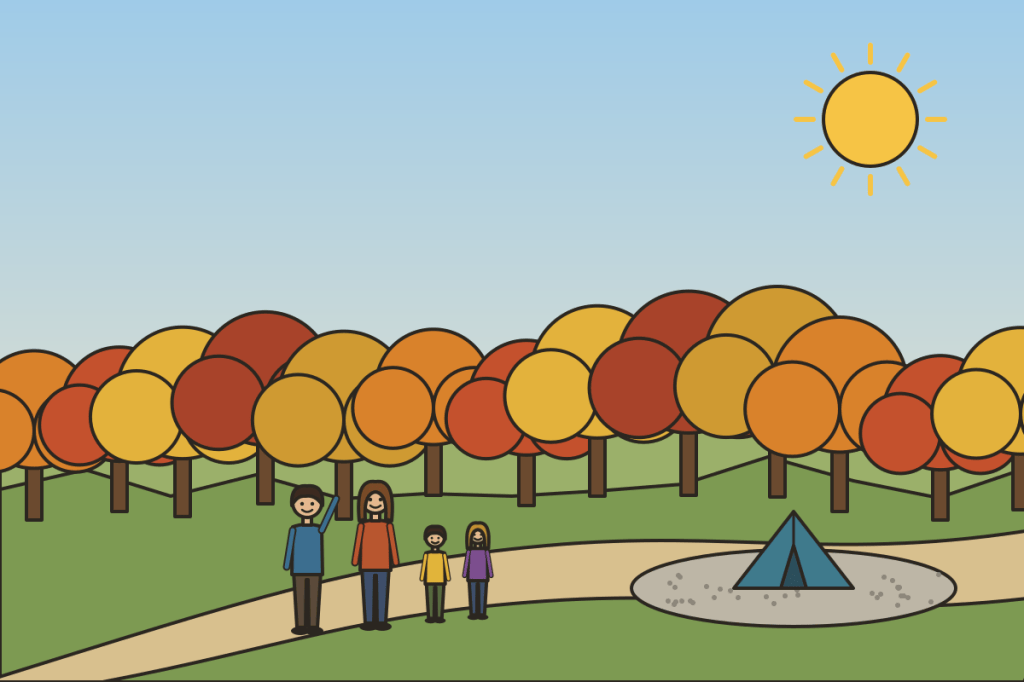
Walking the whole circle, I noticed that the land falls naturally into about three parts. One holds the log house, the gardens and the big barn. Another is the wooded hillside. And a third section, about four acres, was once set aside for a separate home. That plan didn’t come to be, but it left a gift behind: a gravel pad already carved out, with a little road leading down to it.
Standing on that pad this morning, I could see it so clearly.
A little campground of its own
Picture the bathhouse at a good state park campground: clean toilets, hot showers, a place to wash up. Now picture that on the gravel pad, with a small community room beside it and picnic tables under the trees.
The pad is big enough for one of those portable buildings you see on lots along the highway, the kind you can rent to own. I always keep those buildings in mind, because they’re so versatile. Dealers offer rent-to-own on nearly every kind they sell, from sheds and lofted barns to cabins and greenhouses, and a shed can be finished out much like a house. One could become the bathhouse. Another could be the community room, with a refrigerator and freezer where campers keep their food cold and make their own ice.
Electricity shouldn’t be hard to bring down there, and once it’s there, so much becomes possible.
Walk-in campsites in the nooks and crannies
This land is full of nooks and crannies: little flat spots under the oaks, quiet hollows, sheltered places on the hillside. Each one could be a tent site. Like the walk-in sites at some campgrounds, people would park near the pad and carry their gear in. No cars rolling past your tent, no headlights at night. Just birdsong, the wind in the trees, and the creek running after a rain.
Some sites could be close to the bathhouse for people who can’t walk far, and others tucked further into the woods for those who want real quiet. With a few gentle rules, like quiet hours, it would stay a peaceful place for everyone.
A lifestyle camp people can afford
Here is the heart of my dream. I love lifestyle centers, places where people go to learn to eat whole plant foods, move their bodies, rest, breathe clean air and trust God. But the cost puts them out of reach for so many. A stay of just a few days, with a private room and every meal provided, can run into the thousands of dollars.
When I was 26, I stayed at a healthy-living center where I could live in a simple dorm, and it cost so little I could hardly believe it. That experience shaped my life. I want that door to be open for others: not only for people who are very sick, but for anyone who wants a fresh start, and for whole families who want to come together.
At a lifestyle camp, guests could:
- Bring their own food and cook for themselves, keeping it cold in the community refrigerator. The camp could ask that all food brought in be plant-based.
- Pay for just one meal a day at the main house, if they’d like a home-cooked meal and good company.
- Fast quietly at their own campsite, if they choose to.
- Join the activities: wild edible walks, permaculture and gardening classes, hikes, cooking demonstrations, singing, prayer and quiet time.
Food is one of the biggest costs of any retreat. When people can feed themselves, or choose a single shared meal, the price drops a great deal. And the walks and classes are livelier with more people taking part. A wild greens walk could teach plantain, dock and wintercress. The land couldn’t feed everyone, and it doesn’t need to; learning to see food growing all around us is gift enough.
Others have already shown that people want this kind of choice. One large raw vegan festival in the mountains of Northern California offers tent camping under the oaks and pines alongside rustic cabins for families. A nonprofit meditation retreat in England priced its bring-your-own-tent option far below its cabins and huts, so more people could come.
Room for every budget
The camp could sit alongside other kinds of rooms, so everyone finds a place that fits:
- Dorm rooms in the log house, for a simple shared stay.
- The attic. The house has attic space on two sides, and at least one side could become small private rooms. (I still need to go look at the other side!)
- The big barn has room for things to be built inside it, even a second story.
- Small cabins with their own showers, for people who need more comfort. They wouldn’t need kitchens, since guests could share the main kitchen.
Tree houses, and a new life for our cedars
We have a lot of eastern red cedar here. They’re lovely in their own way, but they spread fast. Here in the Ozarks, where fires no longer sweep through the way they once did, cedars crowd into open areas and shade out the native grasses and wildflowers. Arkansas conservation workers cut cedars to restore our rocky glades, and once the light comes back, wildflowers that lay dormant for years return on their own.
So thinning cedars could open up sunny meadows and campsites at the same time. And the wood is a treasure: cedar is fragrant and resists rot, which is why pioneers used it for long-lasting fence posts and shingles. Cut cedars could become posts, benches, steps, trail signs and platforms. The branches could be chipped for trail mulch or buried in hugelkultur garden beds.
As for tree houses: builders today use special treehouse attachment bolts that go into the trunk and carry the weight while letting the tree keep growing around them. These usually need a fairly sturdy tree, around ten inches across or more, and many builders prefer hardwoods over evergreens. Most of our cedars are slender, so the sweetest idea may be a “tree house” that stands on its own posts, nestled up among the cedar branches. A raised platform on deep-set poles can be built without attaching to a tree at all, and those poles could come from the cedars themselves. Picture a platform tent on cedar legs, tucked among the trees, with a ladder and a view.
What it would take
A dream like this needs practical steps. A buyer would want to plan for electricity down to the pad, a water source and septic system for the bathhouse, and the right permits from the county and the Arkansas Department of Health. A tree-house builder or arborist could advise on any structures among the trees. None of it is out of reach. The gravel pad and the little road are already there, and that’s a real head start.
A model for others
What moves me most is that this could become a model. If one place shows that a lifestyle camp can be simple, quiet, family-friendly and affordable, others could copy it on their own land. Healthy living shouldn’t belong only to people who can pay luxury prices.
The Living Springs Log House and its 14.75 acres are now for sale. Maybe your dreams could come true here, or someone’s dreams that you know. If this vision speaks to you, please pass it along.
See more of the property at www.livingspringsloghouse.com.
The Living Springs Log House Is for Sale
Offered at $475,000 for 14.75 acres near Huntsville, Arkansas. Listed with Lori Hawkins of Viridian Real Estate. See the Zillow listing. To ask questions or arrange a visit, text Patricia at (479) 313-0414. Calls are welcome too.
A note on health and safety: This article shares ideas, not medical advice. Anyone planning to fast or change their diet while managing a health condition should get guidance from a qualified practitioner. On wild edible walks, only eat plants you can identify with certainty. Any campground, bathhouse or structure would need the proper local and state permits.
This article was written together with Claude. The vision, the morning walk and the questions about cedars, tree houses and affordable lifestyle camps are Patricia’s. Claude helped write it and expand the research.


[…] A walk-in lifestyle camp. The gravel pad and its little road could host tents, small cabins and a bathhouse. A Walk-In Lifestyle Camp. […]
LikeLike