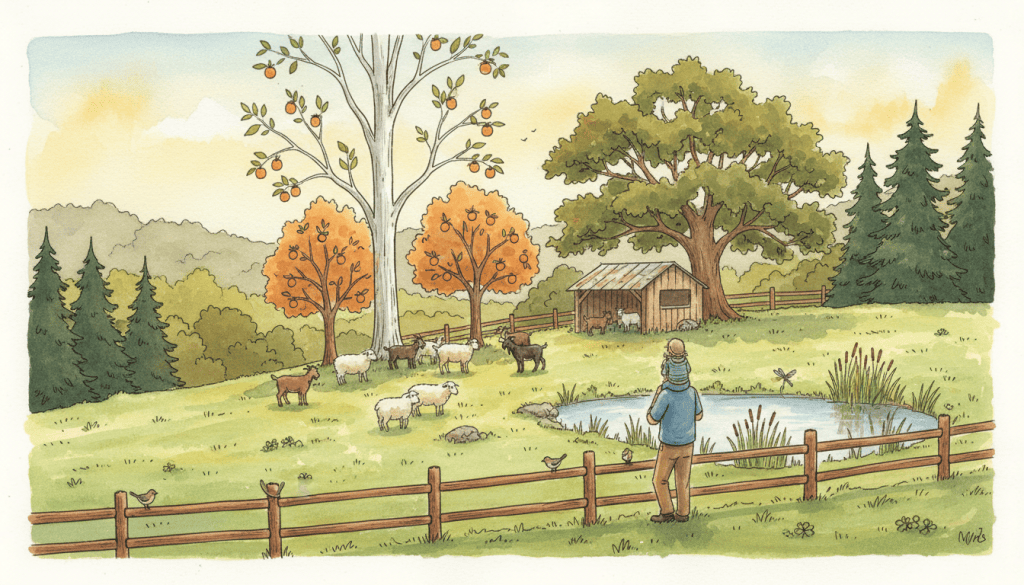
In short: The overgrown field at the Living Springs Log House was once a pasture, and it can become one again for rescued farm animals in a season or two. This article covers cutting cedars, managing lespedeza, brush hogging, and seeding. The second half covers water, shelter, and a timeline.
Part 2 of the Living Springs Log House Improvement Checklist. These are suggestions, not professional advice. See the full note at the end.
A Note From Patricia
I always knew this overgrown field could become a farm animal sanctuary. I could see it and feel it. What I didn’t know was how many creative ways there are to bring it back, and I’m so grateful to have learned them.
This was once a real pasture, and it was fairly clear before Barbara bought the property. Most of it is a gentle slope, with a few steep areas, and it will need fencing. There is a lot of work ahead.
The good news is that the work can be shared. In a co-living community, residents who work online could earn their living, help pay the mortgage, and give their time to getting the sanctuary up and running. I think there is a good chance many vegans and others from Northwest Arkansas would also love to come out to volunteer and get to know this place as an event center.
The possibilities are endless, and I am so excited! Thanks, Claude.ai of Anthropic, for writing this wonderful article.
Land that was cleared a generation ago and then left alone does not stay empty. In the Ozarks it fills in fast: eastern red cedar springing up wherever a bird dropped a berry, sericea lespedeza crowding out the grasses, and a scatter of sumac, sassafras, persimmon, and young oak. To a conventional farmer this looks like a problem to be bulldozed and sprayed. To us it looks like a resource waiting to be sorted.
Our goal is a pasture where rescued animals can graze, rest in the shade, and live out their lives in peace. We want to get there in a season or two, not ten years. And we want to do it in a way that heals the soil, feeds the wildlife, and wastes nothing. Here is how.
Start by Walking the Land
Before a single tree comes down, walk the field slowly, more than once, in different light. Permaculture begins with observation. Notice:
- Which trees to keep. Flag them with bright ribbon so no one cuts them by mistake. Good keepers are persimmons, oaks, black walnuts, hickories, and a few well-shaped mature cedars. Aim for scattered shade islands across the pasture so animals never have to walk far to get out of the sun.
- Where water goes. Watch where rain runs and where it pools. The slope tells you where to slow water down and where a shelter should never sit.
- High, dry ground. This is where the animal shelter will go.
- The winter wind. Our cold winds mostly come from the north and northwest. Shelters and windbreaks should answer that.
A simple sketch on paper, with the keeper trees, the water paths, and the high ground marked, will guide every decision that follows.
The Cedars: A Gift, Not Just a Chore
Eastern red cedar has one wonderful weakness. It cannot resprout from its roots. Cut it off below its lowest living branch and it is gone for good. No poison, no stump grinding, no digging. Small ones can be taken with loppers or a pruning saw, larger ones with a chainsaw.
Fall and winter are the best time to cut, which means the season is right now. Birds have finished nesting, the ground is firm, the weather is kind to the people doing the work, and the cleared ground will be ready for seeding in late winter.
Leave some cedars standing on purpose. A handful of mature, full-bodied cedars along the north and west edges make a living windbreak, and a few scattered through the field give year-round evergreen shade and shelter for songbirds.
Then put every cut tree to work:
- Fence posts and building poles. Cedar heartwood resists rot for decades in the ground. The straightest trunks become posts for the new pasture fence and the frame of the animal shelter. The land builds its own shelter.
- Brush berms on contour. Lay smaller trees and limbs in long rows following the contour of the slope. These “dead hedges” slow rainwater, catch soil that would otherwise wash away, and become shelter for rabbits, quail, and songbirds. Over the years they rot down into rich soil.
- Wildlife brush piles at the field edges.
- Mulch and bedding. A wood chipper turns cut cedar into good pathway mulch and a pleasant-smelling layer under shelter bedding. Robert, my former husband and a resident at the log house, has a chipper that he would sell. It needs some repair, but it is an extremely important and handy tool for land like this, for mulch, bedding, and turning brush into material that builds the soil.
The Lespedeza: Let the Animals Help
Sericea lespedeza is the stubborn one. It was planted across the South for erosion control and it carries an enormous seed bank in the soil. Extension researchers have found that mowing alone weakens it but has not eliminated it, even after several years. The goal is not perfection. The goal is to stop it from going to seed and to tip the balance toward grasses.
Here is the good news for a sanctuary. Goats and sheep will eat lespedeza, and goats in particular can graze it hard enough to keep it from setting seed. Lespedeza is also rich in tannins, which have been studied for their ability to help goats and sheep resist intestinal parasites. So the plant everyone else is spraying can become part of a healthy diet for our rescued residents.
- Graze it young. Lespedeza is tender and palatable in spring and early summer, and turns woody and bitter later. Rotate goats or sheep onto infested areas while it is young.
- Mow in mid to late summer on any patches the animals missed, right as it begins to bud and before it flowers. That single cut prevents most new seed.
- Crowd it out. Lespedeza loves thin, poor, open ground. Thick grass and clover are its enemy. Every step that builds soil and fills in bare spots works against it.
- Be patient and persistent. Expect three years of steady effort before it fades into the background.
The Small Trees and Brush
Young sumac, sweetgum, and other volunteer saplings are best handled by browsing animals and by mowing. Goats strip leaves and bark from small woody plants and, over a couple of seasons, will clear brush that would take people weeks of work. Anything they leave behind can be cut and dropped in place as mulch. Plants that resprout from the stump, unlike cedar, will keep coming back for a while, so plan on cutting them back two or three times until they give up.
For Faster Results: Brush Hogging Part of the Field
Everything above is the slow, careful way, and it is the best way to heal the land. But a sanctuary may want a place for animals sooner. For immediate results, a brush hog, a heavy rotary mower pulled behind a tractor, can clear part of the field in a day or two. It knocks down lespedeza, briars, brush, and small saplings, including young cedars, which will not come back once they are cut below their lowest branch.
We do not have to choose one way or the other. A good plan is to brush hog only the gentlest part of the field, closest to the pond site and the water, and make that the first paddock. The rest of the land can be reclaimed the permaculture way, one section at a time.
- Walk it first. Flag the keeper trees, and look for hidden rocks, old stumps, stray wire, and holes. The flags from your first walk keep the operator away from the trees we want to save.
- Leave the steep areas to hand tools and animals. A tractor on a steep slope can roll over. Loppers, chainsaws, and goats are the safer way on the steep spots.
- Watch for sharp stubs. A brush hog can leave slanted, sharp stubs on cut saplings that can hurt hooves and puncture tires. Go back over them, or cut them flush by hand, before animals graze there.
- Time it kindly. Fall and winter, after the birds have finished nesting, are the best time, the same season as cutting cedars. In summer, a pass right as the lespedeza begins to bud keeps it from setting seed.
- Leave the clippings. The chopped material falls in place as mulch, protecting the soil and feeding it as it breaks down.
- Seed right behind it. Freshly mowed ground is a perfect place to scatter cool-season grass and clover, so pasture fills in before weeds do.
If no one on the property has a tractor and brush hog, brush hogging is often hired out locally by the hour or by the acre. Neighbors or the Madison County Conservation District may know who does it.
Another fast option is forest mulching. A forestry mulcher grinds brush and small trees right where they stand and leaves the chips on the ground as mulch, so nothing has to be piled, burned, or hauled away. Freedom Tree Service gave us an estimate of $1,500 for an 8-hour day, with about two days to clear an acre. You can read more in Forest Mulching: The Living Springs Log House Improvement Checklist, Part 10.
Building Pasture Instead of Just Clearing It
Clearing makes space. Seeding makes pasture. The fastest way to a green field is to work with the seasons:
- Fall (now): Cut cedars, build brush berms, set fence posts. Scatter cool-season seed such as orchardgrass, annual rye, and white clover on cleared ground where you can, then let animals or a light rake press it in.
- Late winter (February): Frost-seed red and white clover onto the bare spots. The freezing and thawing of the soil works the seed in for you. Clover feeds the soil with nitrogen and fills gaps where lespedeza would otherwise move in.
- Spring: Plant warm-season grasses and native forbs. Ask the Madison County Conservation District or the NRCS office about native seed mixes. They often have cost-share programs for pasture improvement and wildlife habitat.
- Summer: Rotational grazing and the mid-summer lespedeza mowing.
Rotational grazing is the heart of it. Divide the pasture into several paddocks with simple electric or woven-wire fencing and move animals often, giving each section a long rest. Grass that is grazed and then allowed to recover grows deeper roots, holds more water, and slowly shades out the weeds. The animals’ manure feeds the soil as they go. In a sanctuary there is nothing to harvest and sell, so the measure of success is simple: healthy animals and land that grows richer every year.
A Word About Persimmons
Persimmons are wonderful shade and wildlife trees and deserve to stay. One caution: horses, and to some degree other animals, can develop serious digestive blockages from eating large quantities of the fruit and seeds. If horses or donkeys will share this pasture, consider fencing around the persimmons in fall, or keeping the persimmon groves in a paddock used by other residents during fruit drop. Talk with your veterinarian about the specific animals you expect to take in.
Continue Reading
Water, four kinds of animal shelter, and a realistic timeline are in Water and Shelter for a Sanctuary Pasture.
A Few Insights
- Cedar cannot resprout from its roots, so cutting it is enough. No poison is needed.
- The plants others call weeds, like lespedeza, can become food and medicine for rescued goats and sheep.
- The slow way and the fast way can work together: brush hog one gentle paddock for quick results, and reclaim the rest the permaculture way.
A note on these suggestions: The repairs and improvements described here are our best understanding from research and our own experience living on the property. We are not contractors, engineers, or licensed inspectors, and these may not be the best or only solutions. Before starting any repair or project, please consult a qualified professional, such as a contractor, drainage specialist, or home inspector, who can look at the site in person.
How we wrote this together: This article was written together by Patricia, a resident of the Living Springs Log House, and Claude.ai, the AI assistant made by Anthropic. Patricia brought her knowledge of the overgrown pasture and her vision of a farm animal sanctuary shared by a community; Claude researched permaculture ways to reclaim the land and shaped it all into an article. The illustration was created with AI.
The Living Springs Log House Improvement Checklist
- Part 1: Catching the Rain
- Part 2: From Cedar Thicket to Sanctuary Pasture (this article)
- Part 3: Water and Shelter for a Sanctuary Pasture
- Part 4: Rocket Stoves for Heat and Cooking
- Part 5: Rocket Stoves Beyond the House
- Part 6: Re-Screwing the Metal Roof, Safely
- Part 7: Staying Cool Without Air Conditioning
- Part 8: Staying Cool, Room by Room
- Part 9: Caring for the Cypress Siding
- Part 10: Forest Mulching
- Part 11: Small Gaps, Honest Fixes
- Part 12: A Quieter Log House: Soundproofing
See more of the land, the spring, and the gardens at www.livingspringsloghouse.com


[…] Part 2: From Cedar Thicket to Sanctuary Pasture […]
LikeLike
[…] Part 2: From Cedar Thicket to Sanctuary Pasture […]
LikeLike
[…] Part 2: From Cedar Thicket to Sanctuary Pasture […]
LikeLike
[…] Part 2: From Cedar Thicket to Sanctuary Pasture […]
LikeLike
[…] Part 2: From Cedar Thicket to Sanctuary Pasture […]
LikeLike
[…] Start small. You don’t have to mulch everything at once. Forest mulching a small area first keeps the cost down and lets you see how the land responds. From there, permaculture techniques can carry the work further at a gentler pace, such as sheet mulching, planting cover crops, and letting animals help with grazing and browsing. You can read more in our permaculture article, From Cedar Thicket to Sanctuary Pasture. […]
LikeLike
[…] Part 2: From Cedar Thicket to Sanctuary Pasture […]
LikeLike
[…] water already flowing to the pond site, four kinds of shelter, and a realistic timeline. Start with the first half for clearing the […]
LikeLike
[…] more: A Farm Animal Sanctuary Already Written Into the Property, From Dream to Sanctuary, From Cedar Thicket to Sanctuary Pasture, and Water and Shelter for a Sanctuary […]
LikeLike
[…] more: A Farm Animal Sanctuary Already Written Into the Property, From Dream to Sanctuary, From Cedar Thicket to Sanctuary Pasture, and Water and Shelter for a Sanctuary […]
LikeLike
[…] into pasture again), 5% garden and lawn, and 40% forest, with roads running throughout. Read more: From Cedar Thicket to Sanctuary Pasture and Water and Shelter for a Sanctuary […]
LikeLike
[…] From Cedar Thicket to Sanctuary Pasture […]
LikeLike
[…] Part 2: From Cedar Thicket to Sanctuary Pasture […]
LikeLike
[…] Part 2: From Cedar Thicket to Sanctuary Pasture […]
LikeLike
[…] Part 2: From Cedar Thicket to Sanctuary Pasture […]
LikeLike