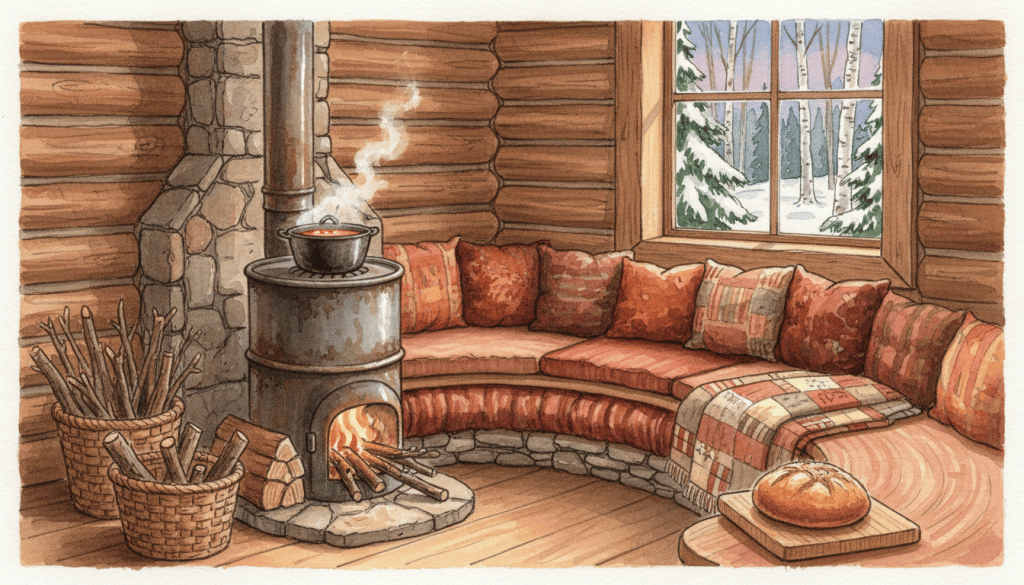
In short: Instead of spending $18,000 to replace the aging heating and air systems, a rocket mass heater could warm the log house with fallen sticks, cook and bake with the same fire, and keep working when the power goes out. The second half covers the basement suite, the metal building, and the animals.
Part 4 of the Living Springs Log House Improvement Checklist. These are suggestions, not professional advice. See the full note at the end.
I have known about rocket stoves for about ten years. Today something clicked. The heating and air system at the log house is getting older. It is working well, but the inspector and others have told us that once a system reaches this age, it is usually easier and less expensive to replace it than to keep repairing it. I got an estimate to replace both HVAC systems in the upper house and basement suite: $18,000! So the question came to me: what if, instead of putting that money into a new system, we looked at a rocket stove?
What Is a Rocket Stove?
A rocket stove is a simple, efficient wood-burning stove built around an L- or J-shaped burn chamber. Short sticks and small branches are fed in through a side opening. Air is pulled in underneath the fuel, and the fire rises up an insulated chimney called a heat riser. Because the chamber is insulated, the fire burns very hot, and that heat is the secret to everything good about it.
Less Smoke, Less Pollution
Smoke is unburned fuel. An open fire or a smoldering woodstove sends much of the wood up the chimney as smoke, soot, and creosote. A rocket stove burns hot enough that far more of the wood is burned completely, turning into heat instead of haze.
- Far less smoke once the stove is up to temperature
- Cleaner air for people, gardens, and animals
- Much less wood needed to do the same work
- Fallen sticks and branch trimmings become fuel, with no need to cut down trees
Heating the Two Upper Stories
The upper house has two stories with a large open space, and that is actually a good fit for a rocket mass heater. It warms a home in two ways. The steel drum over the fire gives off radiant heat right away, warming people and things nearby the way sunshine does. Then the hot exhaust travels through a long bench of cob, stone, or brick before it leaves by the chimney. The bench soaks up that heat and releases it slowly for many hours after the fire goes out, so a fire in the morning and another in the evening can keep the house comfortable all day.
The heater would sit on the main floor, in or near the open space. Heat rises, so the warmth naturally climbs to the second story, and the log walls themselves store heat much like the bench does. In a tall room, warm air can gather near the ceiling; a slow ceiling fan pushing air downward brings it back to where people are. A mass bench is very heavy, so the floor beneath it needs to be checked, and the heater needs to be sized to the space.
Cooking and Baking with the Same Fire
In the main house, one fire could do even more. The flat top of a rocket heater’s steel drum gets hot enough to simmer a pot of soup or beans. Some rocket heaters are also built with an oven in the path of the hot exhaust, so the same fire that warms the house bakes bread and roasts vegetables. A wood-fired cookstove with an oven, the kind many Ozark kitchens once had, is another way to bring cooking and heating together. Either way, the fire is doing three jobs at once (heating, cooking, and baking) with no propane and no electricity.
Comparing the Costs
Replacing both heating and air systems, in the upper house and the basement suite, would cost about $18,000. After that, the propane and electric bills keep coming every winter.
A rocket mass heater costs far less to build. Builders sharing their real costs on the Permies.com forum report:
- Under $500 when materials are scavenged and a chimney is already in place
- About $1,500 to $5,000 for a do-it-yourself build with new materials
- Roughly $5,000 to $9,000 when most of the labor is hired
The Winter Savings
Once it is built, a rocket heater runs on fallen sticks and branches from the land, which cost nothing but the time to gather them. Propane, by comparison, was averaging about $2.60 a gallon nationally in early October 2026. Every cold day the rocket heater carries the load is a day the propane tank lasts longer and the electric bill drops. Over several winters, those savings add up on top of the money not spent on a new system.
When the Power Goes Out
A rocket mass heater needs no electricity at all. In an ice storm, when the power can be out for days, the house stays warm and there is still a way to cook. That kind of security is hard to put a price on.
Finding the Right Person to Help
This is the key: finding a really good person who knows how to build one. That person might be:
- A rocket mass heater builder; many learned through hands-on workshops
- A natural builder or mason who works with cob, stone, and brick
- A permaculture designer with heating experience
- A plumber who knows radiant floor heating, for an outdoor version that heats water
- A certified chimney sweep to inspect the chimneys before any fire goes in
Someone who also works in heating and cooling, and who understands both the old system and the new idea, would be ideal.
Continue Reading
Heating the basement suite from outside, the metal building’s barrel stove, and keeping animals warm are in Rocket Stoves Beyond the House.
A Few Insights
- Cleaner burning and using less wood are the same thing: a hotter fire wastes less.
- An aging system can be an invitation to rethink, not just replace.
- One fire can heat, cook, and bake, with no propane and no electricity.
Related articles
- Rocket Stoves Beyond the House: The Living Springs Log House Improvement Checklist, Part 5
- Staying Cool Without Air Conditioning: The Living Springs Log House Improvement Checklist, Part 7
- Staying Cool Without Air Conditioning, Room by Room: The Living Springs Log House Improvement Checklist, Part 8
- An Off-Grid Living Checklist for the Arkansas Ozarks
A note on these suggestions: The repairs and improvements described here are our best understanding from research and our own experience living on the property. We are not contractors, engineers, or licensed inspectors, and these may not be the best or only solutions. Before starting any repair or project, please consult a qualified professional, such as a contractor, drainage specialist, or home inspector, who can look at the site in person.
How we wrote this together: This article was written together by Patricia, a resident of the Living Springs Log House, and Claude.ai, the AI assistant made by Anthropic. Patricia brought ten years of interest in rocket stoves and the idea of using one in place of replacing the aging heating and air systems; Claude helped with background on how rocket stoves work, gathered the cost figures, and shaped the ideas into an article. The illustration was created with AI.
The Living Springs Log House Improvement Checklist
- Part 1: Catching the Rain
- Part 2: From Cedar Thicket to Sanctuary Pasture
- Part 3: Water and Shelter for a Sanctuary Pasture
- Part 4: Rocket Stoves for Heat and Cooking (this article)
- Part 5: Rocket Stoves Beyond the House
- Part 6: Re-Screwing the Metal Roof, Safely
- Part 7: Staying Cool Without Air Conditioning
- Part 8: Staying Cool, Room by Room
- Part 9: Caring for the Cypress Siding
- Part 10: Forest Mulching
- Part 11: Small Gaps, Honest Fixes
- Part 12: A Quieter Log House: Soundproofing
See more of the log house, the spring, and the gardens at www.livingspringsloghouse.com


[…] Part 3: Rocket Stoves for Heat and Cooking […]
LikeLike
[…] A rocket stove for cooking. A rocket stove burns fallen sticks cleanly and keeps the cooking heat outdoors. You can read more in our article, Rocket Stoves: Clean Fire for a Self-Reliant Life at the Log House. […]
LikeLike
[…] Part 3: Rocket Stoves for Heat and Cooking […]
LikeLike
[…] Part 3: Rocket Stoves for Heat and Cooking […]
LikeLike
[…] Part 3: Rocket Stoves for Heat and Cooking […]
LikeLike
[…] Part 3: Rocket Stoves for Heat and Cooking […]
LikeLike
[…] Part 3: Rocket Stoves for Heat and Cooking […]
LikeLike
[…] A rocket stove for cooking. A rocket stove burns fallen sticks cleanly and keeps the cooking heat outdoors. You can read more in our article, Rocket Stoves: Clean Fire for a Self-Reliant Life at the Log House. […]
LikeLike
[…] the metal building’s barrel stove, keeping animals warm in winter, and other uses. Start with the first half for how rocket stoves work and what they […]
LikeLike
[…] The heating and air systems are getting older. Replacing both was estimated at about $18,000. We’ve written about lower-cost alternatives in Staying Cool Without Air Conditioning and Rocket Stoves. […]
LikeLike
[…] plus a large propane wall heater in the kitchen/dining room as a power-outage backup. Read more: Rocket Stoves, Clean Fire for a Self-Reliant Life and Rocket Stoves Beyond the […]
LikeLike
[…] Part 4: Rocket Stoves for Heat and Cooking […]
LikeLike
[…] Part 4: Rocket Stoves for Heat and Cooking […]
LikeLike
[…] Rocket Stoves, Clean Fire for a Self-Reliant Life: The Living Springs Log House Improvement Checklis… […]
LikeLike