In short: Three small things were found by the garage stairs: a corner gap once stuffed with steel wool, bare unfinished stairs, and a gap beside a door frame. All three are small, inexpensive fixes, and this article explains each one.
These are suggestions, not professional advice. Click here to read the full note.
The repairs and improvements described here are our best understanding from research and our own experience living on the property. We are not contractors, engineers, or licensed inspectors, and these may not be the best or only solutions. Before starting any repair or project, please consult a qualified professional, such as a contractor, drainage specialist, or home inspector, who can look at the site in person.
Part 11 of the Living Springs Log House Improvement Checklist. A disclosure of three small conditions found on October 15, 2026, with what they likely mean and how to fix them.
At a Glance
- A small gap in a wall corner at the garage stairs was once stuffed with steel wool. It now looks rusty and frayed. A dead-animal smell was noticed nearby once, and it has since gone away. No signs of animals have been seen anywhere in the log house.
- The wooden stairs are bare, unfinished wood with old paint drips.
- There is a gap between the door frame and the wall at the doorway by the garage stairs.
- None of these has been repaired yet. All three are small, inexpensive fixes.
Why We’re Sharing This
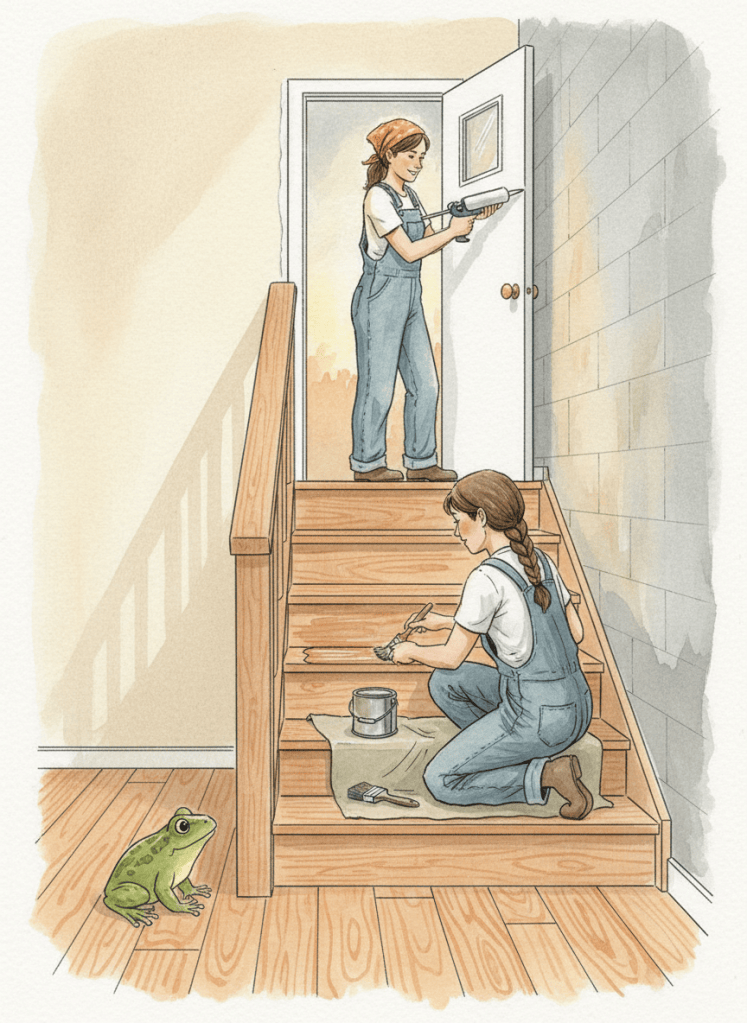
A house is honest about itself if you look closely enough. Living in a log house in the Ozarks means living alongside weather, wood, and the small creatures nearby. So far, the only regular visitor is a friendly frog that often hops around when Patricia goes to close the garage door in the evening. We’d rather show these things plainly than have anyone discover them later.
1. The Corner Gap and the Steel Wool
What was found: Where the wall corner meets the wooden stair trim, there is a small gap. Patricia filled it with steel wool some time ago, having heard that it keeps mice out. It now looks brown, frayed, and possibly chewed. Around the same time, she noticed what smelled like a dead animal. That smell is gone now.
What it likely means: Regular steel wool rusts when it gets damp, and rusted steel wool crumbles and frays, so the chewed look is most likely rust breaking down. Patricia has not seen any signs of animals in the garage, on the stairs, or anywhere in the log house. The smell may have come from a small animal that died inside the wall or nearby. That can’t be confirmed, and the smell has not come back.
Recommended fix:
- Wear gloves and a dust mask. Lightly spray the area with a household disinfectant, let it sit a few minutes, then wipe it up. Don’t sweep or vacuum it dry, since dust from mouse droppings shouldn’t be stirred into the air.
- Pull out the old steel wool.
- Pack the gap firmly with copper mesh or stainless steel wool. Both resist rust, and mice dislike chewing them.
- Seal over the mesh with paintable caulk or patching compound (or a pest-blocking foam, trimmed flush once dry), then paint to match.
- Keep an eye out for droppings, gnaw marks, or odor. If any signs ever appear, check the outside of the house near this spot for an entry point.
2. The Unpainted Stairs
What was found: The stair treads and risers are bare wood, never painted or sealed, with scattered drips of old white paint.
What it means: This isn’t a structural problem. Unfinished wood is just more likely to absorb stains and wear faster.
Recommended fix:
- Scrape off the paint drips, clean the wood, and sand lightly.
- Caulk the small gaps where the stairs meet the walls.
- Choose a finish: a clear, water-based satin polyurethane keeps the natural wood look that suits a log house; porch-and-floor paint is the other option.
- Either way, add an anti-slip grit to the finish or use clear grip strips, and avoid a glossy finish on stair treads.
3. The Gap Between the Door Frame and the Wall
What was found: At the doorway by the garage stairs, there’s a visible gap where the door frame meets the wall. Yellow expanding foam shows inside it, and at the bottom the gap runs down toward the same stair corner described above.
What it means: The foam was likely put in when the door was installed, but the gap was never finished over with caulk or trim. It’s mostly cosmetic, though open gaps can also give insects and mice a pathway.
Recommended fix:
- Trim any foam sticking out, flush with a utility knife.
- For a gap under about a quarter inch, fill with paintable acrylic latex caulk. For a wider gap, press in foam backer rod first and caulk over it, or cover it with a thin strip of trim.
- Paint to match.
- Also check that the door closes and latches evenly. If there’s a gap between the door itself and the frame, tightening the hinge screws or adding weatherstripping usually fixes it.
Status
As of October 15, 2026, all three conditions are documented with photos and have not yet been repaired. This article will be updated once the work is done.
A Few Insights
- Steel wool is a common fix that doesn’t last in damp places. Copper mesh does the same job without rusting away.
- The three conditions are connected: the stair corner and the door-frame gap meet in the same spot, so sealing them together closes off one possible path for mice before anything uses it.
- Small, visible things are the easiest to disclose and the cheapest to fix. Naming them openly builds more trust than hiding them.
Related articles
- Foundation Edge Disclosure and Repair Guide
- Caring for the Cypress Siding: The Living Springs Log House Improvement Checklist, Part 9
- From Bat Roost to Bright Room, Part 1: Cleaning Out the Log House Attic
- A Quieter Log House, Do-It-Yourself Soundproofing: The Living Springs Log House Improvement Checklist, Part 12
How We Wrote This Together
This article was written collaboratively by Patricia, a resident of the Living Springs Log House, and Claude.ai, an AI assistant made by Anthropic. Patricia took the photos, described what she noticed, and shared what she had tried. Claude looked at the photos, offered an analysis of what each condition likely means, and suggested practical repairs, which Patricia then shaped into this disclosure. The illustration was created with AI.
Credit: Analysis, repair suggestions, and drafting assistance were provided by Claude.ai, Anthropic’s AI assistant.
The Living Springs Log House Improvement Checklist
- Part 1: Catching the Rain
- Part 2: From Cedar Thicket to Sanctuary Pasture
- Part 3: Water and Shelter for a Sanctuary Pasture
- Part 4: Rocket Stoves for Heat and Cooking
- Part 5: Rocket Stoves Beyond the House
- Part 6: Re-Screwing the Metal Roof, Safely
- Part 7: Staying Cool Without Air Conditioning
- Part 8: Staying Cool, Room by Room
- Part 9: Caring for the Cypress Siding
- Part 10: Forest Mulching
- Part 11: Small Gaps, Honest Fixes (this article)
- Part 12: A Quieter Log House: Soundproofing
See more of the Living Springs Log House at www.livingspringsloghouse.com


[…] Part 8: Small Gaps, Honest Fixes […]
LikeLike
[…] Part 8: Small Gaps, Honest Fixes […]
LikeLike
[…] Part 8: Small Gaps, Honest Fixes […]
LikeLike
[…] Part 8: Small Gaps, Honest Fixes […]
LikeLike
[…] Part 8: Small Gaps, Honest Fixes […]
LikeLike
[…] Part 8: Small Gaps, Honest Fixes […]
LikeLike
[…] Part 8: Small Gaps, Honest Fixes […]
LikeLike
[…] Small Gaps, Honest Fixes […]
LikeLike
[…] Honest notes on repairs and small fixes. Read more: Foundation Edge Disclosure and Repair Guide and Small Gaps, Honest Fixes […]
LikeLike
[…] Part 11: Small Gaps, Honest Fixes […]
LikeLike
[…] Part 11: Small Gaps, Honest Fixes […]
LikeLike
[…] Part 11: Small Gaps, Honest Fixes […]
LikeLike
[…] Part 11: Small Gaps, Honest Fixes […]
LikeLike
[…] Small Gaps, Honest Fixes: The Living Springs Log House Improvement Checklist, Part 11 […]
LikeLike