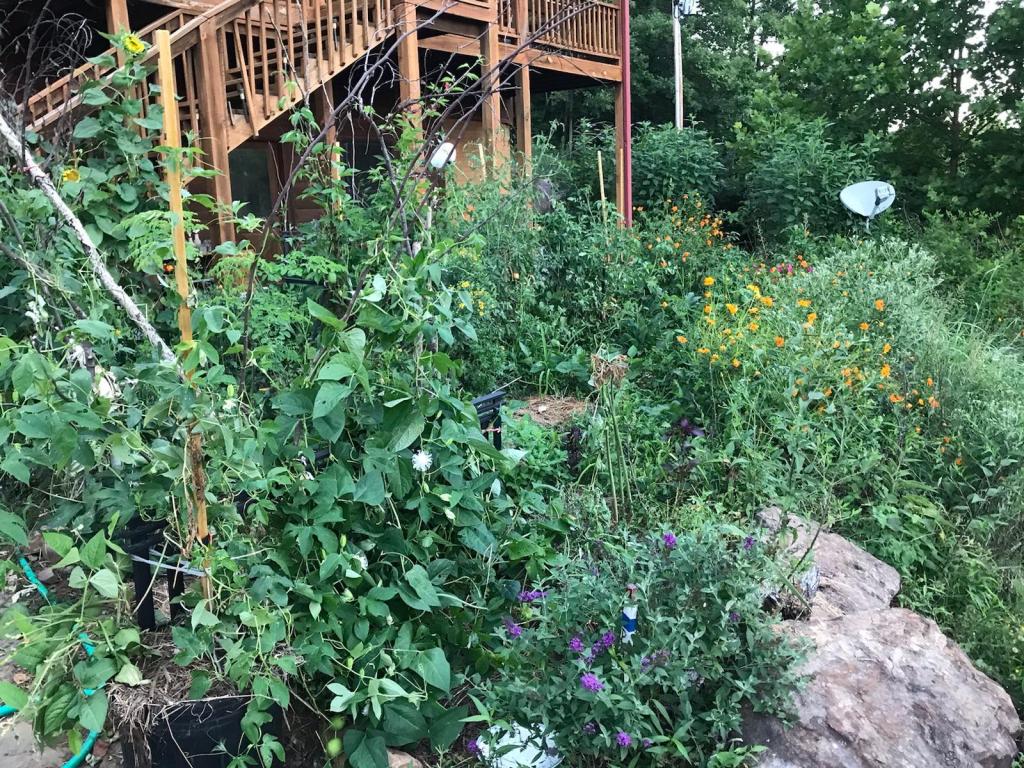
Inside a sturdy fence, behind a handsome gate, there’s a patch of ground about 40 by 55 feet that I love more than almost anywhere on this land. It’s our organic garden, and it didn’t start out looking like much: just a long, deep hole in the ground and a lot of buckets of compost.
It began with a banana circle, sort of
When I started, I followed instructions for something called a banana circle. It comes from permaculture, and it’s simpler than it sounds. You dig a round pit roughly two meters across and up to a meter deep, and the center becomes a wet composting area. The soil you dig out gets mounded around the edge into a raised ring, and that’s where the plants go. The compost in the middle feeds everything around it. It’s composting you never have to turn, and the organic matter soaks up water and lets it seep slowly out to the roots.
It’s called a banana circle because it was designed for the tropics, where bananas are hungry, thirsty plants. But the idea travels. Gardeners in cooler places use the same system for other heavy feeders, and the planting doesn’t even have to be a circle; a line works too, as long as every plant can reach the compost trench.
That’s what I did. Ozark bananas weren’t the goal; food was. I dug a very deep trench and filled it with compost I’d been collecting, bucket after bucket. It wasn’t easy. A mattock was the only tool that would dig into the rocky soil, and I pulled out some rocks I was amazed I could handle. Then I planted, and the garden began to grow.
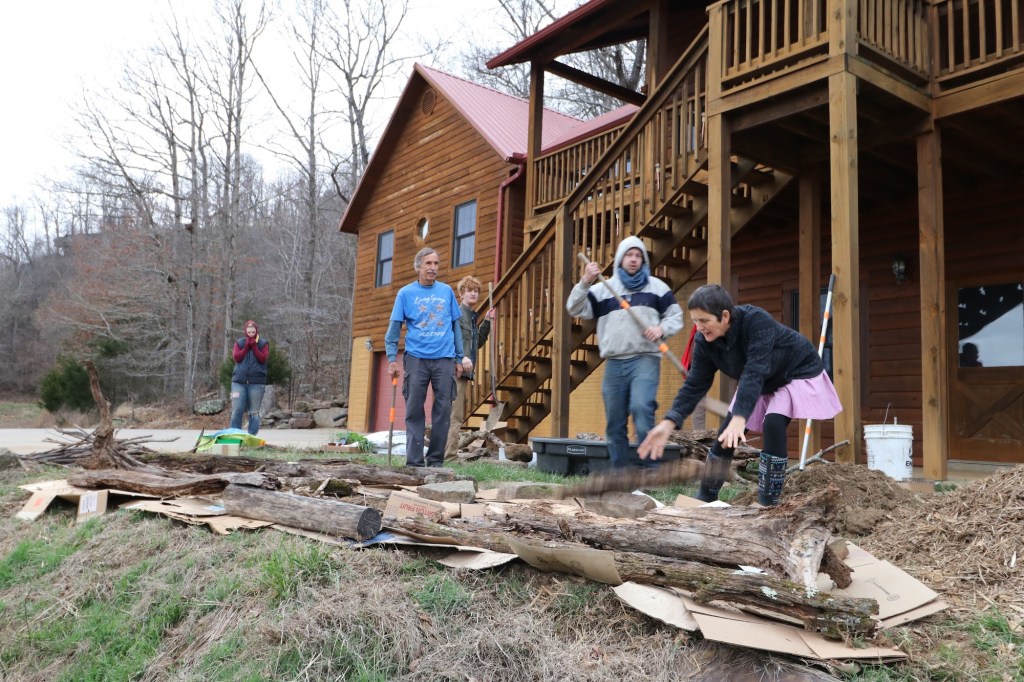
Feeding the soil, year after year: 9 years total
Once the soil started coming alive, I couldn’t stop. I kept expanding the garden a little at a time. I added vertical growing with cattle panels, those sturdy livestock fence panels that bend into arches and trellises, so beans and vines could climb and the ground space could do double duty.
Mostly, I kept feeding the soil. I laid down cardboard, and then lots and lots of mulch: leaves, pine needles, wood chips, and organic matter gathered from the forest, plus some ashes. The worms love the cardboard. It also smothered the Bermuda grass. I still have to pull some Johnson grass and Bermuda, but very little.
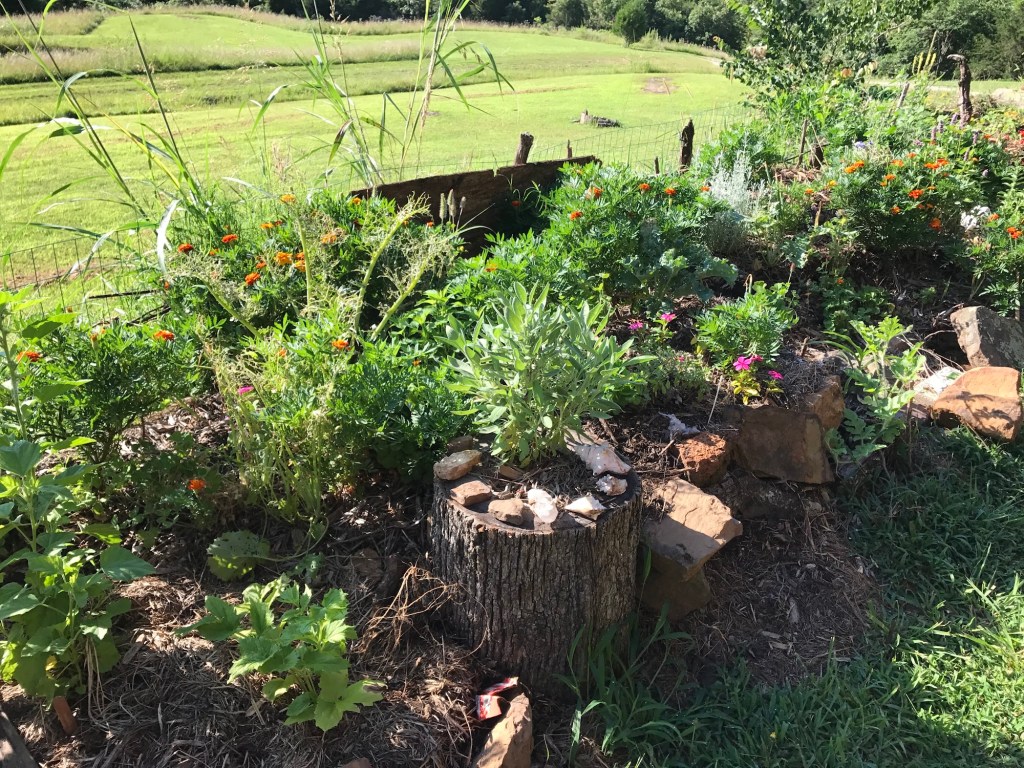
I know I could do even better. There are so many more things I could try. But still, it’s a great garden.
A family season
My son and daughter-in-law lived here for about six or seven months, from January 2026 to around July 2026, and the garden was one of the projects they dove into. They enriched the soil with rabbit manure, more hugelkultur, and plenty of mulch. My son also put in a wonderful new fence to replace the old electric fence that was falling apart, and installed a nice gate. He’s good at gates. And fences.
I’m so grateful for their work. I feel very sad that they couldn’t stay to reap what they sowed, but their time here was a blessing, and the garden still carries it. I bring some vegetables to them when I visit.
Two little beds that say “welcome”
In early August I built two small hugelkultur beds. The house is being sold, but I’m not going to stop gardening just because of that. Those beds are my way of telling the new owners: you are welcome here.
What is hugelkultur?
Hugelkultur (say HOO-gul-kul-TOOR) is German for “hill culture.” Instead of hauling off fallen logs, branches, and leaves, you bury them and build a garden mound on top. You pile up woody material, cover it with compost and topsoil, and plant right into the mound.
The magic is in the wood. As the logs rot, they act like sponges, holding water and giving it back to plants over a long stretch of time. The beds encourage worms, fungi, and other good soil life, and the soil actually gets better from one season to the next. In a sense it’s a slow, buried cousin of the banana circle: both turn what the land drops into food for what grows next.
To be fair, the benefits mostly come from gardeners’ experience rather than formal research. I can only tell you what I’ve seen in my own beds.
This year’s harvest
What a harvest we had! Especially the green beans and tomatoes. They just kept coming.
I also love the dock and the other wild edibles that are thriving here. I let them grow. They chose this soil, and I’m glad to share it with them.
Now it’s time to throw out some seeds that like the cool weather and see what happens. Whatever comes up will be a gift for the new owners.
The compost, the chickens, and freedom
A compost pile is part of the garden too, built right against the outside so it keeps feeding the beds.
For a while, Robert, my former husband and a resident at the log house, kept chickens in part of the garden. Robert isn’t vegan. Barbara and I gave him the freedom to do what he needed to do to meet his own needs. A garden can hold more than one way of living, and so can a home. However, in any future home I have, there will be strict rules: no exploitation of animals at all. I compromised, but I regretted it.
I love this garden. Nine years of compost, cardboard, mulch, rotting logs, and family hands are in that soil, and you can taste it in every bean.
How we wrote this together
This article was written collaboratively by Patricia, a friend of Barbara’s and a resident of the Living Springs Log House, and Claude.ai, an AI assistant made by Anthropic. Patricia shared the garden’s story in her own words: the trench, the buckets of compost, the cardboard and mulch, the fence and gate, the harvest. Claude researched banana circles and hugelkultur, explained them plainly, and shaped her memories into an article.
A few insights
- This garden layers techniques. It started as a trench version of a banana circle, then grew with cardboard and forest mulch, hugelkultur, and manure. Each built on what came before.
- Nothing here was wasted. Cardboard, leaves, pine needles, ashes, fallen wood, and even the “weeds” ended up feeding the garden or the people in it.
- Gardening is an act of hope. The newest beds were built for people who haven’t arrived yet. Patricia’s son and daughter-in-law sowed what they couldn’t stay to harvest, and Patricia is planting for owners she hasn’t met.
Sources
- Banana Circle – Full Cycle Permaculture
- How to Build a Banana Circle – PermacultureFX
- Hugelkultur – Maine Organic Farmers and Gardeners
- What Is Hugelkultur? – Gardenista
- Hugelkultur – Canada’s Local Gardener


[…] Read more about the gardens: The Spectacular Permaculture, Wild Edible, Pollinator, Native Gardens, Medicinal and Other Plants Come Up Every Year, and The Garden That Grew From a Trench. […]
LikeLike
[…] more about the gardens: The Garden That Grew From a Trench, The Spectacular Permaculture, Wild Edible, Pollinator, Native Gardens, and Comfrey: The Plant I […]
LikeLike
[…] Read more: Homesteading in the Ozarks, Living Off the Grid, Gently, An Off-Grid Living Checklist for the Arkansas Ozarks, and The Garden That Grew From a Trench […]
LikeLike
[…] more: Homesteading in the Ozarks, Living Off the Grid, Gently, The Garden That Grew From a Trench, and The Cave Spring: Where the Water Comes […]
LikeLike
[…] 40′ x 55′ established organic garden. Read more: The Garden That Grew From a Trench […]
LikeLike
[…] The Garden That Grew From a Trench: Nine Years of Feeding the Soil at Living Springs Log House […]
LikeLike