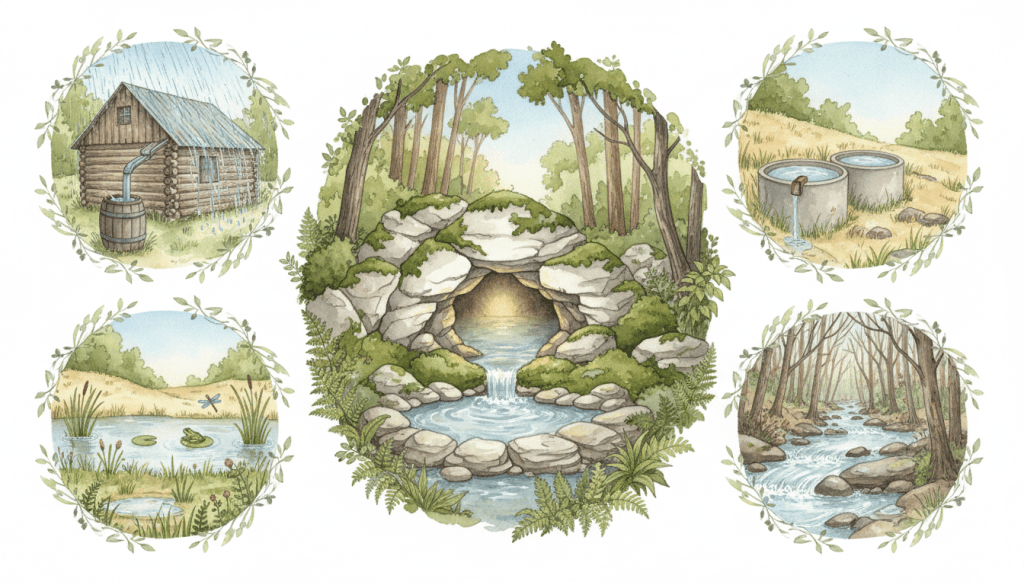
In short: A cave spring has been the log house’s only water source for nine years, filling two cisterns. The roofs, the overflow, and a pond site on the hill could catch and store much more. This article covers the proven water. A second article covers the possible springs, the creek, and storing water for drought.
By Patricia Mikkelson, resident and friend of the owner, Living Springs Log House
I have lived at the Living Springs Log House for nine years, longer than I have lived anywhere else. If you ask me what this land teaches, my answer is water. It falls on the roofs, runs down the hill, seeps from the ground, rises from a cave, and rushes toward the lake after a good rain.
Some of what I describe is proven by nine years of daily living. Some is only potential. I don’t know whether the wet places on this land are true springs. Nobody can promise that until it has been investigated. I’m sharing what I’ve seen with my own eyes, and anyone who loves this land should explore it for themselves.
Take the Video Tour
This video shows most of the water systems at the Living Springs Log House.
The Proven Source: The Cave Spring and the Cisterns
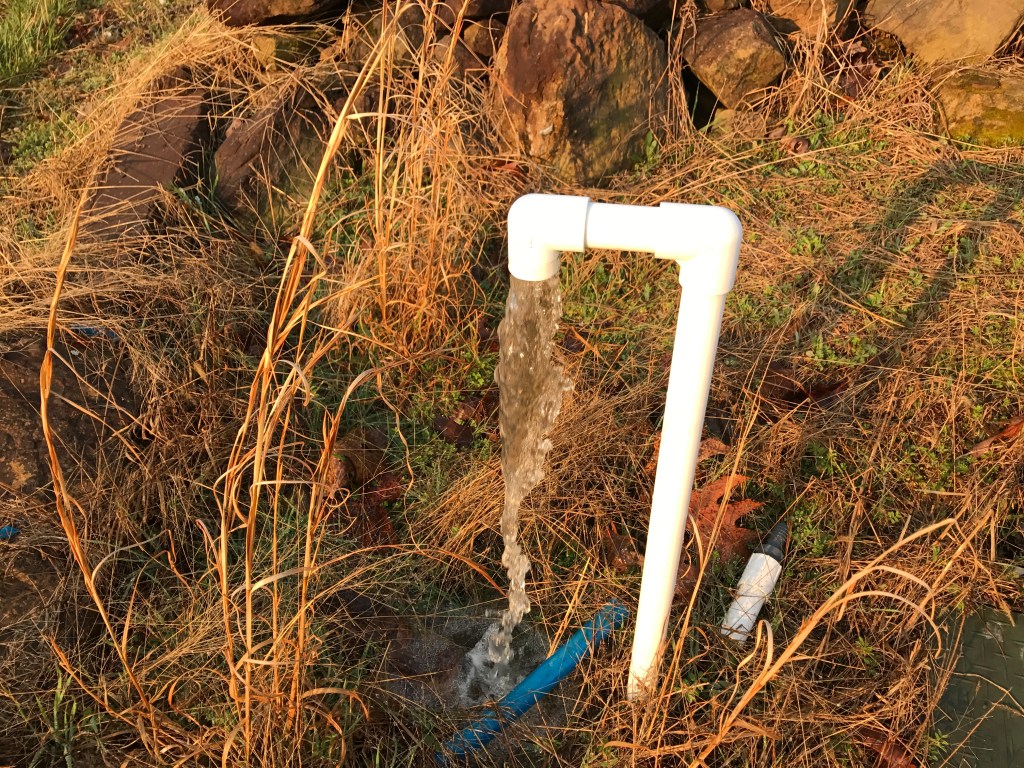
For nine years the cave spring has filled our cisterns, and it is the only water source we use. We have no city water and no other supply. The cisterns have stayed full enough for our use through hot Ozark summers and cold winters, except when someone forgot to turn off a hose or when technical difficulties came up.
Both cisterns have overflow pipes. When the cisterns are full, the extra water leaves through those pipes, and right now most of it simply drains away. That overflow is an opportunity. It could be piped to a garden, a stock tank, a pond, or more storage tanks, so that water now lost gets saved for later.
Water From the Sky: The House and Metal Building Roofs
Every roof is a water catchment. Here is a useful rule of thumb: one inch of rain on 1,000 square feet of roof gives roughly 600 gallons of water. Northwest Arkansas gets a generous amount of rain in a typical year, so the house and metal building roofs together could gather many thousands of gallons.
The gutters, downspouts, and pipes are already in place. The gutters are on the small side, though, and in heavy rain they overflow. Larger gutters and downspouts would capture much more. From there, the water can be directed wherever it’s needed:
- Rain barrels at each downspout for watering gardens and flower beds
- Larger tanks (food-grade poly tanks or metal tanks) for bigger storage
- Additional cisterns for long-term storage
- Ponds and swales to soak water into the land
A simple “first flush” diverter keeps the first, dirtiest rinse off the roof out of storage tanks. For drinking, roof water would need proper filtering and testing.
Slow It, Spread It, Sink It
On a hillside, rain wants to race downhill and leave. The permaculture saying “slow it, spread it, sink it” describes the opposite approach: catch water and give it time to soak into the soil, where it feeds plants, trees, and the groundwater below.
- Swales are shallow ditches dug level along the contour of a hill, with a mound on the downhill side. They catch running water and let it soak in.
- Berms and rain gardens hold water near trees and gardens.
- Rock check dams in small drainages slow the flow and reduce erosion.
- Mulch and deep-rooted plants help the soil drink like a sponge.
Water held in the land helps green the hillside and recharge the ground that feeds seeps and springs downhill.
The Pond on the Hill
A system is already in place to feed the pond site, which sits on a level spot partway up the hill. The pond needs to be dug out, and that level ground could allow it to be quite large. Water held higher on a hillside is valuable, because gravity can carry it downhill to gardens, animals, or other ponds without pumps.
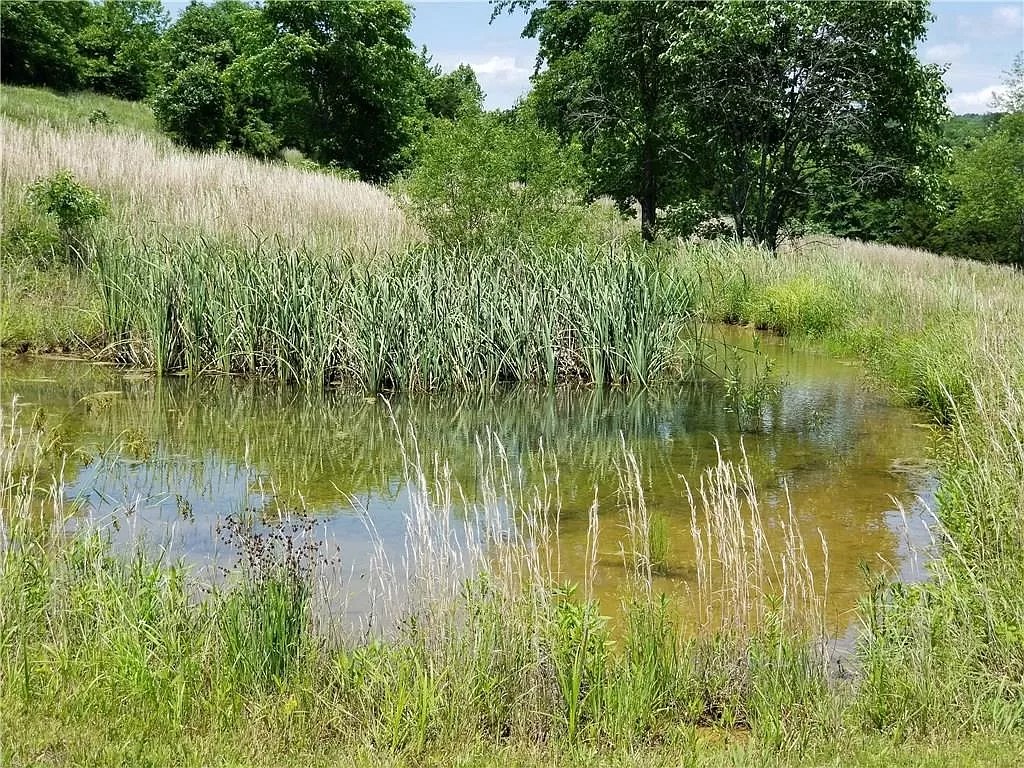
Could it spill into a second pond? Yes, that is a common design called a pond chain or cascade. The upper pond fills first, and when it’s full the water flows through a planned spillway into a lower pond, then perhaps on to swales or gardens. Each pond holds water longer and gives wildlife another place to drink.
A good pond depends on soil that holds water, a well-built dam or bank, and a safe spillway for big storms. The free local experts listed in the second article can help answer these questions. Larger dams can also require state approval, so check before building.
Continue Reading
The seep, the wet spot at the bottom of the property, the wet-weather creek, storing water for drought, and who can help are in The Possible Springs, the Creek, and Storing Water at the Living Springs Log House.
A Few Insights
- The proven water here is the cave spring.
- Every roof is a water source: one inch of rain on 1,000 square feet of roof gives about 600 gallons.
- Water held higher on the hill can flow downhill to where it’s needed, with no pumps.
How we wrote this together: This article was written together by Patricia Mikkelson, a resident of the Living Springs Log House, and Claude.ai, an AI assistant made by Anthropic. Patricia shared nine years of living with the water on this land. Claude researched water harvesting and ponds and helped shape the article. The illustration was created with AI.
To see photos of the land, the metal building, the gardens, and the spring, visit www.livingspringsloghouse.com


[…] For the whole story of the water on this land, including the cave spring, the seep, and the wet-weather creek, read Water, Water Everywhere: The Water Story of Living Springs. […]
LikeLike
[…] explains how to explore them, how to store water for drought, and who can help for free. Start with Water, Water Everywhere for the proven […]
LikeLike
[…] Maybe, but we can’t promise it. There is a seep on the upper part of the property near the house, and a spot on the lower part of the property where a puddle has been seen holding water. We haven’t watched them through every season. Buyers are welcome to look for themselves. Read Water, Water Everywhere: The Water Story of Living Springs. […]
LikeLike
[…] above the house — one of the property’s defining features for homesteading. Read more: Water, Water Everywhere, The Possible Springs, the Creek, and Storing Water, and Catching the […]
LikeLike
[…] Water, Water Everywhere: The Water Story of the Living Springs Log House […]
LikeLike
[…] Water, Water Everywhere: The Water Story of the Living Springs Log House […]
LikeLike