I think about the usefulness of this property and wonder, “Could someone actually make a living out here?” It’s a good question. Living on the land is one thing; paying for it is another. After years at the Living Springs Log House, I’ve come to see that these 14.75 acres hold many ways to earn, and most of them can be mixed and matched. Here’s every idea I can think of, from the practical to the dreamy, with links to articles where I’ve written about them in more detail.
From the start, the basics are already here. The house has electricity and high-speed internet, so anyone who runs an online business can keep working from the first day, while the land-based ideas below take root.
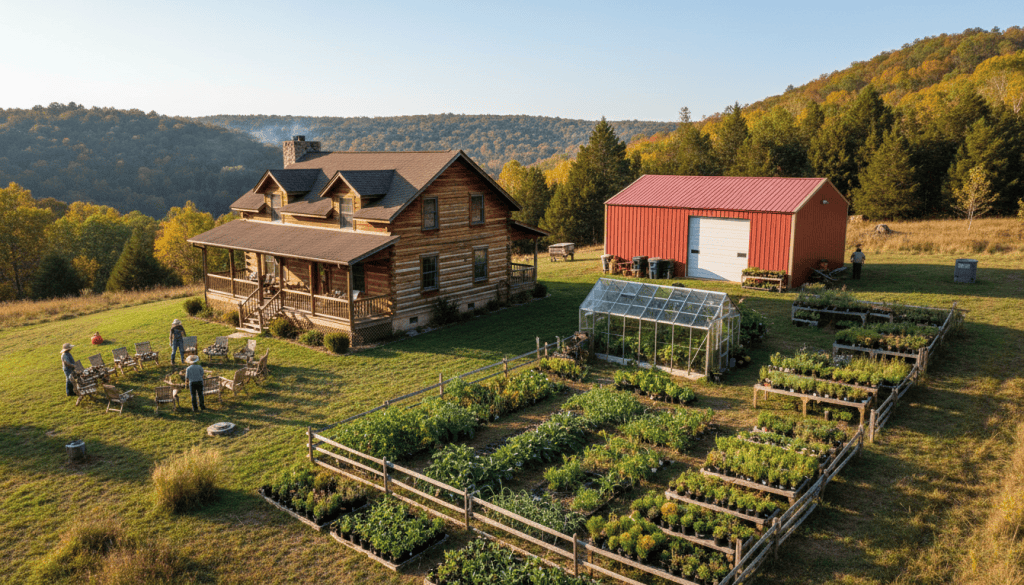
Homes that bring in income
- Co-living. Private bedroom suites and shared spaces make the house a natural fit for renting rooms to people who want to live in community. Why I think it could work well for co-living, and the Vegan Co-Living Handbook.
- Sober living. Similar to co-living, but with a different purpose: a quiet, structured home for people in recovery. A Quiet Place to Heal.
- Multigenerational family business. To me this is the ideal: grandparents, parents and children living and working the land together, each generation bringing its own skills. Multigenerational living here and a guide for families dreaming of a shared homestead.
- Co-housing and intentional community. Members share costs and can start shared businesses. A Common House Already Built and Room for a Village.
- Renting the basement suite. It has its own entrance, one very large room, two small rooms and a full bathroom, with rough-in hookups for a kitchen. Its central heating and air doesn’t work right now, but space heaters and a window air conditioner keep it comfortable, because it’s so well insulated. It could be a long-term rental, or a small home for an elder who wants to live near family.
- Small homes for elders. With the right licensing, a few seniors could live here together in the country, with family close by.
- More rooms for more people. The house could be expanded, including finishing the attic, so there’s room for many more residents and guests. Room to Grow.
The metal building: mushrooms and much more
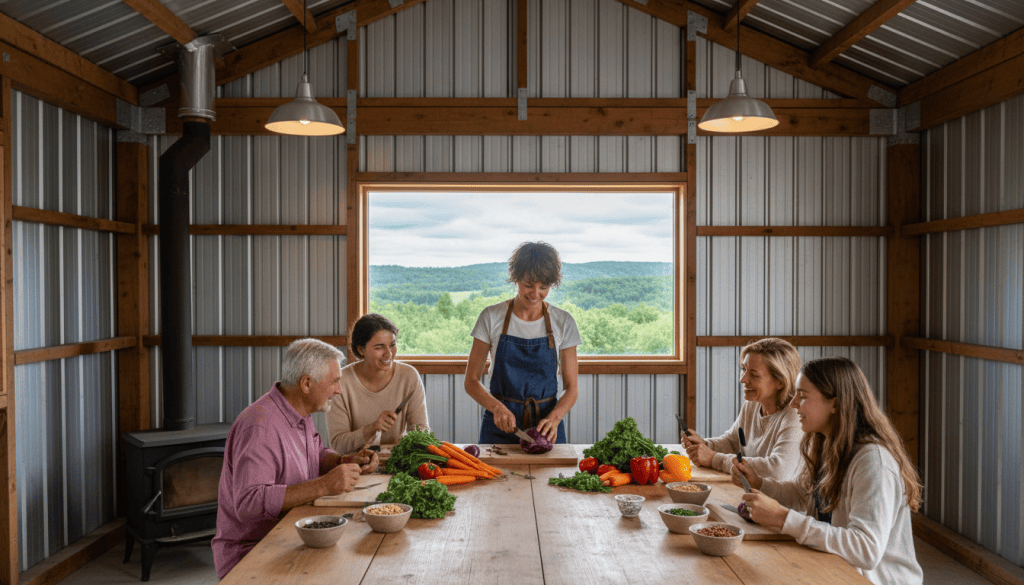
The 40-by-60-foot insulated metal building, with power, a bathroom, a wood stove, its own septic system and a 14-foot door, is one of the land’s biggest assets. More about the metal building.
- A mushroom farm. Gourmet mushrooms like oyster and lion’s mane can be grown indoors year-round in just part of the building, leaving the rest free for other uses. Shiitake can also be grown on hardwood logs in the woods. Read the full story in A Mushroom Business in the Barn, Part 1 and Part 2.
- Classes and workshops: plant-based cooking, gardening, canning, wild-foods walks and mushroom growing, with many more ideas in “A teaching homestead” below.
- A makerspace or studio: woodworking, art, crafts, repair work, or a canning kitchen. Space could also be rented to others.
- Events and gatherings: community dinners, music nights, conferences in the Open Space style, and celebrations.
Growing and selling plants
- A nursery of useful plants. Comfrey grows from root pieces and comes back year after year. Wild edibles like plantain and dock, Jerusalem artichokes, lamb’s quarters and longevity spinach could all be potted up and sold, locally or by mail. A Little Plant Nursery and Homemade Salves, Comfrey: The Plant I Planted Once, and Four Years With Longevity Spinach.
- Seeds. Wild-edible and unusual seeds sold by mail order.
- Longevity spinach. It grows easily from cuttings, mails well, and I’ve already sold it at the Madison County Farmers Market.
- Year-round greens. The grow room has kept kale, longevity spinach, mint and moringa going through winter.
- A greenhouse by the basement suite. A greenhouse that reaches out from under the basement-suite deck could grow greens and herbs through the cold months. Building a Greenhouse.
- Market garden and CSA. The 40-by-55-foot fenced organic garden could be expanded to supply farmers markets or weekly CSA boxes, along with residents and guests.
- Dried herbs and teas. Herbs dried on racks or in a dehydrator, sold as teas and seasonings.
- Herbal salves. Plant-based salves from comfrey, plantain and other healing plants. The Healing and Edible Plants of the Living Springs Log House.
Welcoming guests
- A walk-in lifestyle camp. The gravel pad and its little road could host tents, small cabins and a bathhouse. A Walk-In Lifestyle Camp.
- RV sites. There’s room for RVs and tiny homes on wheels.
- A retreat center. The house could hold several guest rooms, and the metal building a dining hall or classroom. Why it could become a retreat center and a lifestyle medicine retreat.
A teaching homestead
With forest, pasture, a spring and rocks everywhere, nearly every corner of these 14.75 acres could become a classroom. The people who live here wouldn’t need to know all these skills themselves. They could invite teachers to lead weekend workshops and week-long retreats, and earn from hosting, meals and lodging. It would take good marketing, but an entrepreneur could turn this land into a paradise of learning.
- Natural building. There are spots on the land for many kinds of buildings: cob, cordwood, a treehouse, and even a place where an Earthship could go. Each class leaves a new building behind, so the land keeps gaining rooms for community living and for future students.
- Wilderness living and survival skills. With so much forest, this is a natural place to teach shelter building, fire making, foraging and finding your way in the woods.
- Hiking and backpacking. Planning a trip, packing light and walking safely in the hills, with practice hikes right on the land.
- Trail building. Students learn to lay out and build trails, and leave new paths through the woods for everyone who comes after.
- Permaculture and food forests. The dream is to make every inch of this land a food forest, with quiet places for prayer and meditation woven through it. Every class would bring that dream a little closer.
- Fruit trees and forest care. Planting and pruning fruit trees, and caring for a forest so it stays healthy for generations.
- Homesteading skills. Gardening, canning, simple repairs, tool care and the many everyday skills of country living.
- Water skills. Rainwater catchment, repairing and protecting a spring, building berms to slow runoff, and digging a pond by hand. The spring’s overflow and a level spot up the hill where a pond could be dug make this a place to learn by doing.
- Bringing back a pasture. How to restore a worn or overgrown pasture so it’s healthy and useful again.
- Rock gardens. This land has rocks everywhere, which makes it a perfect place to learn how to build a rock garden.
- Greenhouses and low tunnels. Building simple low tunnels and full greenhouses to stretch the growing season. Building a Greenhouse.
A farm animal sanctuary that sustains itself
A sanctuary can earn its keep through overnight stays, visits, classes and gardens, alongside donations. A Different Kind of Sanctuary and This Land Could Be a Farm Animal Sanctuary.
Working off the land
- Building and handyman work. There’s a lot of building going on in Madison County, and people with carpentry, building or handyman skills often find steady work. I can’t promise it, but the need seems real.
- A helping-hands business. Organizing, cleaning, yard work and moving help are always needed, and there are skilled people around here who could use marketing support to reach the families who need them. A business that brings the two together would be a great match, and it could be run right from the land.
- Planting gardens for others. Designing and planting organic gardens and food forests for families and churches, and teaching them to care for them.
Sharing what you learn
- Videos, podcasts and writing. A room in the basement suite or elsewhere could be soundproofed as a podcasting studio, and high-speed internet makes online work possible.
- Online classes in cooking, gardening, organizing and homesteading.
- A learning center for homeschool families and others.
Getting started together
- Friends and family as investors. Many land-based businesses start with loans or shares from people who believe in the dream.
- A cooperative. Residents can own and run a business together and share what it earns.
- Work exchange. Residents can trade part-time work for lower rent while a business gets going.
Putting it together
Most people who make a living on land like this weave several ideas together: a rental, a nursery, a few classes, some outside work. The Living Springs Log House already has the pieces in place: the house, the suite, the gardens, the spring and the metal building. What it needs is someone with the vision to bring them to life. For every way this land could be home, see Who Is This Land For? and Room to Grow.
The Living Springs Log House is for sale, listed with our realtor, Lori Hawkins of Viridian Real Estate. Learn more at livingspringsloghouse.com, or text Patricia at (479) 313-0414. Calls are welcome too.
The Living Springs Log House Is for Sale
Offered at $475,000 for 14.75 acres near Huntsville, Arkansas. Listed with Lori Hawkins of Viridian Real Estate. See the Zillow listing. To ask questions or arrange a visit, text Patricia at (479) 313-0414. Calls are welcome too.
These are ideas, not promises of income.
How we wrote this together. I’m Patricia, a resident of the Living Springs Log House, and I wrote this with Claude.ai, an AI assistant made by Anthropic. The ideas, experiences and research come from my years on this land and the many articles I’ve written about it. Claude helped gather them, expand the research, write it up and make the pictures. A few things we noticed along the way: almost every idea here builds on something already in place, the metal building turns up in more ways to earn than any other part of the property, and the strongest plans mix several small incomes rather than leaning on just one.


[…] is for sale. To see all the other ways this land could support the people who live here, read Ways to Make a Living at the Living Springs Log House, and learn more about the property at […]
LikeLike
[…] is for sale. To see all the other ways this land could support the people who live here, read Ways to Make a Living at the Living Springs Log House, and learn more about the property at […]
LikeLike
[…] is for sale. To see all the other ways this land could support the people who live here, read Ways to Make a Living at the Living Springs Log House, and learn more about the property at […]
LikeLike
[…] is for sale. To see all the other ways this land could support the people who live here, read Ways to Make a Living at the Living Springs Log House, and learn more about the property at […]
LikeLike